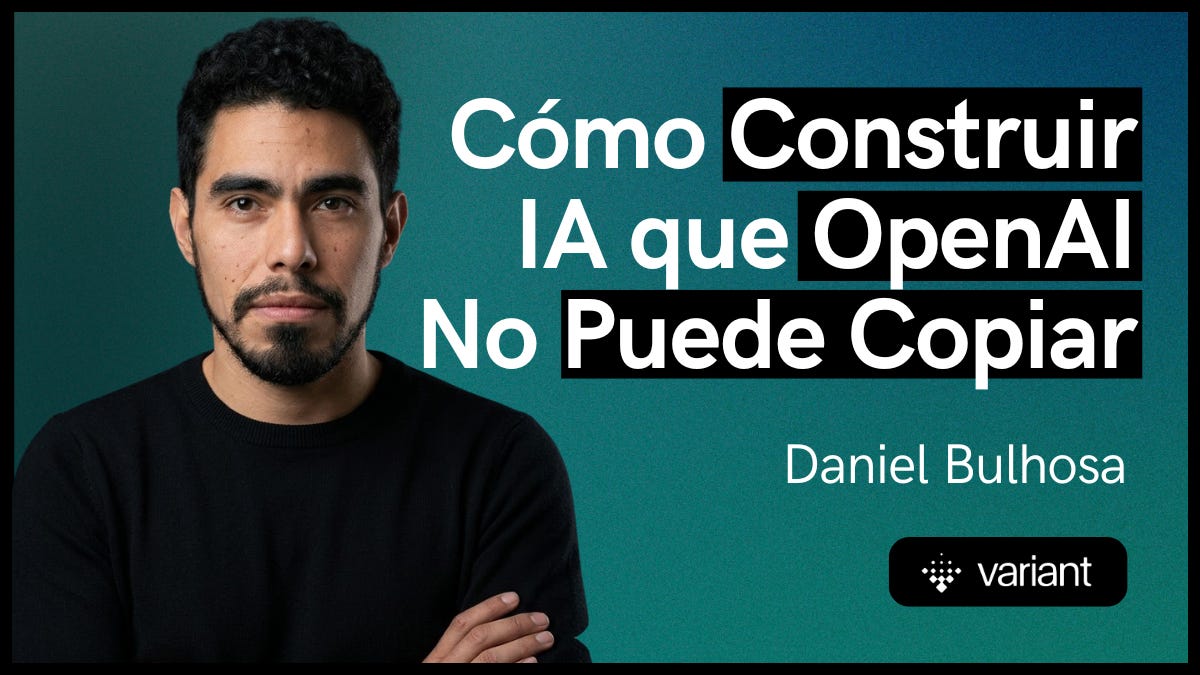
The audio and video are in Spanish. These notes are a translation.
Today I interviewed Daniel Bulhosa, cofounder and CTO of Variant, which he describes as the Pinterest of generative design.
Daniel is a physicist from MIT. He did machine learning at Square and built software for Cruise’s autonomous cars. He is also a visual artist, and he grew up in a family of classical musicians.
His central thesis is that it is still possible to build AI that neither OpenAI nor Anthropic can copy, because frontier models are spiky: they are very good where there is data and very limited where there is not, and they also lose in one area when they gain in another.
Structure and Key Highlights
From a House of Classical Musicians to MIT
- His joke: he tried to be a musician and discovered that physics was easier
- His connection between the two worlds: classical music has a lot of theory and a mathematical element of structure
- What growing up among artists gave him: seeing the height of perfectionism, people who completely master what they do
- His father toured the world with the Simón Bolívar Symphony Orchestra, and he grew up going to concerts at Oberlin
- The second effect of that upbringing: he learned to recognize genius in other people, which is how he saw his cofounder Ben
- What he saw in him: not an incremental optimization, but a vision years ahead, and the ability to justify it from first principles
What He Learned at MIT
- The contrast: he came from a high school of 300 people in a town in Ohio, where he finished everything by noon and had time left over to paint
- The shock: meeting someone who was 16 and had already spent four years doing research in theoretical physics and publishing with the most famous people in the world
- What he recognizes he did not learn there: how to reach that level. He learned that later
- What he did take with him: the humility of knowing how much you have to work, and the discipline to sustain it
- His current measure: the only thing he can compare how much he works today against is how much he worked at MIT
The E-Shaped Professional
- The classic advice was to be T-shaped: a lot of breadth and a single depth
- The version he defends: depth in several areas, even if less deep than the specialist’s
- Why it works now: if you know 30 or 40%, the model completes the rest
- His example: he was never proficient in Lua, and today he can write it efficiently
- His observation about artists: they are very curious and they do not put labels on what they are good at
- The pattern Enzo points out in several Latin American guests: engineers who are also artists, and who judge themselves less
What Happened at Square and at Cruise
- His diagnosis of Square: the founder is very good from zero to ten, but he delegated to an executive profile
- The distinction he uses, from the book The Hard Thing About Hard Things: she was a peacetime CEO when something else was needed
- The root of the problem: Square did not realize it was still a startup, even with thousands of people
- Why he left: he was trying, in 2019 or 2020, to develop the product he is building today, and they preferred to invest in incremental improvements
- His diagnosis of Cruise: too much ambition, and a disconnect from the customer and the environment
- The concrete part: an adversarial relationship with the municipal government, which generated an adversarial culture, and which in his view led to hiding details of the accident
- His technical assessment: he describes Cruise as a cathedral of software engineering, which was ahead of Waymo
Why Small Teams Win
- The friction in large organizations: the context you need lives split across many heads, and each group has different incentives
- At Variant they are five people, and all the context is in his head and his cofounder’s
- What that allows: prioritizing well, changing direction fast, and everyone understanding why
- Why it gets amplified with AI: if he knows the whole codebase, he can communicate it to the model
- His prediction: soon there will be a unicorn of five or ten people
Refounding the Theory of the Organization
- His observation: traditional companies create hierarchies and committees to fight the loss of context, and that costs experimentation
- What he sees at the frontier labs: they treat the company like an incubator
- His example: Claude Code started as one person’s project that nobody stopped, who convinced other people internally to use it and demonstrated traction
- He says he has heard the same thing from OpenAI: groups that experiment and, if there is potential, the company becomes the vehicle
- The pre-AI precedent: Cash App started that way inside Square
His Code Review Agent
- The problem: he spent a lot of time doing code review and repeated the same things to his engineers
- The solution: he gave the model all of his reviews from the last three months, plus his best practices, and turned it into a review agent
- The result: his team uses it, and he reviews less because it is a copy of his judgment
- What that also does: it puts his context available on demand for whoever needs it
- His observation about the current level: over the last four months he had a hard time telling Claude’s PRs apart from his engineers’
What Variant Is
- You scroll and six or twelve generated designs appear, and you keep browsing
- What it emulates: the process of hiring a design agency, which gives you options and you discard as you go
- Why it is not linear like ChatGPT: design is a search process, where there are several correct answers with different balances
Precision Versus Recall
- His framework from classical machine learning: recall is how many of the correct answers you found, precision is how many of the ones you gave are valid
- The precision example: fraud detection, where canceling an innocent person’s account is a disastrous experience
- The recall example: medicine, where being wrong and saying someone has cancer costs little, and failing to detect it is catastrophic
- His application: if you optimize for creativity, you optimize for recall, because being wrong has no cost
- The complementarity: once you find a good option, you put it into Claude Code and optimize it
Designing Is Curating
- What matters more than technical skill is taste
- His nuance: taste is not only the aesthetic. It is understanding the experience and what is intuitive, and fewer people have that
- His critique of the Figma skill: moving pixels has no design value. It is the tool for visualizing the concept
- What Variant removes: the need for that technical skill
The Canvas Nobody Used
- They started with a version similar to the current one, and the designers felt they did not have enough control
- So they built a Figma-style canvas, with style controls and chat
- The result of the closed beta: nobody used the canvas
- The two reasons: the designer demands a level comparable to Figma, and competing there means being marginally better and not different
- And the person who truly enjoys Variant is not a designer, and got lost in the canvas
- What they discovered in the videos: people liked the idea of the canvas because it made the tool feel like a design tool, but they only used it to organize
On AI Slop
- His technical nuance: generating more does not raise the proportion of slop, which is constant in a probabilistic system
- The real goal: raise the proportion of high-quality designs
- What it takes: people who understand what a good-quality output is and know how to discriminate
- What he says is missing at other companies in the space: being clear about what the objective is
Why He Keeps Up with the Research
- Two reasons: understanding how to train better today, and knowing what is coming
- The current example: mid training was barely talked about, and now it shows up in papers from large labs
- The direction that interests him: language diffusion models, as opposed to autoregressive LLMs
- His argument: writing a website is not a linear left-to-right process, and a diffusion model generates in parallel
- His hypothesis: a diffusion model trained specifically for front-end would better reflect the structure of that data
- What they did during YC: he trained a model that was state of the art for graphic design
- His conclusion: people underestimate how easy it is to beat general-purpose models at a very specific skill
Why Frontier Models Cannot Handle Everything
- The extreme example they gave him: the one who will build the best model for designing airplane parts is not OpenAI, it is Boeing
- The reason: that data does not exist in public, and you are not going to hire anyone who makes airplane schematics
- The term researchers use: the models are spiky
- The commercial nuance: when you train a frontier model you have to balance capabilities, and sometimes you gain in one area and lose in another
The Reinforcement Learning Problem
- The models were trained on the preferences of ordinary users
- What the ordinary person wants: not to be challenged, something simple, to feel good
- The result: pleasant models that tell you what you want to hear
- What they did in the opposite direction: prioritize the expert
- The effect they are after: democratize the expert’s experience for the person who does not have it
On Whether Taste Will Remain an Advantage
- Anthropic’s director of design said that designers cling too much to taste and that AI will catch up to them
- His answer: she is probably right
- His breakdown of good design: a database of inspiration and experiences, plus the reasoning to combine them toward an objective
- What a system can imitate: that 80% of the effort, the knowledge base, and the technical execution
- What is left: the taste of the top 1% or 10%
How Designers React
- Half ask why, if they love design, they want to eliminate it
- The other half remembers when they did all of that by hand and experiences it as magic
- The person who is not a designer reacts well, but does not appreciate how hard it used to be, and he thinks that is a good thing
The Future of the Profession
- The professions are blending together: product manager, engineer, and designer are increasingly the same person
- Which of the three he believes is the most important: design
- His reasoning: agents replace programming and project management first, just as the Anthropic report on the future of work said
- His conclusion: the future is better for whoever loves design, the product, and the user experience
His Advice for a 20-Year-Old in Caracas or Lima
- It is the best moment, because AI democratizes knowledge and delegation
- The effect: someone in a country with more resources no longer has as much of an advantage
- What does start to make the difference: the brand, the relationship with the customer, and the problem you choose to solve
- His example: a company that went from 0 to 100 million ARR in eight months by understanding the Asian market better than Lovable
Who He Thanks
- His grandmother, who died a few years ago
- She grew up in a poor neighborhood in Caracas, thirteen people in one room, with no education, and as Afro-Latinos in a time of racism
- What they told his great-grandmother: that those children were going to be thieves and prostitutes
- What happened: they all went to university, some became lawyers, an uncle was minister of sports, and his grandmother made it to UNESCO and the United Nations
- What that left him: if she got there from the neighborhood, how far he can go starting from a town in Ohio
Silicon Valley Glossary
| Term | Meaning | Context in the episode |
|---|---|---|
| Precision / recall | How many of your answers are valid, versus how many of the correct ones you found | The axis that separates Variant from ChatGPT |
| Spiky | Models that are very good in some areas and weak in others | Why there is still room against the frontier labs |
| Mid training | The intermediate training phase between pre and post | The research topic that started showing up in papers |
| Language diffusion model | A model that generates text in parallel instead of sequentially | The technical direction he finds promising for front-end |
| Autoregressive | Generates token by token, from left to right | The limitation of LLMs for tasks that are not linear |
| RLHF | Training on human preferences | Why the models came out eager to please |
| AI slop | Low-quality generated output | What he insists is not a consequence of generating more |
| SOTA | State of the art | The model he trained during YC for graphic design |
| Wartime / peacetime CEO | Crisis leadership versus leadership in stable times | His diagnosis of what Square was missing |
| E-shaped professional | Depth in several areas instead of in only one | The profile he believes wins now |
| Taste | Aesthetic and product judgment | What is left when execution gets automated |
People, Companies and References
People Mentioned
- Daniel Bulhosa: cofounder and CTO of Variant, a physicist from MIT
- Ben: his cofounder, a designer, in whom he saw the genius
- His grandmother: from a neighborhood in Caracas to UNESCO
- His father: toured the world with the Simón Bolívar Symphony Orchestra
- Will Gaviria: from Coactive, a mutual friend at whose dinner they met
- Jack Dorsey: founder of Square
- Enzo Cavalie: host of the podcast
Companies and Organizations
- Variant: Pinterest for generative design, five people
- MIT: where he studied physics and mathematics
- Square: where he did machine learning, and which he left because he could not build this product
- Cruise: General Motors’ autonomous cars, which he describes as a cathedral of software
- Anthropic and OpenAI: the frontier labs, and their incubator structure
- Figma: the competitor they decided not to imitate
- Boeing and Airbus: the example of data that no lab has
- Lovable: the reference for the market another company understood better in Asia
- Runway, Krea, ElevenLabs, Replit: the examples of applying new research first