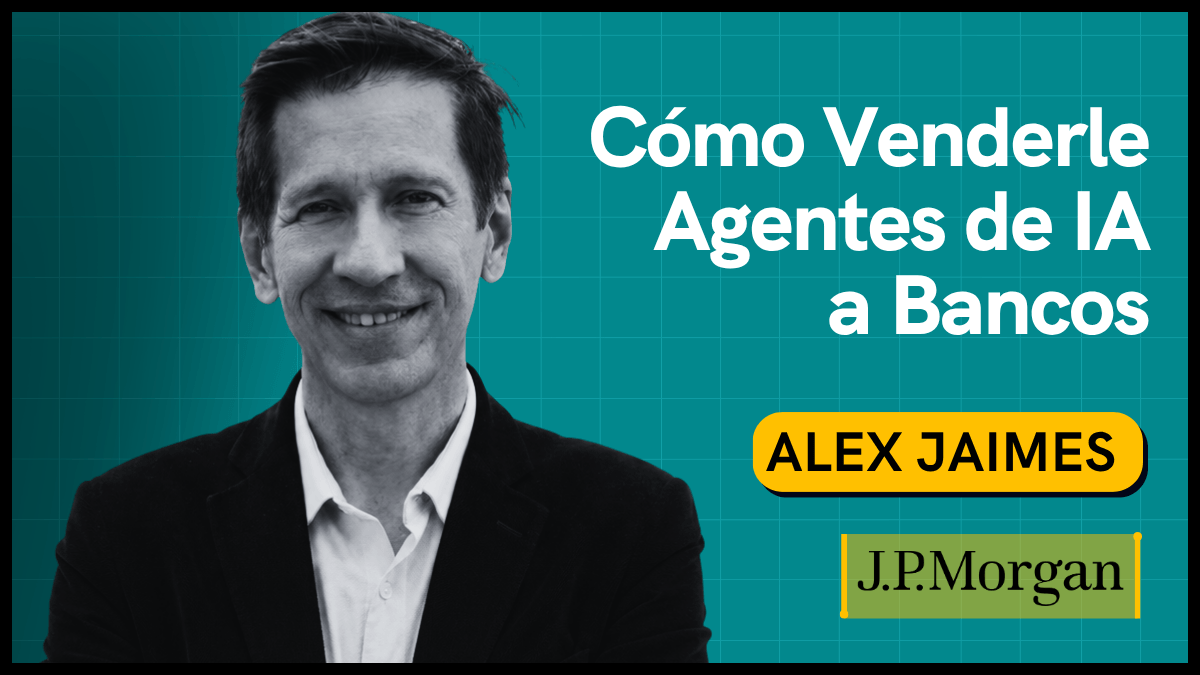
The audio and video are in Spanish. These notes are a translation.
Today I interviewed Alex Jaimes, Managing Director of AI Agents and Search at JPMorgan. Before that he was Chief AI Officer at Dataminr, where he built the system that alerted to a flu-like outbreak in Wuhan in December 2019, and before that he did research at Bell Labs, Yahoo, and Fuji Xerox.
Many of the AI solutions large companies receive come from startups that did not even exist a year ago. A demo shows that the product can work once. To sell to a company like JPMorgan, you have to show what happens when it fails.
I asked him what he needs to see in order to take a vendor seriously, how he decides what gets bought and what gets built, and whether corporates are going to end up building their own models instead of buying them.
Structure and Key Highlights
Two Months as a Park Ranger in the Darién
- A Colombian government program let him choose a national park; he chose the most remote one, and the hardest to reach
- Two hours of electricity a day, the nearest hospital several hours away by boat and on horseback, clouds of mosquitoes that made it impossible to be outside
- Food arrived by ship every two months: plantain, rice, and potato, and what little meat there was, salted so it would not spoil
- His only preparation was the malaria pills. No training
- The mistake: he shaved his head thinking nobody would see him for two months. Right in the middle of the armed conflict, that could get him mistaken for a soldier
- What it left him: appreciating a soda, a glass of water. And the habit of putting himself into extreme situations out of his own interest
Growing Up Between Bogotá and New York
- His mom lived in New York, so he traveled often between the two worlds
- The lesson was not the material contrast but an epistemological one: when you see something different from your context, you stop believing that your context is the only one
- In that period Colombia had economic protection, and everything arrived late or did not arrive: movies six months later, things that simply did not exist
- The underlying belief he saw in the region: that for some reason we are inferior
The Visa They Denied Him at the Window
- He was accepted at Columbia, but he had to renew his student visa at the embassy in Colombia
- The consul looked at the passport, told him he had stayed longer than allowed, handed everything back, and called the next person
- He had requested the extension within the deadline, so he was within the rules. He refused to move from the window until they gave it to him
- The other obstacle: he had to show $30,000 a year and he did not have it. Reading the fine print, the rule asked him to demonstrate ability to pay, not to have the money
- He gathered letters from relatives with evidence of their savings. Even his grandmother signed one
- The two lessons: read the details, because inside the rules there is more room than it seems; and do not accept the first no
The Day He Said No to Yann LeCun
- Working at Bell Labs, he would walk the building after lunch, looking at the researchers’ doors
- He found LeCun’s. LeCun worked on computer vision, the topic of his thesis. He knocked without knowing who he was: at that time LeCun was not yet the figure he is today
- LeCun offered him the chance to work with him the following summer. Months passed with no news
- His advisor got him an opportunity at Siemens and he accepted it. LeCun called that same day with everything ready
- He said no because he had already given his word. He does not regret it: changing would have affected the relationship with his advisor
The AI Fears that Stopped Seeming Exaggerated to Him
- Until recently they seemed exaggerated to him, because the systems were limited to doing a single thing
- With agents that modify themselves and get out of their box, he now sees more dangers than he thought
- The underlying problem: agents do not understand cultural context, they do not have values or social norms, and they often try to break all of that
- The challenge of the coming years is to get them to do only what they were designed to do, knowing that whoever designs them always forgets something
Why SaaS Does Not Die
- Two readings for a SaaS founder: the agent destroys the box, or the box is valuable precisely because the agent is dangerous and it pays to contain it
- Alex leans toward the second
- And an observation about the name: SaaS is service. Agents are going to need services; what changes is that many of them will be consumed by agents instead of by humans
Buy or Build
- Cognitive space and attention are limited, and that holds equally for a person and for an organization
- The rule: what is not important but is required gets bought. What is strategic gets built
- The factors are never just one: whether it is strategic, whether you have the data, whether you have the talent, how long each path takes, and the cost
- In regulated industries, buying can take longer than building, because of the cybersecurity tests
- The size of the vendor matters: if something fails, a two-person company may not answer
- “You can’t get fired for buying IBM” no longer applies: today you do not know whether the vendor survives two years, because it is learning while it builds
What a Startup Has to Bring for Them to Take It Seriously
- First the checklist, which is the same for everyone: cybersecurity, certifications, vendor onboarding
- Then what actually decides it: that it solves a real problem and that it understands the customer
- The concrete advice: send technical people to the meetings. If Alex asks a technical question and the person presenting does not know how to answer, it shows
- What he buys with that is not the demo. It is the confidence that the day there is a problem, they are going to solve it for him
- Transparency about exactly what he is buying is key
Who Answers When the Agent Gets It Wrong
- There are levels of agency and levels of responsibility: recommending a bad movie is not depositing money in the wrong account
- He has already seen customers asking startups to sign contracts where the vendor takes responsibility if the agent causes a penalty or takes them out of compliance
- And he expects insurers to cover that risk, which creates an ecosystem of guard rails that copies the social system
- In the U.S., lawsuits work as self-regulation: instead of the government imposing the rules, the risk of a lawsuit forces the behavior
The Law Firm that Is Going to Spend $500M on Its Own Model
- Kirkland announced $500M to build its own legal models. In Silicon Valley a lot of people said it was crazy
- Alex predicted it in a talk more than two years ago, and what surprises him is that it did not happen sooner
- The logic: frontier models serve enormous populations across many tasks. If you are a law firm, you do not care whether the model passes the SAT
- The knowledge required to do it is public; the talent is expensive and scarce, but with $500M you can get it
- He rejects the idea that only three or four people in the world know how to do this
- The way to fail: use the $500M to hire lawyers instead of technical profiles
When to Leave the Public APIs
- He sees series B and C startups putting together their own research teams so they do not depend on the models
- At a certain scale, paying per token stops making economic sense, even though prices have dropped a lot and keep dropping
- You almost never build from scratch: you take an open source model and adapt it with your own data
- That wins on three fronts at once, because the resulting model is smaller: accuracy, latency, and cost
- At the start none of this matters: volume is low, speed is not pressing, and you are still looking for the product
- It is the strategy he published while he was at Dataminr more than three years ago, and he still believes it is the right one
Why Traditional Companies Do Not Get Started
- It is not only the cost of the compute and the experiments: it is hiring the people
- Most of them do not have anyone who understands the area, so they do not know where to start or how to form a team
- If that is not understood at the executive level and at the board, the decision to invest does not get made
- The sad pattern: they hire a Chief AI Officer, the person lasts a year or two, sees that the company is not ready, and leaves
- And a deep difference from traditional software: there you decide and you measure whether it worked. In AI you have to experiment, and there is always a probability that it will not work
The Fear of Open Source
- There is quite a lot of it, and a good part is geopolitical: the open models that work well come from China
- Technically the argument is weak: once you have the model and you adapt it, you control it
- And the argument turns back on itself: with a closed model you also do not know what data went into the training, and you have no guarantee from the company
- Historically open source has been safer because there is a community watching it. An open model gets downloaded by thousands of people in five days; a sales contract goes one by one
The Token Honeymoon
- The current phase is spending without looking at the credit card: use everything to see what sticks, like throwing spaghetti at the wall
- Then the bills arrive, and that is when a different conversation starts
- The real problem is not spending, it is measuring: knowing when the use is having an impact and when it is not
- The concrete stuff gets measured in tickets. The hard part is the everyday tasks where the impact is enormous but quantifying it costs you
- On what percentage of the budget tokens will be in five years, he would put them in the category of cloud and operations, not in the category of software
The COVID Alert, in December 2019
- Dataminr’s platform generates thousands of alerts a day; it is used in the control rooms of governments and large companies
- No isolated alert says what is happening: they accumulate until you can see that the event is bigger
- When everything started to shut down, he was already very well informed. At a conference in Aspen he skied every day knowing it would be the last
- He told an Argentine man who had sold everything to set up a shop in the ski village that he had eight days left and that he needed a plan B
How Trust in a System Is Won and Lost
- In emergency alerts, accuracy is critical, because they reach firefighters, police, and rescue teams
- The key was not never being wrong, but sending the correction as soon as possible when there was an error
- Trust breaks very easily: if a calculator gives you a bad number once, you no longer use it for anything important
- And there is a double standard. We demand that self-driving cars be better than humans, even though the statistics say they already make fewer mistakes
The Path to the Frontier
- First define what your frontier is: building applications, working in a laboratory, or transforming a traditional industry are different frontiers
- Understand what the models do and soak yourself in them. You cannot swim without getting wet
- Build and experiment, do not only read: most of the success depends on the tests
- The idea is always pretty. Only when you build it do you see where it fails, and it almost always fails where you did not expect
Silicon Valley Glossary
| Term | Meaning | Context in the episode |
|---|---|---|
| Agent | A system that carries out tasks with some autonomy, and does not only answer | Its level of autonomy defines how much responsibility is at stake |
| Frontier model | The large general-purpose models | Designed for enormous populations, not for one company’s case |
| Buy vs. build | Acquiring a solution or developing it in house | You buy what is required, you build what is strategic |
| Guard rails | The limits that keep a system from leaving what it was designed to do | The first thing a bank asks before letting an agent through |
| Accountability | Who answers when the system gets it wrong | For agents it is still not settled, and that is why it slows adoption |
| Fine-tuning | Adapting an existing model with your own data | The alternative to training from scratch, and to staying on the public API |
| Public API | Consuming a third-party model and paying per token | Comfortable at the start, expensive when the volume grows |
| Compliance | Meeting the industry’s regulation | In banking it conditions which vendor can even be evaluated |
People, Companies and References
People Mentioned
- Alex Jaimes: Managing Director of AI Agents and Search at JPMorgan
- Yann LeCun: he found him by knocking on his office door at Bell Labs; LeCun offered him a job and Alex ended up saying no
- José Tiberio Hernández: his first advisor at Universidad de los Andes, whom he points to as the person who showed him that the world of research existed
- His PhD advisor at Columbia: Taiwanese, he criticized everything Alex did and raised the bar
- His grandmother: signed one of the letters that let him demonstrate the $30,000 to study at Columbia
- Enzo Cavalie: host of the podcast
Companies and Organizations
- JPMorgan: where he leads AI Agents and Search
- Dataminr: where he was Chief AI Officer and built the alert system
- Bell Labs: the laboratory of the Nobel Prizes, where he overlapped with LeCun
- Yahoo, IBM Research, Microsoft Research: the laboratories that concentrated research 15 or 20 years ago
- Fuji Xerox: three years in Japan before everything else
- Siemens: the offer he accepted the same day LeCun called
- Columbia: the master’s for which he almost did not get the visa
- Universidad de los Andes: where he came to know research
- Kirkland: the law firm that announced $500M to build its own legal models
- Uber and Microsoft: cited as cases of companies that announced limits on token consumption
Data and References
- December 2019: Dataminr’s alert about a flu-like outbreak in Wuhan
- $500 million: Kirkland’s bet on its own legal models
- $30,000 a year: what he had to demonstrate in order to study at Columbia
- 2 hours of electricity a day: life in the Darién park
- From $2 million to hundreds of millions: the jump in spend over a few months that the conversation talks about
- Series B and C: the stage at which he sees startups putting together their own research teams
Discover More of the Startupeable Podcast
Listen to every episode at startupeable.com/podcast.
Subscribe to the newsletter to find out when a new one comes out.
Follow Enzo Cavalie on X: @enzocavalie.