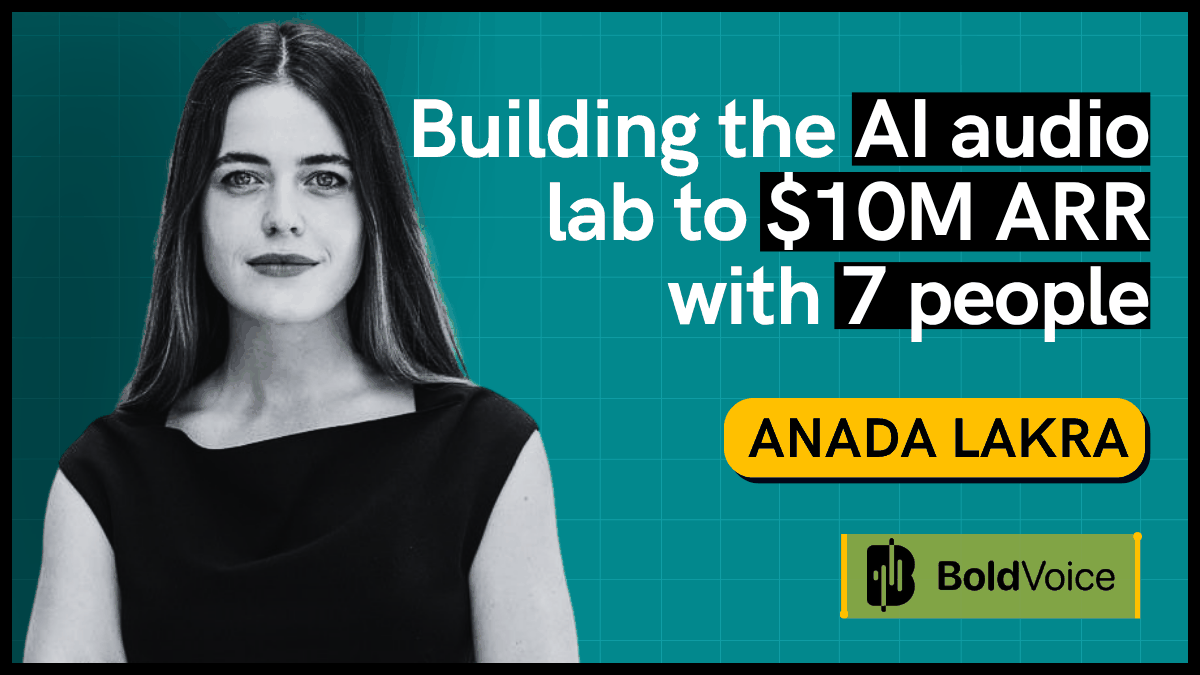
Today I interviewed Anada Lakra, co-founder and CEO of BoldVoice, an AI speech coach for non-native English speakers with over 5 million downloads across more than 100 countries. It is also one of my favorite apps.
Anada grew up in Albania and moved to the US at 18 to attend Yale, having never visited the country before. She had studied English for a decade and still found herself being asked to repeat things constantly.
BoldVoice runs on a team of ten doing tens of millions in revenue, which she describes as an audio AI lab masked as a consumer company. They were doing audio AI before it was cool, without the budgets of the labs.
We talked about why she refuses to call it accent correction, how they built speech models that outperform far better funded teams, and why she finds it bleak to imagine a device that speaks for you.
Structure and Key Highlights
Growing Up in Albania
- Born shortly after communism, in the early and chaotic days of democracy
- A strong belief, in her family and the country, that education drives progress
- Classrooms of 40 to 50 kids, scarce resources, few extracurriculars and little room to stand out
- What that trained: being scrappy, raising your hand first, making the most of scarce resources
- Emigrating is common in Albania, and the idea was planted early by her father
- Albania is one of the most pro-American countries in the world, and the American dream carried a strong brand
- She figured out the US application process on her own: tests, letters, the whole convoluted thing
Luck on Top of the Work
- She was already a junior at Yale when her father won the green card diversity lottery, after applying for almost 20 years
- She was just under 21, young enough to be included
- Without it: an F1 visa, finding an employer to sponsor an H1B, and the lottery, which she describes as a 50/50 chance among her international friends
- Her observation on entrepreneurship: always a mix of effort and luck
- The irony she names: you can attend one of the best colleges in the world and still not get to stay
- Enzo only learned the diversity visa existed the year he moved. In Albania everyone knows, and roughly 80% of the country applies
The Accent Problem, from Experience
- She had studied English for almost 10 years and passed every test, but learned it from Albanian teachers with the same accent
- The gap was between reading, writing and comprehension on one side, and speaking on the other
- The dining hall moment: mispronouncing lettuce. Her own major was economics, one of those words where the stress shifts
- These paper cuts accumulate across classrooms, social settings and job interviews
- What it becomes: “I don’t sound the way that I do in my head”, and then filtering yourself before speaking
- Enzo’s version: working at Reach Capital and saying “Rich Capital”, which people found funny for a venture firm
Why She Reframes the Word Accent
- Accent is not the goal. You can have a strong accent and still be clear, confident and connected to your audience
- What they actually work on: pronunciation clarity, sound swaps, cadence, word stress
- Accent is a catchall phrase carrying baggage that does them a disservice
- What they explicitly reject: accent correction and accent reduction, terms speech coaches use
- Their framing: you are learning a skill, like public speaking or writing
- The prioritization inside the product: sounds that hurt comprehension, not cosmetic ones
- Massage versus massage barely matters. Ship versus sheep does
- Her line for founders: it is never about sounding American
Building the Audio AI
- Their internal description: an audio AI lab masked as a consumer company
- Why it is hard: accents vary enormously and there is no single right answer
- They employ some of the best speech and dialect coaches in the world, who write the content, appear in the videos and train the model to hear as well as they do
- Their audio ML engineers retrain constantly on coach evaluations, user samples and user feedback, with heavy automation
- Her claim, with a caveat: they have built the AI in the world that is best at hearing how you actually sound
- Why accuracy is everything: their effectiveness lives and dies by it, because bad hearing means bad feedback
- What is next: scoring longer speech samples so you can get feedback on a real meeting
- A further possibility: accent-aware transcription, since misrecognition is a large unsolved problem
Pricing as a Mission Decision
- $150 a year, roughly $12.50 a month, similar to a Duolingo premium subscription
- One hour with a human coach costs more than a full year of BoldVoice
- The tension: some users have high willingness to pay, but price should not exclude the immigrants who would benefit most
- Part of the mission: accent coaching today exists, but only CEOs can access it
- Her stance: she would rather capture a wider market than maximize short-term revenue on a niche expensive product
A Team of Ten
- Seven people at roughly $10M in revenue when they first met, before coding agents took off
- How: extreme focus, a strong team, and a culture built for heads-down time
- Small teams need no coordination overhead, no hierarchy and few meetings
- Multiple user interviews every week, which is both motivating and a fast feedback loop
- The plan is 20 to 25 by end of year, still lean relative to revenue
- On research versus product: they do not hire people who want pure research. They hire applied ML engineers who care about the problem
- The ML engineers sit with everyone else, mostly in person in New York
- Their explicit stance: “we don’t care about beautiful code, we care that it works”
Product as the Only Durable Moat
- Her view: if you repackage off-the-shelf models and your only differentiator is a marketing machine, competitors catch up and your ads get more expensive
- A moat can come from process or proprietary data, not necessarily from models
- What is not optional is product differentiation
Consumer Marketing Right Now
- Tougher than ever, with a new AI tool launched and marketed every day
- Many are wrappers with little differentiation, and consumers cannot always tell
- The knock-on effect: unethical onboarding funnels and paywalls erode trust in all subscription apps
- Attention is moving away from Instagram toward surfaces where you cannot run ads
- Companies that relied on SEO are seeing the shift
- Her answer: use product as marketing, and build what only you can build
- The example: Accent Oracle, a free tool at accentoracle.com that detects where your accent is from, built on their own models, shareable and viral
Hiring in the Age of Agents
- Unlike companies that overhired and are now rethinking, they never had headcount waste
- She resists calling them AI native, since they started before ChatGPT took off, but the tools are embedded everywhere
- No role has been eliminated. What changed is what they look for
- On the “engineering is dead, then design is dead” cycle on Twitter: you still need designers, but designers who can work with Claude
- What they want to see: people who tinker, stay curious and can be 2x or 3x more effective than a year ago
On Devices that Speak for You
- She finds the idea bleak
- Her framing: let AI do the background work, and let communication remain the human thing
- “Just send the AI and stay at home, right?”
- Where she concedes it makes sense: call centers, because they are transactional, and those are a step from being fully automated anyway
- For anything relational, especially when you might meet the person, you want your own voice
- The long-term vision: an always-on speech coach that hears you in every room and gives the right feedback in the moment
Silicon Valley Glossary
| Term | Meaning | Context in the episode |
|---|---|---|
| Accent reduction | Industry term for eliminating an accent | What they explicitly refuse to build or say |
| Word stress | Which syllable carries emphasis in a word | One of the biggest sources of confusion, as in economy versus economics |
| Applied ML engineer | Engineer who builds models to ship into a product | The profile they hire, as opposed to pure researchers |
| Moat | What stops competitors from replicating you | Her argument that marketing alone is not one |
| CPM | Cost per thousand ad impressions | The metric rising as AI tools crowd the same channels |
| Product as marketing | Using differentiated features to drive acquisition | Their answer to the collapsing consumer playbook |
| Diversity visa lottery | US green card lottery for underrepresented countries | How her father got the family a green card after 20 years of applying |
| H1B | US work visa requiring employer sponsorship | The path she avoided thanks to the lottery |
| ARR | Annual recurring revenue | The $10M they hit with seven people |
| AI native | Built assuming AI from the start | A label she resists, since they predate ChatGPT’s takeoff |
People, Companies and References
People Mentioned
- Anada Lakra: co-founder and CEO of BoldVoice
- Ilya: her co-founder and CTO, with her since day one and five years into the company
- Her father: instilled the ambition and applied for the diversity lottery for almost 20 years
- Enzo Cavalie: podcast host
Companies and Organizations
- BoldVoice: AI speech coach, 5M+ downloads in 100+ countries, team of 10
- Accent Oracle: their free viral tool that detects where an accent is from
- Yale: where she studied ethics, politics and economics
- Duolingo: the pricing reference point
- Reach Capital: where Enzo worked, and the source of his own mispronunciation story
Data and References
- 5 million downloads across more than 100 countries
- $150 a year, about $12.50 a month
- 7 people at ~$10M in revenue, growing to a target of 20 to 25 by year end
- ~80% of Albania applies to the diversity visa lottery