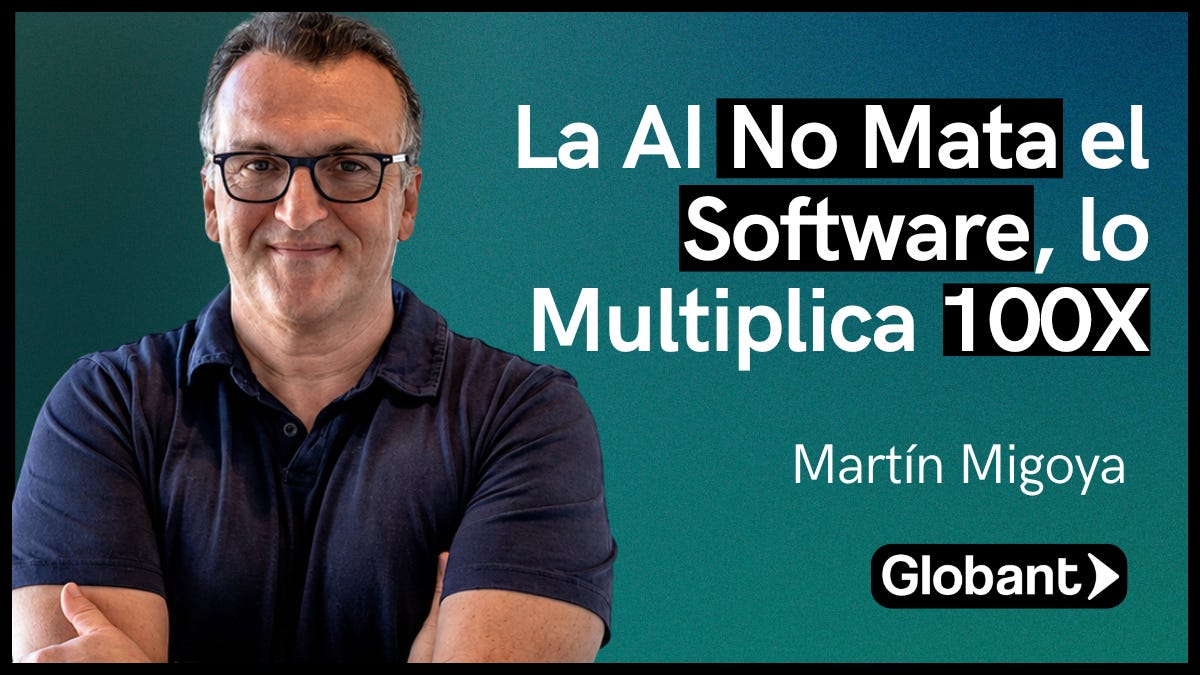
The audio and video are in Spanish. These notes are a translation.
Today I interviewed Martín Migoya, co-founder and CEO of Globant, one of the largest technology services companies in the world. It was born in Argentina, it trades on the New York Stock Exchange, it has more than 30,000 employees, and it generates $2.5 billion a year in revenue.
The company started on a napkin with three friends more than 20 years ago. All four are still in.
It came to be worth almost $10 billion before the pandemic, and today the stock is near pre-pandemic levels, even though the company is several times larger. Martín argues that the market is pricing in that the same thing will be done for less money, and that is exactly what is not going to happen.
His thesis is that AI is doing to services what AWS did to hosting: a new industry he calls AI native services, or services as a software.
Structure and Key Highlights
Music and the Blank Page
- He has guitars, a studio, and a band, and he once compared his setup with Dave from YouTube on a Zoom call
- The parallel that interests him: making music is facing a blank page with every note available and deciding what to do and what not to do
- On creating with AI: he sees it as a catalyst. A good idea shines more and a bad one gets discarded faster
- What does not change: the difference between a good idea and a bad one, and between knowing how to execute it or not
Four Partners, Twenty-Three Years
- The original idea was to sell technology from Latin America to the rest of the world
- What he says keeps them together: the client first, and an industry of human relationships
- He defines them as a team that knows how to build teams, and the founders are no exception
The Dichotomy Between the Company and the Stock
- His read: the market was not right when the stock was worth 15 times more, and it is not right now
- What is being priced in today is that the same thing will be done with less time and less money
- His correction: the first part is true, but it is not going to be the same thing. It is going to be much, much more
- On running a public company: you do not manage for the next quarter but for the next five or ten years
- The only controllable thing is operating the company and having happy customers
- His answer to people who say being private takes the pressure off: a private company has to make the same bets
The Parallel with the Birth of the Cloud
- Around 2000 and 2011, standing up a site required buying servers from IBM, HP, or Dell, getting hosting and connectivity, building a 24x7 team, and guaranteeing power and security
- And also praying that a traffic spike would not arrive
- Only very large companies could do it
- What Amazon did: coordinate technology that already existed in a different way, and rent out the servers left over from Black Friday
- That created two entire industries, cloud and SaaS, that add up to trillions
- His thesis: the same thing is happening now with services, a $2 trillion industry, or $6 trillion depending on what you include
- That industry was always full of friction: assembling teams, RFPs, proposals, ramping people, and scope that changes all the time
What AI Pods Are
- He describes them as the company he would have founded if he were starting from scratch today
- You interact with agents from minute zero, not with a human
- Once the goals or epics are defined, agents fire in parallel for each one, and everything ends in human supervision
- Each pod is an adaptable recipe: architecture, bug resolution, digital twins, vulnerability analysis
- Everything stays traced: every token consumed is explained and the decisions stay in a log
- You can chat with the agent about the state of the project or directly with the human forward deployed engineer
- They already have pods announced with Vercel, Anthropic, NVIDIA, and Salesforce
- They have spent three quarters reporting the growth of that segment
How the Invoice Changes
- The old model: fixed price with milestones, or engineer and architect hours by profile
- The new one: by story points, by user story according to size, or by millions of supervised tokens
- The example that illustrates it best: supervision of streaming channels, where they charge per streamed hour and not by the number of people watching screens
- There they align with the client’s unit of value, which knows how much it earns per hour on air
- The organizational change: from assembling a team per project to something closer to an assembly line with specialized roles
- On charging for the outcome: when measuring it is hard, you charge for consumption, but a consumption similar to an LLM’s million tokens
Why He Does Not Believe AI Kills Software
- He finds amusing the argument that software companies have a terrible problem
- His question: who is going to dare to develop a SAP, which runs your accounting system, and if it gets the numbers wrong, who notices
- His diagnosis: there are exaggerations that send a software company’s stock down 50 or 60%
- What he does see coming: data projects, process automation, technical debt that gets freed up, and a change to 100% of the interfaces
- Inside Globant they count about 5 petabytes of information they can now make sense of
- On the real difficulty: it is easy to get to the first prototype, and very different to make something repetitive and scalable
- His technical nuance: it is a non-deterministic technology, and getting it to answer the same thing twice takes a lot of effort
- His line for anyone who says implementing this is extremely easy: it is because they never did it
- A data point he mentions: in 2020 Globant had a patent for something very similar to Copilot
- His read of the current leap: it comes less from the models than from the harness and the environment that gives context
The Jevons Paradox Applied to Services
- The price point changes and feasibility changes, so companies are going to consume more of everything
- Also, new companies are born designed more efficiently, which forces the existing ones to transform
- Using AI is not enough: you have to transform the business
- On the argument that clients will do it on their own: it is the old promise of low code, until integrations show up that a single person cannot handle
- His definition of where services are born: when you have to do something necessary but not strategic and you do not even have people to think about it
- On whether the need will disappear once the infrastructure is fixed: needs are not tied to debt but to flow. As long as there is growth, there will be needs
The Real Cost of AI
- It is not only the tokens: it is the tokens plus the cost of supervising what is right plus the cost of supervising what came out wrong
- The perverse multiplier: the worse you use it, the more supervision work it generates for you
- His criticism of companies that reward whoever consumes the most tokens: they incentivize use, not good use
- The discipline he proposes: route easy questions to cheap models and hard ones to expensive models
- On the studies that show AI projects failing: they fail because it is a complex technology, not because it is useless
Processes with Humans Accelerated by AI, or AI Processes Supervised by Humans
- Everyone’s first instinct is to do the same thing more efficiently
- The second is to put AI at the center
- That switch, simple to state, is where companies set themselves apart
- Why it matters: it is what lets you charge differently and understand the process with a depth that was impossible when there were only humans
- The underlying reason for the speed: an agentic process does not wait for an email to cross from one area to another for a week
- What remains human: intent
The Engineer’s New Role
- They went from writing lines of code to supervising agents
- The ones who win are those who use the freed-up time to think strategically, whether they are senior or junior
- Why it is harder: before, you understood the modules because you wrote them. Now the modules appear and you have to understand them
- The training that is needed: higher levels of abstraction and a critical eye
- His anecdote vibecoding a bot: he discovered the model was hardcoding words with conditionals instead of interpreting, which was exactly what he had asked for
- His conclusion: AI does suboptimal things that only someone who understands the problem detects
- On testing: a good part is still done with human brains, because it is hard to reach, through creativity, where a person reaches
- Globant launched a pod called Vibe to Enterprise, to pull out of the trap what was vibecoded and does not scale
On Forward Deployed Engineers
- He thinks it is a magnificent concept that Palantir knew how to put on the market
- His nuance: at Globant they have done it since the founding, only Palantir marketed it well
- Today they use it more than ever inside the AI Pods platform
Closing
- On his original mission: to plant in the mind of any Latin American who works in technology that they are up to the level of the game
- That is already proven, and now he can afford to inaugurate a model that does not exist, this time from the region
- His list of clients that taught the craft: Google, Disney, Electronic Arts, Riot Games
- How he feels today: like an entrepreneur who is starting a company again
Who He Thanks
- His father, who in 1972 was among the first to think you could export fabrics from Argentina to the world
- He would spend months visiting customers in the United States, Europe, and Latin America, with no cell phones and no LinkedIn, calling home once a month
- The call he remembers: his father told him he had sold two years of production from the denim plants and the alpargata plants
- What it left him: that you could do that from La Plata, and that the world ends up being a fairly meritocratic place
Silicon Valley Glossary
| Term | Meaning | Context in the episode |
|---|---|---|
| AI native services | Services redesigned with agents at the center and humans supervising | The category Globant says it is creating |
| Services as a software | Buying services with the ease and scalability of a product | The other way he describes the same thing |
| AI Pod | A package of agents with a recipe, traceability, and human supervision | Globant’s unit of delivery and of billing today |
| Jevons paradox | Making a resource cheaper increases its total consumption | His argument for why the services market grows instead of shrinking |
| Technical debt | Pending work accumulated in the systems | One of the fronts AI frees up and makes approachable |
| Harness | The layer that wraps the model and gives it context | What he attributes the current leap to, more than to the models themselves |
| Forward deployed engineer | An engineer embedded with the client | A concept he attributes to Palantir in marketing, and to Globant in practice |
| Story points | A unit for estimating work in agile development | One of the new billing units |
| Model routing | Sending each query to the cheapest model that can solve it | His recommendation for controlling the real cost |
| Supervised tokens | Tokens consumed plus the human cost of reviewing them | The billing unit he proposes for work that is hard to estimate |
| Innovator’s dilemma | When the business that made you big keeps you from changing | The question Enzo asks him, and that he answers by calling it a natural migration |
| Slop | Low-quality AI output that generates extra work | What poorly designed supervision ends up producing |
People, Companies and References
People Mentioned
- Martín Migoya: co-founder and CEO of Globant
- His three partners: the same ones since the napkin, 23 years later
- His father: a fabric exporter from Argentina in the 1970s
- Peter Gabriel: whom he crossed paths with at a Founders Forum
- Jeff Bezos: for the decision to rent out the leftover servers from Black Friday
- Enzo Cavalie: host of the podcast
Companies and Organizations
- Globant: 30,000 employees, $2.5 billion in annual revenue, listed in New York
- Vercel, Anthropic, NVIDIA, Salesforce: partners on the announced AI Pods
- Palantir: for the forward deployed engineer concept
- Amazon and AWS: the precedent he uses to explain his thesis
- SAP and Salesforce: the examples he uses against the idea that software dies
- British Airways: a client whose new application they just launched
- Google, Disney, Electronic Arts, Riot Games: clients he mentions as a school
- Mercado Libre: the other company he cites as a giant’s shoulder for the region
- Dio: sponsor of the episode
Data and References
- $2 trillion: the size of the services market, or $6 trillion depending on what is included
- 5 petabytes: the information Globant has inside and that it can now make sense of
- 2020: the year of its patent for something similar to Copilot
- Almost $10 billion: the pre-pandemic valuation