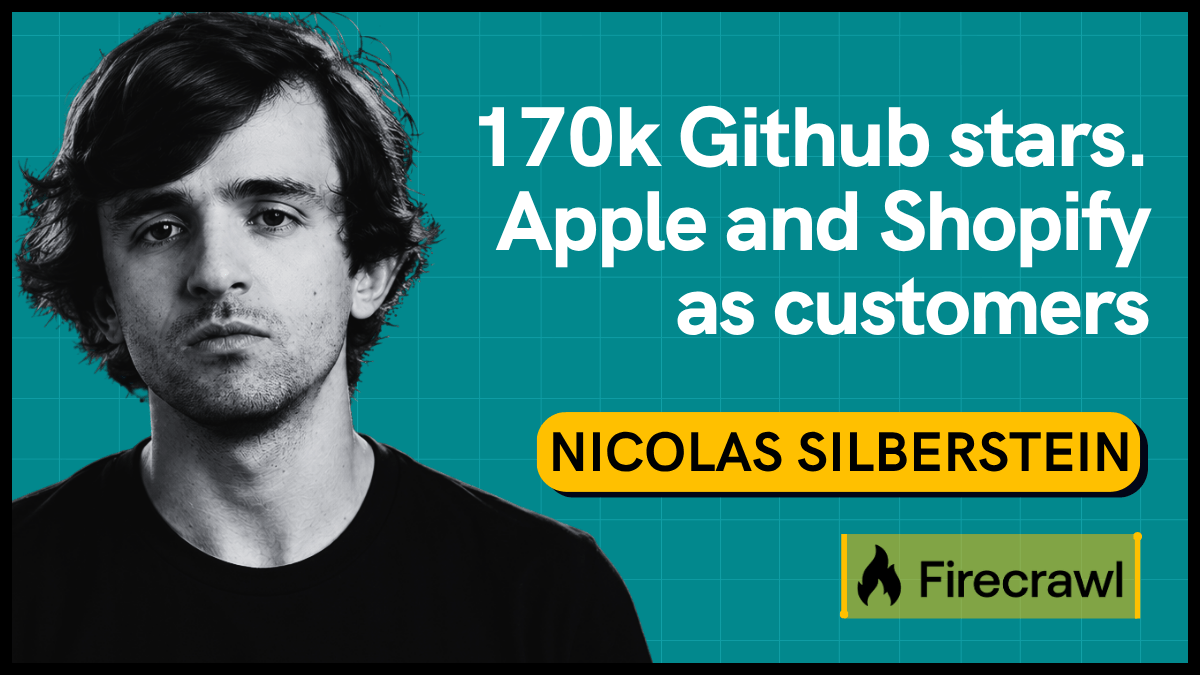
Today I interviewed Nicolas Silberstein, co-founder and CTO of Firecrawl, the tool that lets AI agents read the internet.
He grew up in Brazil playing for São Paulo FC and was invited into their pre-professional academy at twelve, which meant dropping out of school. He chose code instead. Today Firecrawl is used by 350,000 developers and by companies like Shopify, Replit and Zapier.
The core of the conversation is a question every founder in the valley should be asking right now: when the cost of building goes to zero, what makes your product defensible? His answer is the indie hacker test, and it is uncomfortable.
We also talked about why winning developers is how you win agents, and about his ambition of becoming the eyes of superintelligence.
Structure and Key Highlights
From São Paulo FC to Code
- Joined São Paulo FC around age five or six, playing left wing
- State champion at nine or ten, with four practices a week and games all weekend
- At twelve he was invited into the academy, which required dropping out of school and traveling across Brazil
- He did the math himself: too many people compete for too few spots, and he was strong academically
- On how competitive it is: thousands of kids per trial, selecting 20 to 40, then another trial to select 23. He compares it to applying to YC or the Ivy League
- Of that last team, only one player turned pro, and he had picked him out in advance
- In Brazil there are more role models of successful soccer players than of technical founders
- What stayed with him: knowing how to handle pressure and competition from a young age
Video Games as the Entry to Programming
- His father, an engineer, did not like him playing games, so he suggested he build his own instead
- He was building 3D games as a kid and used school projects as an excuse
- He published a few, never marketed them, just wanted friends to play
- What hooked him: seeing programming turn into something visible and real
Getting to the US
- He knew early that CS degrees in Brazil would not give him what he wanted
- Applied to 40 universities on the logic that whichever gave the biggest scholarship was the one meant to be
- University of New Hampshire gave him a full ride, and he had to look up where New Hampshire was
- He met his co-founder there, as a roommate
Seven Products Before Firecrawl
- He rejects the word failures: each one was exponentially better than the last
- First a college app, like every college kid who wants to do startups. University sales cycles are slow and budgets are zero
- Then a UI component library for Flutter, plus a developer community on Instagram that reached 50,000 engaged people
- They noticed those people were struggling to learn to code, so they built a course platform inside VS Code, in the pre-AI era
- They launched a video of the product before building it, put a price on it, and people bought
- They applied to YC with that product, on a whim, while already making good money
The YC Interview
- They left the 10-minute interview convinced they had done badly
- YC is not fond of education businesses, and they had no impressive backgrounds
- The rule was that a phone call means you are in and an email means you are out. Two hours later, an email arrived
- The email was the partner asking to talk. They prepped as hard as they ever have
- Nicolas, the partner, opened with congratulations. Everyone on the call froze
Building for Developers Means Building for Agents
- Firecrawl’s three pillars: reliability, speed and ease of use
- The strategy is primitives: the smallest unit that does one thing well and is testable
- Old scrapers could not compete on how simple the API was
- Their thesis: whoever wins developers wins agents, because agents are built by developers
- So they ship MCPs, CLIs, and one-click connections to Claude and Codex
- What changes when building for agents: docs no longer need to be concise, you can feed an agent an entire page or skill
- A large part of their marketing is now SEO and GEO, because people ask an LLM which tool to use and you have to appear in that answer
The Indie Hacker Test
- If a product can be built in a weekend, it is not a product, it is a feature
- Enzo admits he tried a memory product and deleted it the same day, twice in one week
- With the cost of building going to zero, differentiation is the question every startup has to answer or become obsolete
- Firecrawl’s answer is a data flywheel: their own index, cached pages, understanding of how the web works
- Someone can build a passable scraper in a weekend, but not match the quality, latency and reliability
- Without a flywheel, a network effect or proximity to hardware, you are replaceable
- The classic advice was to ignore defensibility early and let execution reveal the path. He argues that with AI you need that conversation much sooner
- His caveat: it is still a great time to vibe code an app and make money. It is building a generational company that demands more
Non-Developers and Invisible Distribution
- Two paths: explain the value in terms they understand, or embed the product so they never notice
- Lovable has a native connector, so users never sign up for Firecrawl and never know their agent is using it
- What matters is winning the agent, which makes it more important for non-developers, not less
Open Source as Go-to-Market
- They launched open source and cloud on day one, identical, with no feature held back
- People still did not want to self-host, they just wanted an easy way to fetch the web
- His view today: GitHub feels less like community and trust and more like Product Hunt, a distribution surface
- Still a believer, but no longer sure it is the best first move
- The hiring side effect: many of their hires came from the repo, self-vetted through their PRs
- The open question: with coding agents, how do you evaluate that signal now
- On their team they have people who started programming at five and people who never learned to code and ship amazing products
- Toby Lütke, founder of Shopify, found them through open source and asked to put in a check without taking a meeting. Shopify is also a customer
The Web Agents Will Use
- The unanswered question: how different the web will look for humans in a few years
- Agents should not have to scroll, click dropdowns and fill forms to get data, it should be an API call
- Signals of the shift: llms.txt and sites converting themselves to markdown
- His own hypothesis is that not much changes for humans in five years, because we still want visual, well-made content
- The alternative is generative UI: your agent builds the interface you need for the data you want
- Cloudflare published days earlier that agent traffic has surpassed human traffic on their network
- His conclusion: a company not thinking about agents has slim chances of being around in five years
The Ambition
- To become the context engine for AI and the eyes of superintelligence
- The public web is a start, but most valuable data sits behind private barriers
- That means eventually competing with companies nobody considers competitors today, including data providers selling into CRMs
- His bet among energy, chips, training data and inference-time data is data
Silicon Valley Glossary
| Term | Meaning | Context in the episode |
|---|---|---|
| Primitives | The smallest units of functionality, designed to be composed | Firecrawl’s design philosophy: simple blocks you call once and forget |
| Indie hacker test | If someone can build it in a weekend, it is a feature and not a product | Their internal filter for whether something is defensible |
| Data flywheel | The product improves as more people use it | Firecrawl’s moat: their own index, caching and accumulated understanding of the web |
| Defensibility | What stops a competitor from replicating you | The question he argues you now have to answer far earlier than before |
| MCP (Model Context Protocol) | Standard for connecting tools to AI models | One of the surfaces they ship so agents can reach Firecrawl |
| GEO (Generative Engine Optimization) | Optimizing to appear in answers generated by LLMs | Where much of their marketing now goes, alongside SEO |
| llms.txt | File that exposes a site’s content in a format models can read | A signal of the web adapting itself to agents |
| Generative UI | Interfaces generated on demand instead of designed in advance | One scenario for how the web could change for humans |
| Inference-time data | Data the model consumes when answering, not when training | The layer Firecrawl is betting on, versus training data |
| Context engine | Infrastructure that supplies real-time context to AI | What they want to become |
People, Companies and References
People Mentioned
- Nicolas Silberstein: co-founder and CTO of Firecrawl
- Toby Lütke: founder of Shopify, invested after finding them through open source
- His parents: his father, an engineer, pushed him to build games instead of playing them
- Ronaldinho, Kaká, Ronaldo: the role models he grew up with in Brazil
- Enzo Cavalie: podcast host
Companies and Organizations
- Firecrawl: the tool that lets AI agents read the web, 350,000 developers
- São Paulo FC: the club where he trained as a kid
- University of New Hampshire: gave him the full scholarship that brought him to the US
- Y Combinator: where they got in with the education product, and where their ambition changed
- Shopify, Replit, Zapier: customers
- Lovable: native integration where users never see Firecrawl
- Cloudflare: published that agent traffic surpassed human traffic on their network
- Claude, Codex: the coding agents they integrate with
Data and References
- 350,000 developers: current user base
- 170,000 GitHub stars: the open source traction
- 40 universities: how many he applied to before the full ride
- 7 products: what they built before Firecrawl
- 50,000 people: the developer community they built on Instagram