The audio and video are in Spanish. These notes are a translation.
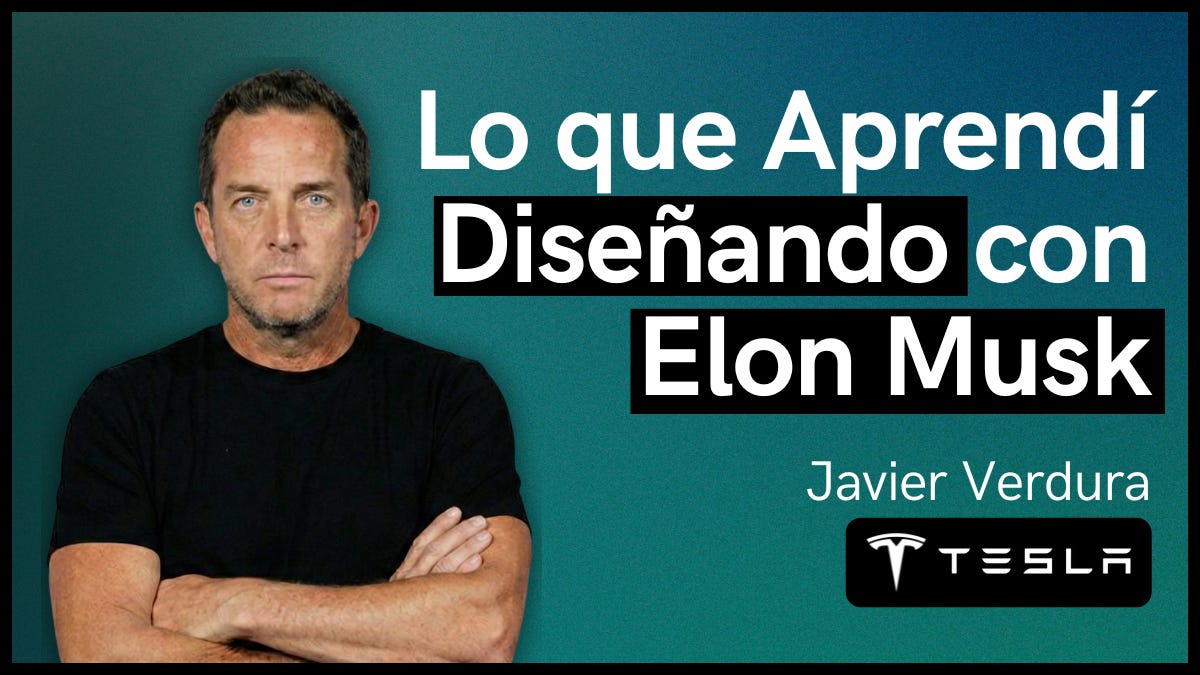
Today I interviewed Javier Verdura, global director of product design at Tesla for more than 10 years. He designed the Supercharger, the Solar Roof, and the Powerwall, and he also worked on the Dragon capsule and the SpaceX spacesuits.
For years he had a meeting every Friday with Elon Musk to review prototypes. His description of those meetings is that if he did not like something, he would tell you in a way that would make a lot of people cry.
I reached him through Daniel Rabinovich, CEO of Mercado Libre, who mentioned him a couple of times while I was preparing that interview. I had no idea that one of Tesla’s design directors was Mexican.
We talked about why Tesla does not do focus groups, about how you respond when they ask you for something impossible, and about why at Tesla it is more dangerous not to take a risk than to take one.
Structure and Key Highlights
The Hospital Basement
- As a child in Mexico City he was fascinated by cars and by taking things apart at home, even though he did not know that industrial design existed
- His dad was a neurosurgeon at the Hospital Inglés. On Saturdays he would take him along to do rounds and afterward they would go down to the basement
- There his dad was friends with the maintenance team, which had a workshop where they welded. He was not satisfied with certain surgical instruments and he would ask them for modifications
- Part of his Saturday was going to review his prototypes
- What stayed with him: his dad was a surgeon, not a designer, and even so he wanted to make things better than what already existed. He was an industrial designer without knowing it
- His answer on whether that can be trained: what matters is curiosity and the instinct to improve what exists
Two Coincidences that Defined His Career
- A friend of his dad’s at the hospital had a son who was a professor at Art Center College of Design. His dad mentioned to him that his son was a disaster at school but that he liked cars and drawing
- At 15 they sent him for a summer to Los Angeles to spend an entire day with that professor. He was struck by the school and decided that he had to get in
- His reflection: if that conversation had not happened, he would not be where he is
- The second was an exhibition at the Museo Rufino Tamayo on Italian design from 1945 to 1985, with a Ferrari parked in the lobby
- For him, seeing that Ferrari was like seeing a spaceship. That is where he understood that a person could dedicate their life to designing things like that
How He Gets to Tesla
- On the first day at Art Center a legendary professor told them to sit in alphabetical order for the entire semester. Franz von Holzhausen ended up next to him
- They became best friends because they did not know anyone else, and they stayed close for the whole program
- In 2008, turning 40 on a sailboat trip, Franz told them he was going to leave Mazda to go to Tesla. Half the group told him he was crazy
- Javier was one of the people who told him to do it, with the argument that if it did not work out he could get another job
- Four years later, landing in New York from Shanghai, Franz called him saying he was looking for a design director for Tesla. Javier offered to think of candidates and Franz told him that he was talking about him
- The cons were real: he would earn less than at his agency and he was moving to a more expensive city. The pro was working on something that could change the world, with someone he had respected since school
- His interview with Elon lasted 15 minutes and he came out worried. Human resources explained that the normal length was three or four minutes
A Design Studio Versus Tesla
- At a consultancy every 15 minutes of your day gets charged to a client, the way it works for lawyers
- At Tesla the question changed completely: how much time do I put into this, and the answer was however long it takes until the design is right
- His description of the feeling: free, without the handcuffs of being a consultant
- When he arrived in 2012 Tesla had about 2,000 employees. Today it is past 150,000. The studio was a hangar next to SpaceX
The Supercharger, His First Project
- All the money and the resources were going into launching the Model S, and the weekly question was whether they could make payroll
- In the middle of that they asked him to design a charger that would become the icon of fast charging
- His direct question was why divert resources if they were barely getting the car out
- Elon’s answer: if we do not do this, the car is not going to matter. Nobody buys a car they cannot charge quickly, and everyone’s first objection is where do I charge it
- It was the first time he understood that he was working with someone who saw the future with a clarity that very few people have
What Pressure Means at Tesla
- He had never worked so much in his life, and working as a design consultant was already a lot
- He saw people fired immediately for not doing something well. There is no latitude for errors that are not calculated
- The rule he quotes from Elon: the passing grade is being extraordinary. Not good, not great, extraordinary
- His explanation of why it is that way: what he has in mind is so big that he does not have time for people who do not do the work at that level
- A lot of people decide that they cannot work that way and they leave, and that seems legitimate to him
The Friday Meetings
- They would bring a list of products, almost always prototypes, and Elon wanted to see them as if they were production
- Each meeting picked up from the previous one: you had to incorporate what he had said and hope that he liked it in order to keep moving forward
- When he did not like something, he would tell you in a way that would make a lot of people cry. That you are an idiot, that you do not know what you are doing
- His method for surviving that: detach yourself 100% from the emotion, even though he is attacking you, and keep what has to be executed
- To this day, meeting with him puts him on the defensive
- What does matter: that he sees progress and that you are trying high-risk things. If he sees that you are pushing the limit, it does not matter that you failed that time
- In his interview Elon asked him whether he failed when he designed. He answered yes, and the reaction was approval. If he had said no, they might not have given him the job
- His reference is Edison: the thousands of attempts were not failures, they were designs that did not turn out better than the previous one
When They Ask You for Something Impossible
- His reaction is excitement, not a block. I have the tools, the people, and my experience to at least try it
- The first time you think you do not know whether you are going to be able to. The times after that, you already believe that you can
- The Solar Roof case: Elon told him that if he had magical powers to put solar panels on every house in the world, he would not do it, because the world would look worse
- When he asked what they were going to do, the answer was that this was his job. Invent something that would make the houses look better than before
- The parallel with the Model S: the brief was not the best electric car, it was the best car in the world, the fastest and the safest, that is also electric
- That is how the Solar Roof ended up: the best roof in the world, that also generates energy
The Cybertruck
- All of automotive design goes in the opposite direction: curves, inflated surfaces, never something flat because it looks deflated
- Franz’s idea was that just as you fold paper you can fold steel, and that would be the design. Elon loved it
- The product reasoning: all pickups look the same, so let’s make a different one, and literally bulletproof, taking to the extreme an expression that in English only means robust
- When he saw the full-size prototype he could not believe that car was going to be produced
- At the launch, driving around in the prototypes, seeing it on the street looked like a scene from a movie
- His reading today: it is a polarizing car with no middle point. He has one and he loves driving it, and there are people who stop him to tell him it is horrible
Designing for Space
- They worked on the Dragon capsule, above all on the exterior, because at SpaceX they are all engineers and for them everything is function
- Also on the spacesuits. The instruction was that when the capsule opens and the astronauts come out they should look like James Bond, not in the enormous suits from before
- His conclusion: for him it matters that everything have a coherent design, down to that level of detail
Why Tesla Does Not Do Focus Groups
- It is a big change for him. At his previous agency they had an integrated focus group space, with a live sketch artist and prototypes reviewed with consumers
- His nuance: focus groups work, but they only take you up to a certain level of innovation. There is a ceiling and that ceiling is the consumer
- How you get past that ceiling: with a leader who has a vision of the future so fixed that he does not need to ask anyone
- His argument: if people had that vision, they would be executing it. Unless someone is a genius, they are going to tell you what they already know
- The comparison he makes is with Steve Jobs, who was also famous for not asking users
- Where they do listen: if something is missing that is the reason people do not buy the car, they add it later, because selling cars is part of the mission
- His favorite example of the minimalist interior: a mid century modern house with a chair and a table is still beautiful. A Mercedes is a mansion with Persian rugs and enormous curtains. There are people for both, but the philosophy does not get changed in order to look like everyone else
Deprogramming Someone Who Comes from Another Culture
- The worst possible answer in a Tesla meeting is that something was designed that way because that is how it was done at another brand
- Experience is useful and it is necessary, but the question you have to ask is why it has to be that way, and why it cannot be some other way
- One of Elon’s philosophies that he quotes: the best part is no part
- The method: distill the product down to the most basic from first principles and build from there. If you manage to stay with the basics, it is also cheaper and easier to produce
Risk and Failure
- His reading of the cultural difference: in Latin America admitting failure feels like weakness, and that creates a circle where nobody takes a risk and therefore nobody innovates
- His way of calculating it: define how far you can go in risking time, money, and career, and go up to there. But you have to risk something
- What he says outright: at Tesla it is more likely that things will go badly for you if you do not take risks, because you are not innovating
- His equivalence: risk in product development is innovation
- And risk also takes the form of making 100 prototypes instead of three, because prototype 101 is always better than the first
Design in a World with AI
- His concern about design students is that they spend too much time on the computer and too little with physical materials
- The foundations he considers irreplaceable: being able to make 20 or 30 quick sketches and communicate exactly what you have in your head
- And then build the prototype with your own hands. His line: if a photo is worth a thousand words, a prototype is worth a thousand photos
- His reading of AI: it is one more tool, the way Photoshop or SolidWorks were in their time
- The central argument: given the same prompt, the person who has a designer’s training is going to move much faster than the person who does not
Why He Goes Back to Mexico to Teach
- It matters to him to give Mexican students what he would have liked someone to tell him, and that nobody told him
- His answer when they ask him how to get to where he is: there was luck and being in the right place, but with all the luck in the world you do not get there without dedication and a work ethic
- His two conditions: that you love what you do, and that you give it 100% without leaving anything on the table
- He never thought he would reach this position. He was happy running a successful design studio
- Who he thanks: Franz, who since school pushed things in an uncomfortable way while he preferred to execute well. At 57 he could rest on his wins and his friend does not let him
Silicon Valley Glossary
| Term | Meaning | Context in the episode |
|---|---|---|
| Focus group | Bringing consumers together to evaluate a product before launching it | What Tesla does not do, because the consumer is the ceiling of innovation |
| Design brief | The assignment that defines what a design has to achieve | The Model S one: the best car in the world, that is also electric |
| First principles | Breaking a problem down to what cannot be reduced further and rebuilding from there | The method for not repeating what was already done at other brands |
| The best part is no part | Eliminating components before improving them | The philosophy he quotes from Elon to simplify cost, weight, and assembly |
| Billable hours | Billable hours that get charged to a client | How his life in consulting worked, and what he left behind |
| Production prototype | A prototype built as if it were the final product | The standard required in order to present it at the Friday meetings |
| Passing grade | The minimum grade you need in order to pass | At Tesla it is being extraordinary, not being good |
| Calculated risk | An error that was worth attempting | The only kind of error that is tolerated |
People, Companies and References
People Mentioned
- Javier Verdura: global director of product design at Tesla, Mexican
- Franz von Holzhausen: his classmate at Art Center from the first day, and the person who brought him to Tesla
- Elon Musk: with whom he had review meetings every Friday for years
- His dad: a neurosurgeon who designed surgical instruments in the hospital basement
- Steve Jobs: the other reference for a vision that does not consult the consumer
- Thomas Edison: his example that failed attempts are improvements that accumulate
- Daniel Rabinovich: CEO of Mercado Libre, who mentioned him and led to this episode
- Enzo Cavalie: host of the podcast
Companies and References
- Tesla: where he joined in 2012 with about 2,000 employees
- SpaceX: the Dragon capsule and the spacesuits
- Supercharger, Solar Roof, and Powerwall: the products he designed
- Model S and Cybertruck: the two extremes of the brand’s design philosophy
- Art Center College of Design: the school he discovered at 15 through a coincidence
- Museo Rufino Tamayo: the Italian design exhibition with the Ferrari in the lobby
- Mazda: the company Franz left in order to go to Tesla in 2008
- Universidad de Monterrey: where he teaches when he goes back to Mexico