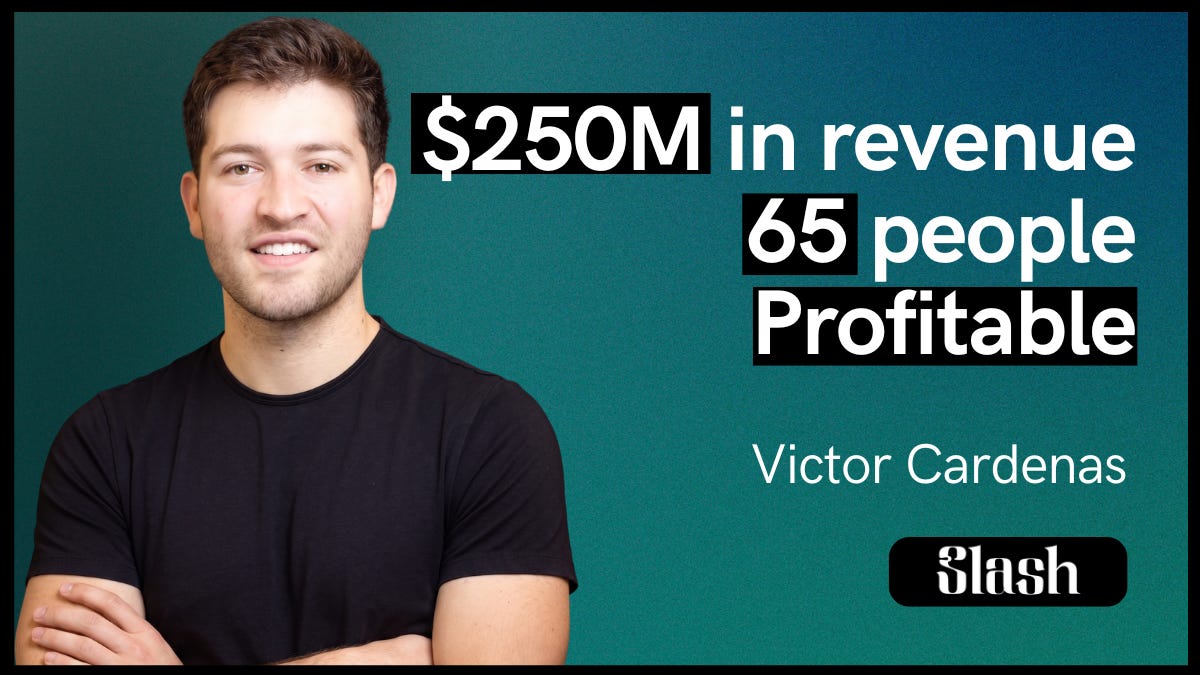
This conversation was recorded live at LATAM at Silicon Valley, in front of a room full of Latin American founders.
Victor Cardenas Codriansky is the founder of Slash, one of the fastest growing business banking platforms in the US. More than 5,000 businesses spend close to $10 billion a year on its corporate cards. He is 25, he dropped out of Stanford at 20, and he raised his most recent round from Ribbit Capital, the fund whose founder had publicly declared that fintech was dead.
We talked about why he thinks Micky Malka changed his mind, how Slash runs a company of this size with an internal agent instead of copious headcount, and what he believes is actually defensible once software itself becomes trivial to write.
He also made the case for Venezuela as an investment destination, and told the story of his grandfather, who put on his first pair of shoes at 13.
Structure and Key Highlights
Why Ribbit Invested in a Fintech After Saying Fintech Was Dead
- Micky Malka told his own LPs that fintech was dead, which Victor reads partly as Ribbit rebranding from a sector fund into a generalist one
- The underlying Ribbit view: the big fintech SKUs were already built out in the 2010s. Take the online brokerage and make it 10x, take the checking account and make it 10x, take online payment processing and make it 10x
- Their observation was that very few net new fintech companies had started inflecting, while the at-scale ones kept getting larger and cross-selling
- His read on why Slash got funded anyway: they broke the mold on both product and go-to-market
- The result is an outlier position for a fund that is now mostly software and AI infrastructure, with one fintech deal
The Grandfather Story He Opens Every Investor Pitch with
- His grandfather was born very poor in Colombia and put on a pair of shoes for the first time at 13
- He moved to Venezuela in his early 20s, and Victor’s father grew up lower middle class while the business was starting
- Together they built the largest importer of ATMs and cash handling equipment across the northern part of Latin America, spanning Venezuela, Colombia and Peru
- By the time Victor came along he had an American international school and then Stanford, privileges neither of them had
- The mandate he took from that: he cannot only get to where they got, he has to make the same order of magnitude jump
- His own summary of the aggressiveness people notice in him: he wants to win much more than he wants to play padel and drink whiskey
Deciding on Stanford Before He Ever Got There
- He told Santiago from Dual Entry, at 15 or 16, that he was applying to Stanford so he could drop out and start a company
- Growing up in Latin America, the only visible path to wealth was starting a business in the US. There is no path where you become an exec at a large public company and make many millions
- Every time he liked something expensive, his father told him he would have to start his own business
- On Silicon Valley as the Champions League of tech: he never had to retrain, because the bar was set there from his first day as a founder
- His argument against the mystique: it is not that people here are more competent, and most of them are not from here. It is that the bar to win at all is so high that people push themselves further than they thought they could
- Who filled the mentor role: YC, which validated him as an outsider and a young founder, plus peers like Manuel and Andre Perez, who were at Stanford at the same time
What Slash Actually Is
- A business banking platform built on the thesis that companies deserve products tailored to their industry
- Before Slash, banking was one-size-fits-all: a construction company, a marketing agency, a medical spa and a crypto company all got the same Chase dashboard
- The product does everything a traditional bank does and everything the first generation of B2B fintechs did, then integrates with the hyper niche ERP nobody else has integrated with
- His description of the shape: a bank account with an app store on top, where each app is vertical specific differentiation
- Strong product-market fit across eight or nine verticals, with USD accounts open to businesses worldwide
- The non-US customers mostly look like the US ones, ecommerce and marketing agencies. Real localization for a specific country is a future ambition, not something they have built
Running the Company on an Internal Agent
- The strategic shift: an incremental hour spent making the organization more productive with AI beats an incremental hour spent recruiting another engineer
- Their internal agent is called Twin. One of their support leads describes his job as pre-Twin and post-Twin
- Twin is connected to Snowflake for customer data, permissioned by employee, to Datadog for real-time logs, and to Intercom for the support surface
- The bottleneck it removed: support queries that used to require going to find context from someone else in the company
- Anyone can set recurring alerts, like a product changelog every morning of every PR that shipped
- Roughly 15% of PRs merged to production are now initiated by non-technical people
- On the customer side, every action available in the dashboard can also be triggered by texting Slashbot in natural language
- What engineers do now: review. Every engineer is effectively an engineering manager
Replacing the SaaS Stack
- They have replaced tools they used to pay for, Retool among them
- His claim about why more companies do not: they are not physically incapable of it, they believe they are. Replacing much of legacy software is now genuinely trivial
- What he expects: margin compression across SaaS, and very cheap competition doing the same thing, even if you do not build your own CRM
- The counterweight is network effects and high migration costs. Without those, expect the replacement wave
- His timeline for how far this goes: in about two years you paste a URL and get a working copy of that product in a day
Where Defensibility Actually Lives
- AI cannot get you network effects
- AI cannot get you a regulatory moat. You cannot vibe code a BIN from Visa or the ability to open demand deposit accounts
- AI cannot vibe code your brand. AI cannot vibe code Nike
- He is honest that he does not have a clean answer for pure play software. The examples he trusts are not pure software: bare metal infrastructure like Databricks, driver networks, data centers
- The first generation of gen AI companies that orchestrated a model to be 30% better at one thing have already been commoditized
- His framing for early founders: build products that only get better as the models get better
Agents as Spenders
- Slash launched an MCP server and a credential you can hand to an agent so it can spend on your behalf, with a 2FA confirmation sent to you right before a transaction
- Customers are already using it for consumer-style errands: message the agent on Slack, have it order groceries or book a flight
- He still frames the customer as the business, not the agent
- What he expects soon: every ecommerce company letting you buy programmatically
- The other area to watch is developer tooling, because people who know nothing about hosting now use whatever the coding tool recommends. That makes getting recommended by the models a real distribution channel
Crypto as a Payments Product
- His view moved a lot over the years. He first saw it in Venezuela, where there were billboards on the highway advertising coins like Dash
- After going down the rabbit hole around the 2021 bubble, his conclusion was that 12 years after the Bitcoin white paper nobody actually transacted with it
- What changed his mind was customer behavior: marketing agencies in the US receiving large payouts from Coinbase and Kraken, because their international clients preferred stablecoins to Swift
- So they made sending and receiving stablecoins as easy as an ACH or a wire from a business account
- A year and a half later they are approaching $2 billion a year in stablecoin volume
- His conclusion: the best use case of the blockchain turned out to be tokenizing the dollar, and the financial system will come on chain over the next 25 years
Reading the Capital One Acquisition of Brex
- He was happy about it, and openly admiring of the Brex founders, immigrants from Brazil who started a unicorn very young
- His precedent: Divvy, acquired by Bill.com for $2.5B in 2021, had built a business comparable in size but focused on middle America rather than Silicon Valley. The talent left and the customers became available
- His bet is that a large acquirer will struggle to match the pace of companies investing constantly in AI talent
- The strategic opening: tech becomes an interesting vertical for Slash, including things like token spend management, since most companies dump all token spend into a single GL code with no attribution per employee
- His YC partner Brad Flora told him they are no longer invested in a B2B neobank except for Slash
The Venezuela Thesis
- His frame is a multipolar world with the US, China and the Gulf as poles, and Venezuela as a country that could have been one
- We are not yet in a post hydrocarbon world, and he believes Venezuela can become the second largest economy in the Americas
- The concrete signal: hotels in Caracas that were at 2 or 3% occupancy before January 3rd are now at 80 or 90%, with lobbies full of hedge fund, private equity and Qatari investors
- The banking comparison he uses: the largest bank in Latin America is Nubank at around $80B, while the Gulf has more than ten banks above $100B
- On the consumer side, Cashea is the local example. He thinks the B2B opportunities are still open
Advice for Founders Trying to Break into the Valley
- You can do it. Every great founder had the same two arms and two legs you have, and getting over the impostor syndrome slump is the first necessary step
- Avoid the noise. Once you raise, you get invited to every dinner and it feels great, but you should only be spending time with two kinds of people: the ones who work with you and the ones who pay you
- Do not lie to yourself. Slash spent a year on a subscription splitting app, a Venmo for recurring payments, justified by the statistic that 60% of Americans share a Netflix login
- No individual person had asked for it. What gave them product-market fit was sneaker resellers asking for a way to create a bunch of cards to buy shoes, a market he estimated at 5,000 people worldwide
- The rule he draws from it: build something for a person, not for a statistic, and let your customer dictate your next step instead of your own roadmap
Quickfire
- OpenAI or Anthropic: Anthropic. Coding adoption is a step function above every other domain, all work can eventually be represented as code, and people leave OpenAI for Anthropic more than the reverse
- Mercado Libre or Nubank: Nubank, because David Vélez had every opportunity to stay in the US and build a software company and chose to go back and set the example
- Who to thank for pushing him to think bigger: his grandfather, and his co-founder, whom he met at a summer camp in high school and who cares less about money than about building something great
Silicon Valley Glossary
| Term | Meaning | Context in the episode |
|---|---|---|
| SKU | A single product line, borrowed from retail inventory language | How Ribbit describes the fintech products already built out: brokerage, checking account, payment processing |
| Neobank | A banking product built as software, usually on top of a partner bank | Slash positions itself as a specialist B2B neobank rather than a generalist one |
| Vertical specific | Built for one industry rather than for everyone | The eight or nine verticals where Slash claims product-market fit |
| Regulatory moat | Defensibility that comes from licenses and approvals competitors cannot copy | A BIN from Visa and the ability to open demand deposit accounts |
| Vibe coding | Building software by prompting a model rather than writing the code | His line that you cannot vibe code Nike, a driver network or a data center |
| MCP server | An interface that lets AI agents use a product’s tools directly | What Slash launched so agents can transact on a customer’s behalf |
| AEO | Optimizing to be the answer a model recommends, the successor to SEO | Why he thinks getting recommended by coding tools is now distribution |
| Stablecoin | A token pegged to a currency, in practice the dollar | Close to $2B a year in volume, driven by cross-border payments |
| GL code | The line in the general ledger an expense gets booked to | The attribution problem with token spend inside companies |
| Margin compression | Profitability shrinking as cheaper alternatives appear | What he expects to happen across SaaS |
People, Companies and References
People Mentioned
- Victor Cardenas Codriansky: founder of Slash
- His grandfather: born poor in Colombia, first pair of shoes at 13, built the ATM import business
- His co-founder: met at a summer camp in high school, the smartest engineer he knew there
- Micky Malka: founder of Ribbit Capital, who declared fintech dead
- Brad Flora: their YC partner
- David Vélez: founder of Nubank, his answer in the quickfire round
- Pedro Franceschi: co-founder of Brex, whose departure he cites as the risk in the Capital One deal
- Santiago: Venezuelan founder of Dual Entry, who heard the Stanford plan when Victor was 15
- Manuel and Andre Perez: peers from the Stanford years who supported each other
- Brandon: the support lead who describes his job as pre-Twin and post-Twin
- Enzo Cavalie: podcast host
Companies and Organizations
- Slash: business banking platform, 5,000+ businesses, close to $10B a year in card spend
- Ribbit Capital: the fintech fund that led his most recent round
- Y Combinator: the stamp of approval that validated him as an outsider
- Brex, Ramp, Divvy, Bill.com, Capital One: the competitive landscape he reads
- Nubank, Mercado Libre, Cashea: the Latin American reference points
- Databricks: his example of infrastructure AI cannot commoditize
- Snowflake, Datadog, Intercom, Retool: the internal stack, part replaced and part wired into Twin
- Coinbase and Kraken: where the stablecoin payouts to his customers were coming from
- Anthropic and OpenAI: the quickfire question, answered in favor of Anthropic
- LATAM at Silicon Valley: the conference where this conversation was recorded