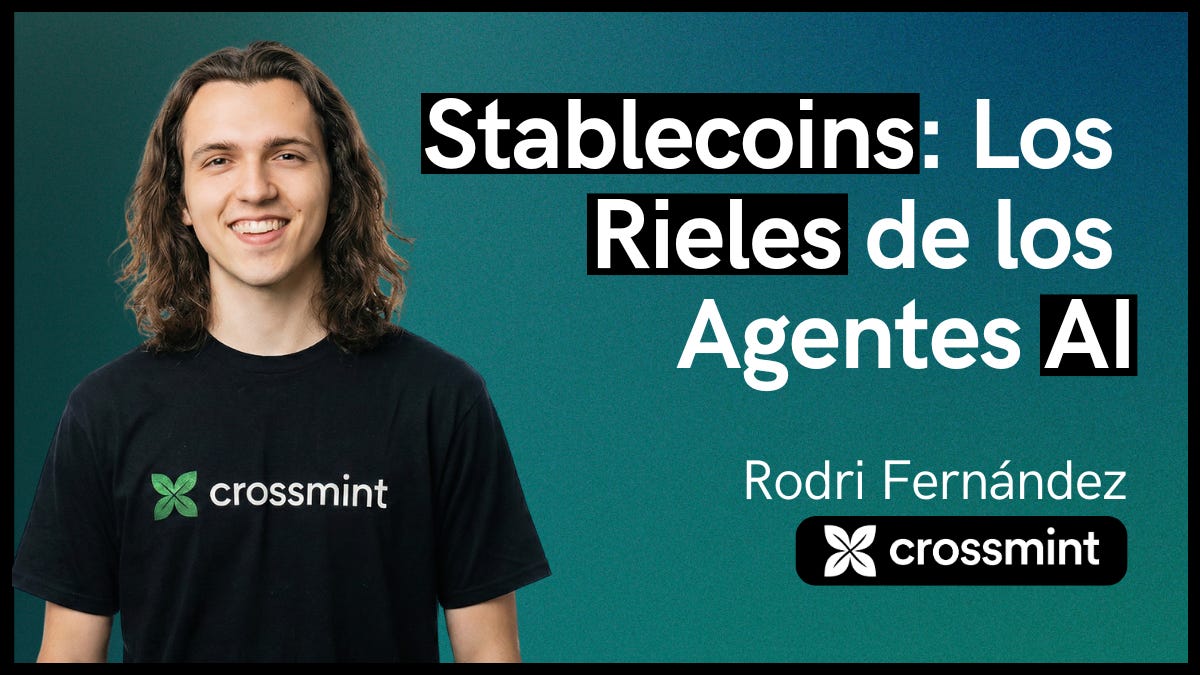
The audio and video are in Spanish. These notes are a translation.
Today I interviewed Rodri Fernández, cofounder and CEO of Crossmint, a stablecoin and blockchain wallet platform used by more than 40,000 companies, including MoneyGram and Visa.
Crossmint raised more than 20 million dollars from funds like Ribbit Capital and grew its revenue more than 10 times in one year.
His personal story is as unconventional as his thesis. At 18 he went to London to live 36 days on the street in order to force a crisis on himself. After that he became a monk in a zen temple. The idea for Crossmint came to him there, while he was meditating.
We talked about why stablecoins are exploding now, about how regulatory arbitrage is going to make the fintech industry global, and about what is still missing for AI agents to become economic agents.
Structure and Key Highlights
36 Days on the Street in London
- He is from Pontevedra, Galicia, a town of about 50,000 people that he had not left until he was 18
- The reasoning: if going away to study in another part of Spain had already changed his life so much, what would happen if he exposed himself to a bigger change
- Since he was a kid he liked movies and the structure of the hero’s journey, that transformation forced by the challenge. He decided to accelerate it himself
- He did not know English either, and he did not have money for a course, so he bought a ticket to London with about 300 euros and a hostel for three nights
- He ended up sleeping in random places and working nights doing public relations for nightclubs, which forced him to talk all the time
- The first surprise: he was extremely happy having nothing. There was a ten-day streak of eating only pasta with bread crackers on top because he could not make sauce
- The conclusion that changed his risk calculus: if I do not need that much to be happy, I can take a lot more risk
- The second thing was hard. The man who got him his first job, a Galician he recognized by the accent in the middle of the street, killed himself a month later. His mother sent him the message
The Risk that Actually Matters to Him
- His definition: the fundamental risk is not running out of a salary or eating ramen. It is reaching 60 and looking back wondering what he did
- That is why he wants a life that is dense across every spectrum, not only in the business. If it touches the spiritual part, he becomes a monk
- The other side of the argument: if you work hard you are never going to go hungry, and if your company fails they are going to want to hire you, because there is no better profile than that of a founder
- His way of operating: he describes himself as having an extreme personality, one thing at a time and absolutely. In the monastery he meditated 20 hours a day, and now Crossmint is 110% of his life
- What he least expected about starting a company: the number of sacrifices people are not aware of, and that the role changes every month because the company changes every month
- What does make up for it: the learning curve does not resemble anything else, and watching the people on the team grow
How Crossmint Is Born in a Zen Temple
- He was in a temple of the Rinzai school, the strictest one, sitting 20 hours a day, and a stick if you slouch
- One afternoon a week was free to meditate on whatever you wanted. He chose to meditate on work, to observe what happened in his brain when he was working
- He talked with Alfonso, today his partner, who was starting the HF0 accelerator in San Francisco. It was late 2021 and NFTs were taking off
- That day they sold some NFTs. He had never created something that generated its first dollar on the internet
- The next day he went back to meditating with the robe on and he could not stop thinking. He packed, he told the priestess at the monastery, and he left for Miami to start the company
- They spent the first three months selling NFTs to understand where the friction was. Within two months they had about 30 people working with them
- They incorporated the company in February 2022
From NFTs to Stablecoins
- The underlying conviction never changed: that blockchain was going to rebuild the financial system and create private ownership of the digital
- What changed was the use case. At that moment people wanted NFTs, so they built infrastructure to remove the friction there
- That same infrastructure kept evolving. Today the main thing is a suite of APIs so that companies can integrate stablecoins
- The typical use cases: remittances, payroll, neobanks, and now agents that need rails to move money
- All of it without the client having blockchain engineers or their own compliance infrastructure
What Problem It Solves Exactly
- The diagnosis: the world’s financial infrastructure is extremely inefficient and it is regionalized. If you want to build something like a global Revolut, you have to go country by country with licenses
- And moving money is expensive. A remittance to Mexico or Colombia takes time and charges fees that hit the person who needs the money the most
- Stablecoins are native digital money that moves at the speed of the internet, between countries, instantly
- The concrete example of MoneyGram: the traditional flow collects the cash in the store, sends it through Swift, and it arrives whenever it arrives. The new flow converts that cash into a stablecoin domestically, almost instantly, and sends it anywhere without going through Swift
- The additional benefit for the recipient: they do not only receive it fast, they can hold the money in dollars and protect themselves from the inflation of their local currency
- And because the infrastructure is composable, on top of it you can offer interest on deposits or investment products
- The end user never sees any of this. They see a normal application, with no seed phrases and no fear of losing the money
Why They Are Exploding Now
- Stablecoins have existed for years, but limited to very niche use cases
- How they work: the cash that backs them is invested in Treasury bonds, and by the mere fact of existing they generate between 3 and 5% in interest. That has big implications for the banks
- What changed in the last year and a half, according to him, is four things
- Developer infrastructure that did not exist before. He compares the moment to what Stripe did ten years ago with online payments
- User experience: before you practically needed a master’s degree in blockchain and it was likely that you would lose the money. Today his grandmother could use it
- Costs: the network fees that made transacting expensive practically disappeared
- Regulatory clarity: the new laws in the United States and MiCA in Europe made large companies feel comfortable
Regulatory Arbitrage, the Second-Order Effect
- The key model is non-custodial wallets. The company gives you the interface, but the private keys are where only the user has access
- Because the application cannot move your money without your signature, it is not providing the financial service, so it does not need a license to offer the wallet
- That makes it possible to receive, deposit, and hold stablecoins, and to access services such as buying a token of a stock or generating yield
- There are parts that do require a license, such as going from cash to stablecoin. That is where partners like Crossmint come in, which hold licenses in several countries
- The consequence I asked him about directly: a company like Robinhood could launch a product in Mexico without being licensed there
- His reading of the aggregate effect: the fintech industry becomes ten times more competitive and much more global, especially in emerging markets
- And the people who benefit the most are those who today pay 6% to receive a remittance and can only invest in instruments from their own country
Marshall Islands
- A country of about 50,000 people spread across 2,000 islands that cover a surface area comparable to that of Mexico, with an economy that is already dollarized
- How the money arrives today: to a correspondent bank in Hawaii, it gets printed, it is loaded onto a plane or a ship, it crosses the Pacific, it arrives in the capital, and from there it goes out on boats to the islands
- The result: sometimes there is simply no cash left on your island, so even if you have money in the bank you cannot use it
- What they are building: a wallet for every citizen, with the universal basic income program being deposited there every four months
- With that they can pay each other the way you do in a payments app and receive remittances from abroad instantly
What to Do if You Are in Fintech
- For an executive the answer is easy: if your financial services company is still not doing anything with stablecoins, step it up, because most of your peers are
- The concrete risk is being left with an anachronistic product. Banks have it somewhat easier because there is regulation that protects them
- For a founder he sees a war between incumbents with distribution that are integrating stablecoins and a new generation of startups
- His comparison: it is the same thing that happened ten years ago when Revolut and Robinhood were created, except that now the opportunity is global from day one
- Where he sees room: products that are natively crypto instead of crypto as an adjacent component, with localization for emerging markets
- And not only consumer. A Brazilian mining company came to him that wants to move 500 million a month to Asia
- The payroll case he likes: paying from the United States to Argentina is slow and expensive, and people prefer dollars. With stablecoins the payment is instant, the company does not have to advance the capital two weeks, and the payroll company ends up able to offer financial services to those people
Competing Against Stripe
- Stripe bought Bridge and Coinbase also entered the market
- His answer: Stripe has distribution, but also the defect of being an enormous company
- The contrast he offers: he knows someone who has spent eight months trying to onboard with Stripe, and they bring clients on in a day
- A client wrote to them on a Friday, started building on Monday, and the following Friday had an end to end product using eight different products that otherwise would have required orchestrating several providers
- What they sell, in his words, is speed and enterprise treatment. And that this is the only thing they do
Economic Agents
- The hypothesis: agents are already superior to humans at many tasks, but they are not yet economic agents, they do not move money
- There is no reason they are not also going to be better at moving money, so most of the transactions in the world will end up intermediated by agents
- What is missing: security standards, verification, authentication, and resolving who is responsible when there is a chargeback
- Why stablecoins and not fiat: they are programmable, they allow microtransactions, and you can generate accounts through an API
- His internal example: a bot that lives in Slack, which you message to say the toilet paper ran out, and it makes the purchase on Amazon. They built it in half an hour, with permissions by type of item, amount limits, and a list of allowed merchants
- What it replaces is the back and forth with the person who manages the office
- The same pattern with flights: ask for a flight to London for less than 200 dollars, check every five minutes, and buy when one shows up. That is what an executive assistant does, or a travel company that charges 15% on top
- The second use case is financial. In a trading app only so many buttons fit, but with text you can define arbitrary conditions for buying
- On security: the advantage is that you can program the limits inside the wallet itself, cryptographically, plus multifactor for larger amounts
- What he says is needed for it to take off: that a good team launch a concrete use case. The infrastructure is already live and documented
- His prediction on interfaces: going to the seller’s website has its days numbered. The infrastructure becomes API first and the agents build the interface on top, personalized for each user
- Who he thanks: his parents in general, and in the context of Crossmint his partner
Silicon Valley Glossary
| Term | Meaning | Context in the episode |
|---|---|---|
| Stablecoin | A token on a blockchain backed one to one by a traditional currency | The central thesis: digital money without volatility |
| Non-custodial wallet | A wallet where only the user holds the keys | The piece that enables regulatory arbitrage |
| Regulatory arbitrage | Offering services without a local license, because of how the product is structured | Why a fintech can be global from day one |
| On ramp | Converting cash or fiat into crypto | The part that does require a license, and that Crossmint provides |
| Composable | Something that can be stacked with other services without permission | Why investments or yield can be offered on top of a wallet |
| Rails | The infrastructure through which money moves | Swift against stablecoins in the MoneyGram example |
| Gas fees | The fees for transacting on a blockchain | One of the costs that practically disappeared |
| Economic agent | An agent that moves money, not only information | The next step he considers inevitable |
| Chargeback | When a transaction is reversed and someone takes the loss | The question of responsibility that holds back agent payments |
| MiCA | The European regulatory framework for crypto assets | Part of the regulatory clarity that unlocked adoption |
People, Companies and References
People Mentioned
- Rodri Fernández: cofounder and CEO of Crossmint, Galician
- Alfonso: his partner, with whom he started the company from the monastery
- His parents: whom he thanks in general, and who found out about London afterward
- The Galician in London: the person who got him his first job and died a month later
- Enzo Cavalie: host of the podcast
Companies and References
- Crossmint: stablecoin and wallet infrastructure for more than 40,000 companies
- Ribbit Capital: among the funds that invested their more than 20 million
- MoneyGram, Western Union, and Visa: the clients that illustrate the remittance use case
- Government of the Marshall Islands: wallets for every citizen and universal basic income
- HF0: the accelerator his partner was starting when the idea was born
- Stripe and Bridge: the large competitor that entered the market through an acquisition
- Coinbase: the other incumbent that is coming in
- Revolut, Robinhood, and Nubank: the fintechs that had to go country by country
- Rinzai temple: the strictest branch of zen, where he meditated 20 hours a day