The audio and video are in Spanish. These notes are a translation.
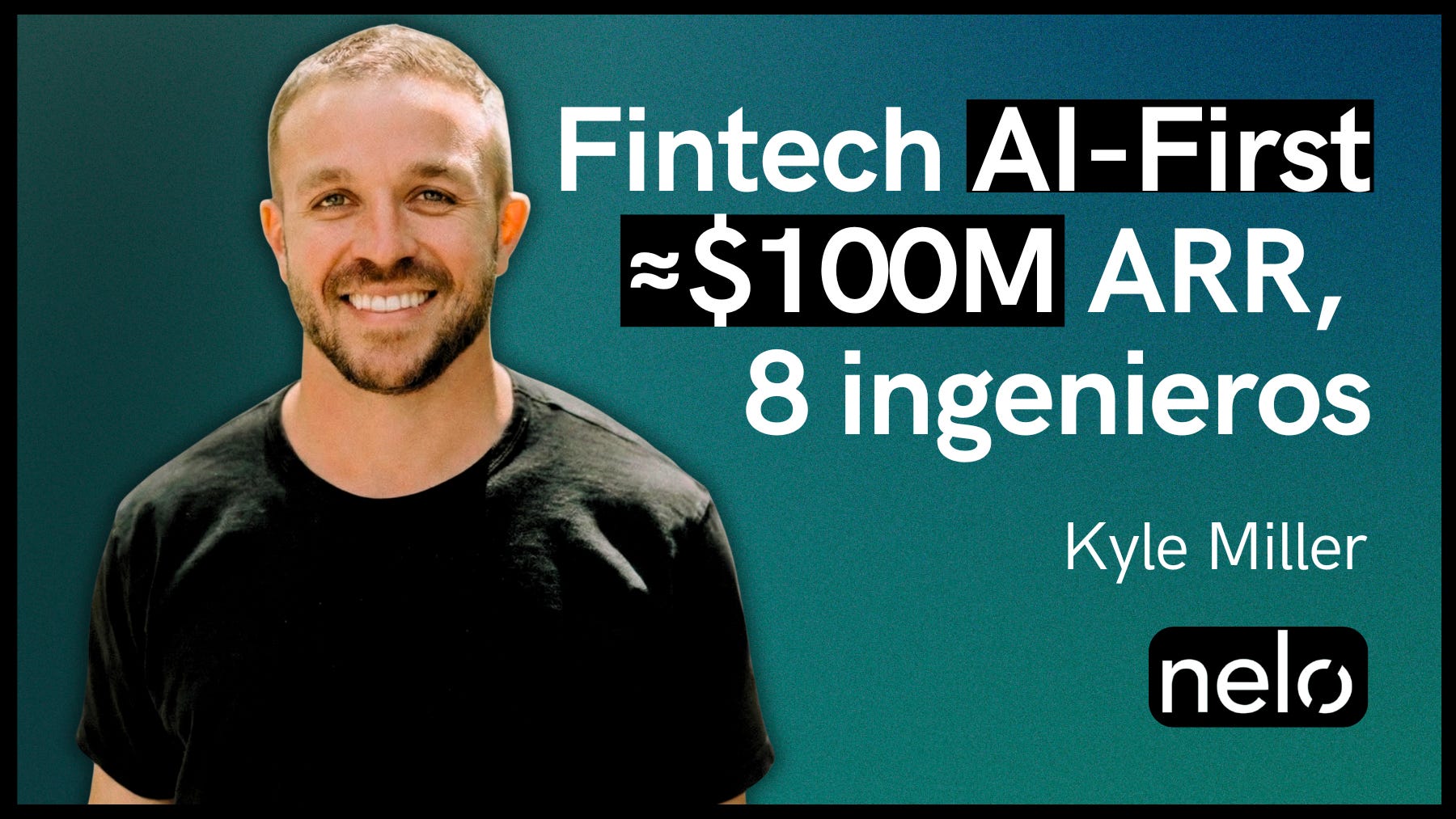
Today I interviewed Kyle Miller, cofounder and CEO of Nelo, an app that brings a marketplace and credit together in one place for Mexico. With 40 people and only eight engineers, they generate close to 100 million dollars a year in revenue.
Kyle was working at Uber when he saw China and India leapfrog the banks with super apps for credit and payments. In 2018 he left Uber right before the IPO, moved his family to Mexico, and founded Nelo.
The interview is in Spanish, which he learned so he could build a Mexican company from the inside.
We talked about why their collections team is a quarter of a person, how a team of one works with agentic tools, and why their competition is not Nubank but Coppel and Elektra.
Structure and Key Highlights
The Decision in Reverse
- He is from Texas, and his wife is from New Hampshire. Mexico was a change, but she knew what she was getting into because he had been thinking about the idea for years
- At the beginning he traveled between New York and Mexico. When their first daughter was born, he realized the family had to make the jump
- Their second daughter was born in Mexico
Seeing the Future in China and Watching It Arrive in India
- He joined Uber in 2014, on the International Growth team, working on how to accept payments from riders and how to pay drivers
- What he saw in China: payments skipped the credit card completely. No card and no cash, everything was a digital wallet. And almost 50% of retail was already online
- He did not know whether China was an anomaly. India gave him the answer
- In 2015 India was a cash economy. Two years later he went back to New Delhi and saw a woman selling food at a street stall with a sign that said she only accepted digital payments
- That is where he concluded that China was not an exception. It was everyone’s future
What He Had to Unlearn
- The data point that frames the problem: close to 80% of adults in the United States have access to a credit card, and in Mexico it is less than 15%
- His advantage was not being a banker. He did not have a model he was trying to replicate, so they built from first principles
- First consequence: only fixed payments, no revolving card, because revolving credit is harder to understand
- Second consequence: they do not use a credit bureau or a traditional score. What weighs the most is the user’s activity and the user’s transactions inside their platform
- What he did have to learn: Mexican culture and the language. In his office almost everyone is Latin American and there are only a couple of foreigners
- His advice for anyone who wants to launch a product in a country that is not their own: learn the language
Finance and Commerce as the Same Business
- What he saw in China: Alipay and Alibaba are the same company, and that is the underlying reason
- If you do not share the margin on the transaction with anyone else, you can offer a better product
- The app is the way people buy, not an accessory to the card. They already have a physical card, but most purchases happen in the application
- There are loyalty levels and a product they call streaks: if you pay on time, your credit line goes up
- The technical difference with a card: the card evaluates you once and assigns you a limit. In the app they can measure the risk and adjust the price on every transaction
How You Get to 2 Million Dollars per Employee
- The first reason is where they come from: the founders come from technical teams, so the question before hiring was always whether it can be automated
- The example people ask him about most: at banks and fintechs, collections teams are enormous. Nelo’s equals 25% of a person, because the process is 100% automated with messages specific to each user
- Second reason, hiring discipline: they never hire for future problems. The problem has to hurt before they open the role
- Third, a culture of experimentation. They have hundreds of tests running live, and the product is the result of that
- Fourth, and the most important, the type of person. With 40 people, each one is between 2.5% and 5% of the company
- His read on Uber: if it were born today it would have 100 times fewer employees, and in 6 or 12 months the answer will be 1,000 times fewer
- The reason: Uber is technology with a physical component, and with riders, delivery workers, and restaurants there is a lot of room for problems. Ten years ago the solution was to hire people
How the Team Works Today
- An engineer took the designs for the identity verification flow, put them into Claude Code, waited a couple of hours, and had the complete product. Before, it took a week
- Because they no longer write the code by hand, they work on three things in parallel while they wait
- His partner told Enzo that they have engineers running five instances of Claude Code at the same time
- What the limiting factor is: knowing which tools exist, because that changes every week, and the imagination to think about what is possible
- His analogy: they handed you a Ferrari, and you can use it to go to the corner store or to travel the world
- How they keep the team up to date: the advantage of being small is that he can talk with each person. They also have Slack channels for new tools and hours set aside to learn from each other
The Team of One
- He was a product manager at Uber, where building a product took weeks or months, with 12 or 15 people and a lot of meetings
- His flow today, if he were a product manager: he starts by researching in the data with Claude Code, which is connected to their databases via MCP and lets you query in natural language
- A couple of hours later he has evidence that a problem exists
- He writes the PRD with skills inside Claude Code, in about an hour, and he uses Devin for the engineering requirements document
- Design is still human. For pixel perfect they still need their designer
- With the designs and the PRD ready, he puts it into Claude Code, grabs a coffee, an engineer reviews the code, and they ship it
- All of that fits inside an eight-hour day. The deeper change is thinking in hours and days instead of in weeks and months
- What holds other founders back, in his opinion: they do not know that it is possible. His concrete advice is to download Claude Code even if the terminal is intimidating, and to use it in Spanish
You Do Not Need to Be an Engineer
- He wrote the first version of Nelo, and it took him six months. Today a founder would do it in days
- His recommendation: focus on the problem, the solution, and the users. If the product solves something real, the technical person shows up
- On systems thinking for someone who is not an engineer: split the solution into parts and be clear about what you are testing in each one
- His trick when the idea is very large: ask the AI to break it into smaller pieces
- To the companies that are falling behind, he would say that it is never too late, but that the technology changes too fast
- The three steps he proposes: the leader understands the technology first, then allows people to use it, and then creates the space to teach and to learn
- On the security of the data, he believes there is a lot of misinformation. The large platforms have secure business plans
How He Hires for This
- He is in every interview at Nelo, and he does the culture interview. The question is simple: how do you use AI in your day to day
- Level one: using AI as a chat, for questions
- Level two: using agentic tools to automate a complete process. That is the bar for everyone, including non-technical roles
- Level three: continuous systems built with agents, highly automated
- Where he finds those people: they usually did it in their personal life, because many companies still do not give access to these tools at work
Why He Does Not Want to Be a Bank
- His starting point: people need credit in order to buy things. On every purchase there is margin for the bank and margin for the merchant
- If you control both sides, you do not share the margin with anyone, and you can offer lower prices
- It is not a new idea in Mexico. Coppel, Liverpool, and Elektra already mix finance and commerce. The difference is doing it 100% digital
- The data point that says the most about their customer: 40% of the people who buy on their marketplace are making their first online purchase
- The key to that is the credit. They receive the product without putting down a single peso, and they pay with no interest
- How the number closes: Coppel’s model is physical stores and thousands of employees. Theirs is an algorithm per user, a thousand times fewer employees, and no stores
- Their figures: around 80 million annualized in revenue, doubling every year, and profitable for the last two years
- They take the risk on the first transaction because they think in LTV, in years of customer value, not in recovering the money on the first purchase
The Other Side of the Marketplace
- Marketplaces are extremely expensive to build. He saw it at Uber, where they spent billions of dollars growing, because the problem is supply and demand at the same time
- Nelo arrives with millions of customers who have purchasing power, which means one side is already solved and already profitable
- On why Coppel and Elektra keep growing despite the digital alternatives: everyone has a digitization strategy, but it is usually a corporate OKR and not a change of culture
- Competition does not motivate him. He played American football, and his coaches taught him to concentrate on the inputs
- His metaphor: if this were a match, we would be in minute two and Messi still would not have touched the ball
Mexico as Home
- Two weeks ago he asked his older daughter, who is 4 years old, where she is from. She answered without hesitating that she is Mexican
- Who he thanks for having thought big: his dad, who worked extremely hard and who left a large corporation to start a company
- What he hopes: that in the future his daughter says the same thing about him on a podcast
Silicon Valley Glossary
| Term | Meaning | Context in the episode |
|---|---|---|
| Buy now pay later | Buy now and pay in fixed installments, assessing the risk on each purchase | Nelo’s model, the opposite of the revolving card |
| Revolving credit | A credit line that renews itself and accumulates interest | What they decided not to offer, because it is hard to understand |
| Credit bureau | The agency that assigns a credit score | What they do not use: their model looks at activity inside the platform |
| LTV | The total value of a customer over time | Why they can take risk on the first transaction |
| Chicken and egg | The problem of getting both sides of a marketplace started at the same time | What makes marketplaces expensive, and what they already have solved on one side |
| MCP | A protocol that connects a model to data sources and to tools | What lets them query their databases in natural language |
| PRD | A document that defines what a product does and who it is for | What now gets written in an hour with skills |
| Agentic tools | Agents that carry out complete tasks, and do not only chat | The bar he sets in interviews for any role |
| Systems thinking | Thinking in systems and in parts instead of in isolated tasks | Why engineers adapt faster to orchestrating agents |
| A player | Someone exceptional in their role, who attracts others like them | His hiring standard on a team where each person weighs 2.5% |
People, Companies and References
People Mentioned
- Kyle Miller: cofounder and CEO of Nelo, former Uber, from Texas
- Stephen: his partner, also former Uber
- His dad: left a large corporation to start a company, his example and his mentor
- His daughters: the second was born in Mexico, and the older one defines herself as Mexican
- Daniel Rabinovich: from Mercado Libre, cited on the challenge of moving a very large company
- Enzo Cavalie: host of the podcast
Companies and Tools
- Nelo: marketplace and credit in a single app for Mexico, 40 people and eight engineers
- Uber: where he worked on International Growth in China and in India
- Alipay and Alibaba: his reference for the idea that finance and commerce are the same business
- Coppel, Elektra, and Liverpool: the real competitors, not the fintechs
- Nubank and Mercado Libre: the path they decided not to follow
- Claude Code: the central tool in their product and engineering flow
- Devin: what they use for the engineering requirements