The audio and video are in Spanish. These notes are a translation.
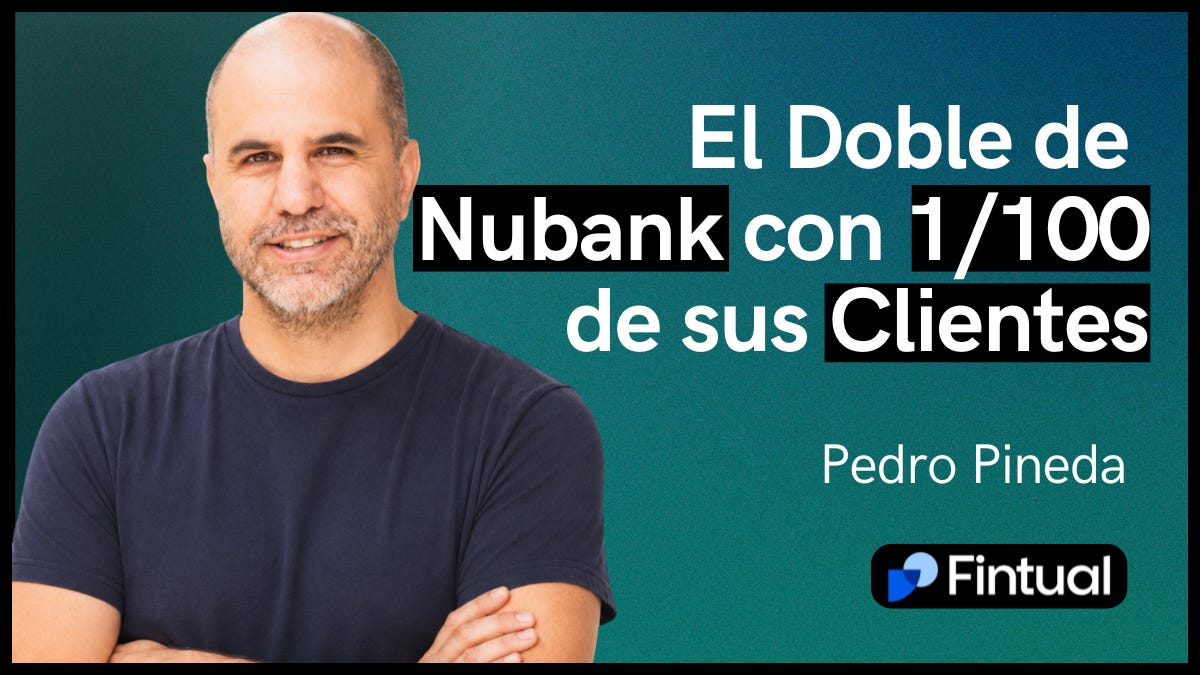
Today I spoke with Pedro Pineda, CEO and cofounder of Fintual, the fintech that manages more than 2 billion dollars in savings for 250,000 people in Chile and Mexico. It was one of the first startups in Latin America backed by Sequoia Capital and by Y Combinator.
The number he himself checks every week because he does not believe it: Nubank has millions of customers and manages 1.1 billion in its own funds. Fintual manages twice that with one hundredth of the customers.
Three years ago he concluded that a bank was not going to beat them, but a new Fintual built with AI could. So he set up a company inside Fintual to disrupt Fintual from the inside.
We talked about how a startup reinvents itself halfway through, about why his lawyers are coding, and about whether Fintual can become the first pension fund built on artificial intelligence.
Structure and Key Highlights
The Kid Who Counted Letters
- His first interview was at five or six, because he was curious, and he claimed that Jesus lived in a North American desert called Bethlehem
- His warning: since he was little, he embellishes a bit in interviews
- He still counts the letters in words to this day
- He met his wife at nine, and she remembered him because he asked her which name had the most letters
Nerd Trips
- He went to Bosnia to see the monuments from Tito’s era, built in honor of the end of the war against the Nazis, and he found them somewhere between ugly and fanciful
- He went to Nukus, Uzbekistan, to the Igor Savitski Museum, where a Russian hid the works of artists who, in Stalin’s era, were not allowed to paint
- Rothko, one of his favorite artists, left for the United States for that same reason
- His wife is more of a nerd than he is: she watches a documentary, keeps researching for another hour, and the next day she has already bought the flights
Board Games as an Evaluation Method
- He is competitive but he does not get angry when he loses, and he follows the rules strictly
- His limit: someone who cheats ceases to exist for him, except in the games that are about cheating
- His coach pointed out that he evaluates people while they play, something he was not aware of
- What he evaluates: integrity, the ability to build a strategy, and enjoying it without suffering when you lose
Two Coaches
- It took him a year to decide whether to hire one, and at some point he had two
- One is Matt Mochary, known for working with Sam Altman and with Brian Chesky of Airbnb
- The value he sees: he has a huge number of confidential data points that he does not reveal, but that guide
- His reflection on that: when so much information is available, what matters is whom you believe, and curation is worth more and more
- The second coach, in Spanish, also sees anyone at the company
- The explicit agreement: he never tells him what he talked about with anyone, and he optimizes for the person’s wellbeing before the company’s, even if the best outcome is that they leave
The Decision to Disrupt Themselves
- Three years ago they concluded that a bank would not beat them, but a new Fintual with AI would
- He leaned on Clayton Christensen’s Innovator’s Dilemma, a book he admits having read only halfway
- He set up a company inside Fintual with the job of disrupting it from the inside
- A side effect he did not expect: it let him hire talent from Google who had not been interested before, and that person is the CTO today
- His measure of how much it mattered: a CEO makes ten relevant decisions a year at most, and this was one of them
- The parallel he acknowledges: it is the same thing banks do with their innovation labs, with nice colors and no ties, operating as far as possible from the general manager
- He admits it sounds ridiculous at a startup of 100 people, but it worked
- The cushion: if it does not work, you did R&D
Few by Design
- They follow Paul Graham’s advice that being few people is a good thing
- His ideal cap: 150 people, very good and very well paid
- His reason: with few people it is easier to align and to decide
- Strategy defines the organization, and his example is mass-market beer versus craft: two different companies, two different org charts
- What is changing: fewer layers of management and fewer middle managers
Getting His Hands Dirty
- He is trying to build a brain for the company from a repository on GitHub, pulling information out of Notion and out of Slack
- He runs two approaches in parallel, his and the head of tech’s, so he can compare them
- Why he does it himself: if he is going to ask the team for something, he has to understand it first
- He calls it the Pedro test, his version of the mom test: if he can do it, anyone can
- The real goal: take the fear away from the legal team or the finance team, who are terrified of his next idea
- On documentation: they write everything down, and he is surprised how much the AI knows about his company because of that
- The experiment that worked for him: ask the AI what the company’s values are and which five people it would reward. It got all five right
How He Leads When the Frontier Is Moving
- His view: leadership does not depend on the technical side
- What people want from their CEO is two things: to feel that they matter to him, and that he will take them to success
- He copied from Jensen Huang the elimination of regular one-on-ones, while keeping himself permanently accessible
- They have a weekly meeting with everyone where he gives feedback in front of the rest, without creating information silos
Conviction, the Real Gap with Silicon Valley
- The tactical example: he asked another founder whether they used fast mode on Claude or Codex, which costs more but does not make you wait
- The answer: they use it, spending 25,000 dollars a month per engineer, and it pays for itself
- His reading: the intuition was right. What he lacked was the conviction to act
- His general diagnosis: in San Francisco they believe themselves capable of many more things than we believe ourselves capable of in the region
- What he maintains is not missing: talent. His school classmates in Puerto Montt are smarter than people he has met in San Francisco with hundreds of millions
- What is missing: daring, and a narrative that lets you believe it
- His favorite example of mindset: Arturo Vidal saying Chile should be world champion, so out of place that it generates rejection
- The line he quotes from the comedian Fabrizio Copano: Chile is a state of mind
- The other variable he acknowledges: the depth of the capital markets. A seed round of 20 million allows spending that in the region would wipe you out
What Surprises Him About Jensen Huang and Sam Altman
- They are very precise when they speak, they do not have words to spare, and you can tell the reflection behind it
- They have a lot of vision of the future, and they compete to impose a narrative of how the world will be, because they are working to make it that way
- What catches his attention most: they do not care what they already achieved, they care what they can achieve
- They live it as something personal, to the point of talking to governments to get it done
The Lawyers Coding
- One of his lawyers, with no prior experience coding, built an analysis of all the case law for one type of legislation, including the cases that exist only on paper, using OCR
- A team stopped using an expensive customer-support SaaS because they built their own, and that week they were the most loved team in the company
- The investments team published a paper generating synthetic data to improve portfolio optimization, with up to 1% more annual return in some cases
- On that 1%: it sounds small, but it is money
What He Looks for When Hiring
- Only two values: hunger and humility
- On opinions: there are dumb opinions and they have to be destroyed. People are respected, ideas are not
- And changing your mind fast when someone shows you that you are wrong
- Psychological safety as a component of productivity: in the weekly meeting someone can tell the CEO, in front of a hundred people, that he is wrong
- It jars new people in the first weeks
- They do not work with jerks, although he admits he admires companies that do have them and manage them a different way
- The metaphor an investor told him at the Sequoia meeting: it is easier to tame a wild horse than to move a donkey
- His nuance: dissent is tolerated if it comes kindly and with some proof, not by interrupting or silencing others
What to Build and What to Buy
- His rule: the closer it is to the customer, the more he wants to do it himself
- The extreme case: the banks in Chile said they had APIs and they did not, and a transfer took from 20 seconds to 2 minutes to be detected
- They got a regulatory license to connect directly to the transfer system, two years of work, in order to eliminate those seconds
- What another CEO told him, and he does not know if it was praise or criticism: you program everything
- For the rest of the software he happily pays so that someone else runs in circles when it goes down
Differentiating a Fintech in the AI Era
- His explanation of why they are simpler: taste developed by listening to people, plus the absence of a legacy programmed 40 years ago
- His advice to the banks, although he hopes no general manager hears it: build the bank again from scratch with AI, and fill it back in with what they already have
- The joke included: the Cobol and Fortran engineers can retire now
- What he doubts the banks have: the taste, and the interest in developing it, because they make too much money to obsess over 20 seconds
- The opportunity he sees AI enabling: segment of one, treating each person differently instead of grouping by age and gender
- The human limit he identifies: people need someone to blame if something goes wrong, and that leaves room for people in investing and in medicine
The Plan to Become an AFP
- The analogy: Nubank is to the banks what Fintual wants to be to the AFPs
- Why they manage twice what Nubank does with far fewer customers: a bank’s business is to lend, not to manage money
- In Latin America a lot of people still believe you have to save at the bank
- They have been studying it seriously for months, and the challenge is enormous because of the volume under management and because of the regulatory obligation to invest in the local market
- His concrete worry: that the 4.9 stars they have today on the App Store fall to 1.2
- The AFP system was created in Chile in 1981, and about 27 countries have adopted it
Who He Thanks
- Half joking, Arturo Vidal, and he prefers not to meet him because you should not meet your idols
- The argument: with that generation Chile won two Copa Américas, something it had never done
- The parallel that matters to him: when there was a woman as president, many girls said they could do it too
- His family, for some genes of overflowing imagination that he attributes to his grandfather and to his father
- On his three cofounders: they are brilliant, and he is probably the one with the most nerve
Silicon Valley Glossary
| Term | Meaning | Context in the episode |
|---|---|---|
| Innovator’s dilemma | When the business that made you big keeps you from adopting what is new | The book that led him to create a company inside Fintual |
| AUM | Assets under management | Fintual’s 2.2 billion against the 1.1 billion in Nubank’s funds |
| AFP | A pension fund administrator, an Afore in Mexico | The market they are studying entering |
| Voluntary savings | Investment a person chooses to make, as opposed to the mandatory deduction | Fintual’s current business |
| Vertical integration | Building yourself what used to sit with suppliers | His criterion: the closer to the customer, the more they do it themselves |
| Segment of one | Treating each customer differently instead of grouping them | What he says AI enables for the first time |
| Mom test | Validating an idea without fishing for the answer you want to hear | The origin of what he calls the Pedro test |
| Psychological safety | Being able to show yourself as vulnerable and to disagree at no cost | What lets someone tell him he is wrong in front of a hundred people |
| Synthetic data | Data generated in order to train when the real data is not enough | How they improved their portfolio optimization models |
| NPS | A measure of how much customers recommend you | The reference to Nubank, one of the highest in the world |
| Fast mode | A more expensive option that cuts the model’s latency | The example he uses to illustrate the gap in conviction |
People, Companies and References
People Mentioned
- Pedro Pineda: CEO and cofounder of Fintual
- His three cofounders: whom he describes as more brilliant than he is
- His wife: whom he met at age nine and describes as the one who keeps him grounded
- Tadashi: a friend from school and from university, with whom he also started a company
- Matt Mochary: his executive coach, known for working with Sam Altman and Brian Chesky
- Clayton Christensen: author of The Innovator’s Dilemma
- Jensen Huang: the person he copied in dropping regular one-on-ones
- Sam Altman: whom he met at the Sequoia gathering
- Paul Graham: for the advice to be few people
- Brian Chesky: for the idea of the eleven-star experience
- David Vélez: founder of Nubank
- Arturo Vidal: the soccer player he uses as an example of mindset
- Fabrizio Copano: for the line that Chile is a state of mind
- Mark Rothko: his favorite artist, present in the story of the Nukus museum
- José Piñera: creator of the AFP system in Chile in 1981
- Enzo Cavalie: host of the podcast
Companies and Organizations
- Fintual: 2.2 billion under management, 250,000 customers in Chile and Mexico
- Sequoia Capital: led its Series A and Series B
- Y Combinator: its other early investor
- Nubank: the comparison, and the model to replicate in another category
- Igor Savitski Museum: in Nukus, Uzbekistan
- Notion: where they document everything, and a sponsor of the episode
- Dio: sponsor of the episode