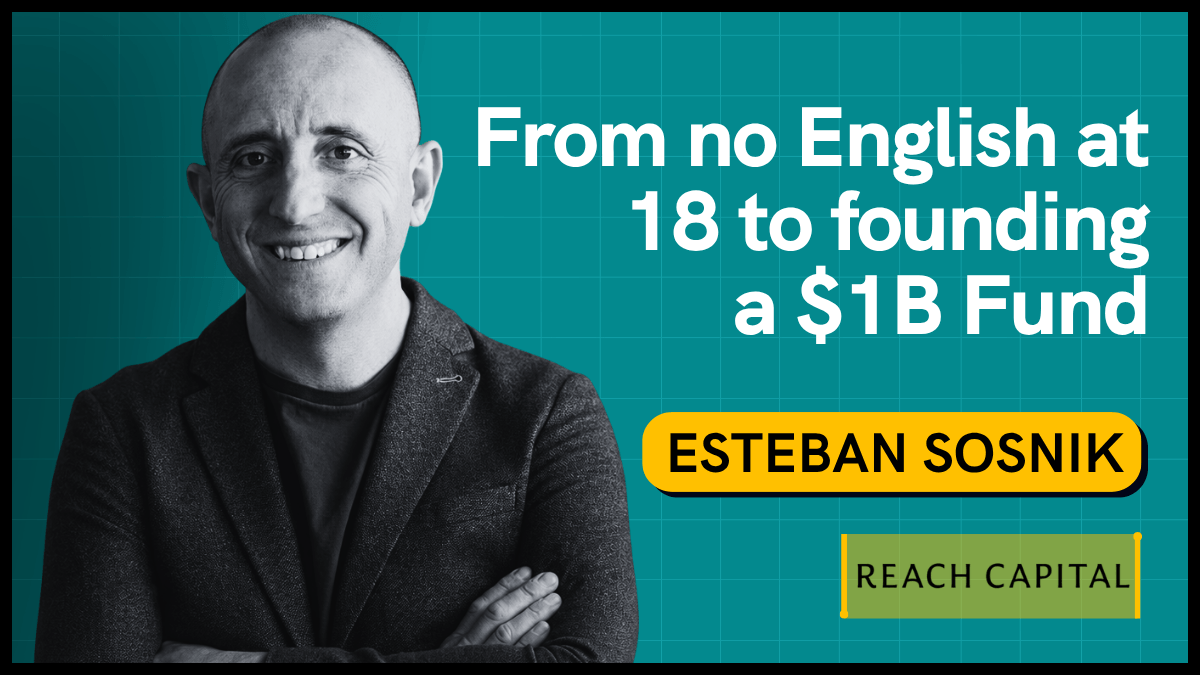
Today I interviewed Esteban Sosnik, co-founder and partner at Reach Capital, a seed fund with over a billion dollars under management that has backed Replit, Handshake, Nearpod and Stepful. He was also my boss for five years.
Esteban left Argentina at 18 barely speaking English, spent his first year of college sleeping in the library, and went on to build and sell two gaming companies, one of them to Activision.
Before that he ran Penguin Holdings, arguably the first venture fund in Latin America, founded by a group that included Wences Casares, Micky Malka and Verónica Serra. That fund made 25 investments. One of them was Mercado Libre at pre-seed.
We talked about what he learned watching that portfolio, why he thinks founders selling into the US have to move themselves rather than hire a head of sales, and why Reach is now betting on agents doing the work humans do not want.
Structure and Key Highlights
Where the Ambition Came from
- Neither parent was an employee: his mother worked her whole career in education, his father had his own psychiatric practice and taught
- His parents spent money on travel instead of cars or apartments, which he credits for his curiosity about other cultures
- He grew up in an Argentina transitioning from dictatorship to democracy, with social justice as a daily conversation
- In a high school vocational class he drew a person placing a brick into an earth made of bricks
- His first career choice was politics and diplomacy, since nobody around him was an engineer or a businessperson
- What changed it: realizing you can have more impact in the private sector. The Jewish saying he cites is that if you change one life you change the world
Leaving at 18
- Nobody pushed him and nobody around him was doing it
- Three reasons: he did not know what to study and Argentina forces you to choose in high school, he wanted a US degree to stand out back home, and a sense of adventure
- The mental trick that let him decide: if he did not like it halfway through, he would come back and start over
- He always expected to return. It never happened
The First Year
- He had studied English in elementary school, not high school, so he was rusty
- He picked political science and philosophy, which he calls the wrong major to start with
- He was learning the language, what a syllabus was, how to take a test, and how to write an essay, which nobody taught him in Argentina
- He remembers falling asleep in the library with a fever and waking up to keep studying
- What he was really learning was the operating system of American culture
- Four years later he graduated with honors and a better job than the classmates who had seemed so sure of themselves
- His read on it: being such an outsider gave him the drive
Penguin Holdings, the First VC Firm in the Region
- Six successful founders who were already angel investing individually, most of them tied to the Endeavor ecosystem
- The name: Penguin for the southern tip of the world, Circle for the community of founders helping each other
- They hired him to run it after a former JP Morgan colleague tracked him down, in an era before cell phones and social networks
- It was a pre-seed fund with 25 investments, and it is a power law business: essentially one worked
Investing in Mercado Libre
- Wences met Marcos through Endeavor and helped him raise his seed round with Chase and Flatiron, the firm that became Union Square Ventures
- Every competitor was buying street banners and TV advertising, trying to popularize the idea of commerce on the internet, from high-rise offices
- Mercado Libre was a group of rebels in a windowless basement, working around the clock with cables everywhere
- They loved that culture, and it was contrarian: everyone knew the competitors and few knew Mercado Libre
- The lesson he took: team talent and culture matter from the earliest years
What He Learned from Wences Casares and Micky Malka
- Both are friends and mentors, and both are deliberately low profile
- Their shared mantra: be known for the quality of your work, not for self-promotion
- On Wences: in a board meeting in 2000, he asked what would happen if the phone disappeared for a day, and said the same would be true of the internet in 10 or 20 years. Everyone’s jaw dropped, because the internet was still a toy
- On Micky: a contrarian who went into fintech before the word existed, and into Bitcoin before funds were even allowed to hold crypto
Wanako: Building a Video Game Industry from Scratch
- No video game studios existed in Latin America, which was the entire point of the company
- Neither founder had industry experience. His partner Mauricio was a lawyer, he was an economist
- The industry told them to hire an experienced American or European executive. They were allergic to the idea and chose to build their own culture
- They started remote and changed their minds, because game development is too interdisciplinary. They set up in Santiago
- Someone visiting the office said they had the highest IQ per square meter in Chile
- The brutal meeting: he flew from Miami, his partner from Santiago, a train and a taxi to a New Jersey suburb, and as coffee was served the executive told an assistant he would be there in five minutes
- Their pitch problem, as he describes it: pitching a record when you have not written the songs, never played an instrument and never produced anything
- The unlock: a racing game for Ford Mexico, built in two or three months on WildTangent, that they then showed to Walt Disney. Disney could not believe what they had built with poor technology
- They sold Wanako to Activision
The 2008 Reset
- His first son was born in July 2008. In September the financial crisis wiped out the cash from the exit, which he had invested in the market
- On selling a company: it feels like giving up your baby, and founders are mostly unemployable afterwards
- Why he sold: the console model had too many stakeholders, so the developer got cents on the dollar
- Social games on Facebook offered a business model where he could go direct to consumer and grow revenue without growing headcount
- The reasoning that moved him from LA to Silicon Valley: if he won in LA he would have won bigger in the Bay, and if he lost he would always regret not having tried
Nearpod and Selling into the US from Outside
- Three Argentinian founders, technical team in Buenos Aires, sales team in Florida, one founder in Brazil
- The name comes from setting up iPods in classrooms
- Dozens of investors said no and they kept going. One founder is a 14-time Ironman
- The exit was over $600M
- His rule: the founder has to do the US go-to-market personally. Hiring an experienced head of sales to handle it is the worst idea
- The founder is the one who has to figure out motion and pricing, and relay what they hear back to a team in another time zone
- At Innovamat it was more than the founder: five or six early engineers and the CRO moved
Fundraising in the US Versus Emerging Markets
- Storytelling is huge, and investors are asking whether you are a missionary or a mercenary
- He encourages founders to talk about struggles, failures and fears, which is the opposite of the instinct in emerging markets to hide what went wrong
- Name dropping does not work. McKinsey and JP Morgan on a resume are edging toward red flags
- There is an over-index on academic credentials. If you have a PhD, put it front and center
- Startup credentials count when they are relevant: being an early employee at an iconic company, not employee 20,000 at Google
- Keep your identity. Nobody expects you to pretend to be American or to like American football
What Rhymes and What Is Different About AI
- What rhymes: we overestimate short-term change and underestimate long-term change
- Also rhyming: capital flooding in, crazy valuations, tourist founders
- What is different: internet and mobile were enablers, and this feels genuinely disruptive because of cognitive ability
- The counterpoint he acknowledges: Replit went from roughly $1-2M in revenue in 2023 to a different order of magnitude
- His reconciliation: technology adoption is faster in general because the world has better infrastructure and a larger middle class
- The dissonance he names: the numbers move faster than our actual habits do
The Replit Lesson
- Reach invested at pre-seed in 2016, when Amjad’s vision was a platform for the next billion developers
- They thought a billion people writing software was crazy. Ten years later it is happening
- The original path was through schools, betting on learn to code as a tailwind
- By 2023 revenue was small but users, engagement and product sophistication kept climbing
- When LLMs arrived, the deployment and security infrastructure was already built
- What made it work was a deeply technical culture that could keep shipping as models improved
Investing Thesis Today
- Fifth fund, $265M
- Reach started education-exclusive in 2015, always oriented toward employability and economic progress
- The new thesis they call work AI or agentic workforce: agents doing labor that is scarce, dangerous or too repetitive
- On technical founders: it used to be acceptable to pair a great business founder with a good technical one. Now the technical co-founder has to be off the charts
- On competition: the wrong move is rebuilding HubSpot with prompt engineering. Now is a white canvas in product, business model and go-to-market
- Vertical focus matters, because proving you are 10x better than a general model requires a specific use case and a data moat
- His prediction for the next 12 months: a bloodbath of cancelled contracts as customers consolidate from ten platforms to one or two
Should You Move to Silicon Valley
- If your customers will be in the US, move, no questions asked, and bring your core team
- If you are building for another region, you do not need to move, but come every two or three months
- His complaint about visitors: they meet a couple of entrepreneurs, do a happy hour and go back to the airport
- What he recommends instead: get an Airbnb, stay two or three weeks, work out of another startup’s office, make friends
Silicon Valley Glossary
| Term | Meaning | Context in the episode |
|---|---|---|
| Power law | A few investments generate nearly all returns in a portfolio | How he describes Penguin: 25 investments and essentially one that mattered |
| Pre-seed | The earliest financing stage, before seed | The stage at which Penguin backed Mercado Libre |
| Missionaries vs mercenaries | Founders driven by mission versus by opportunity | The main thing US investors are trying to read in a first meeting |
| Go-to-market motion | How a company actually reaches and sells to customers | What he insists the founder has to figure out personally in the US |
| Agentic workforce | Agents performing labor rather than assisting with it | Reach’s current thesis, also called work AI |
| Data moat | A defensible advantage built on proprietary data | What he says you need to prove you beat a general model |
| Vertical focus | Concentrating on one industry instead of a generic platform | His answer to competing with foundational models |
| White canvas | Treating product, business model and go-to-market as open questions | How he describes what the best founders are doing right now |
| Churn | Customers who cancel | What he expects over the next 12 months as AI pilots get consolidated |
| Seed fund | Fund investing at the earliest institutional stage | Reach, with over $1B under management across five funds |
People, Companies and References
People Mentioned
- Esteban Sosnik: co-founder and partner at Reach Capital
- Wences Casares: Penguin co-founder, internet and Bitcoin pioneer
- Micky Malka: Penguin co-founder, contrarian investor, on the Midas list
- Verónica Serra: Penguin co-founder
- Marcos Galperin: founder of Mercado Libre
- Fred Wilson: of Flatiron, which became Union Square Ventures
- Amjad Masad: founder of Replit
- Mauricio: his co-founder at Wanako, a lawyer by training
- Guido, Felipe and Emi: the three Argentinian founders of Nearpod
- Maca: his wife
- His parents: both moved countries and reinvented themselves after 50
- Enzo Cavalie: podcast host
Companies and Organizations
- Reach Capital: seed fund, over $1B under management, fifth fund of $265M
- Penguin Holdings: arguably the first venture fund in Latin America
- Mercado Libre: the investment that carried the Penguin portfolio
- Wanako: his first company, video games from Latin America, sold to Activision
- Atacama: his second company, social games, which took him to Silicon Valley
- Nearpod: three Argentinians selling into US schools, exit over $600M
- Replit: pre-seed in 2016, now a leading vibe coding platform
- Handshake, Stepful, Andela, Innovamat: portfolio companies
- Endeavor: the ecosystem that connected the Penguin founders
- Activision: acquired Wanako
- Union Square Ventures: formerly Flatiron, co-investor in Mercado Libre
- WildTangent: the 3D engine they used, a precursor to what Unity became
- Ford Mexico and Walt Disney: the racing game that became their track record