The audio and video are in Spanish. These notes are a translation.
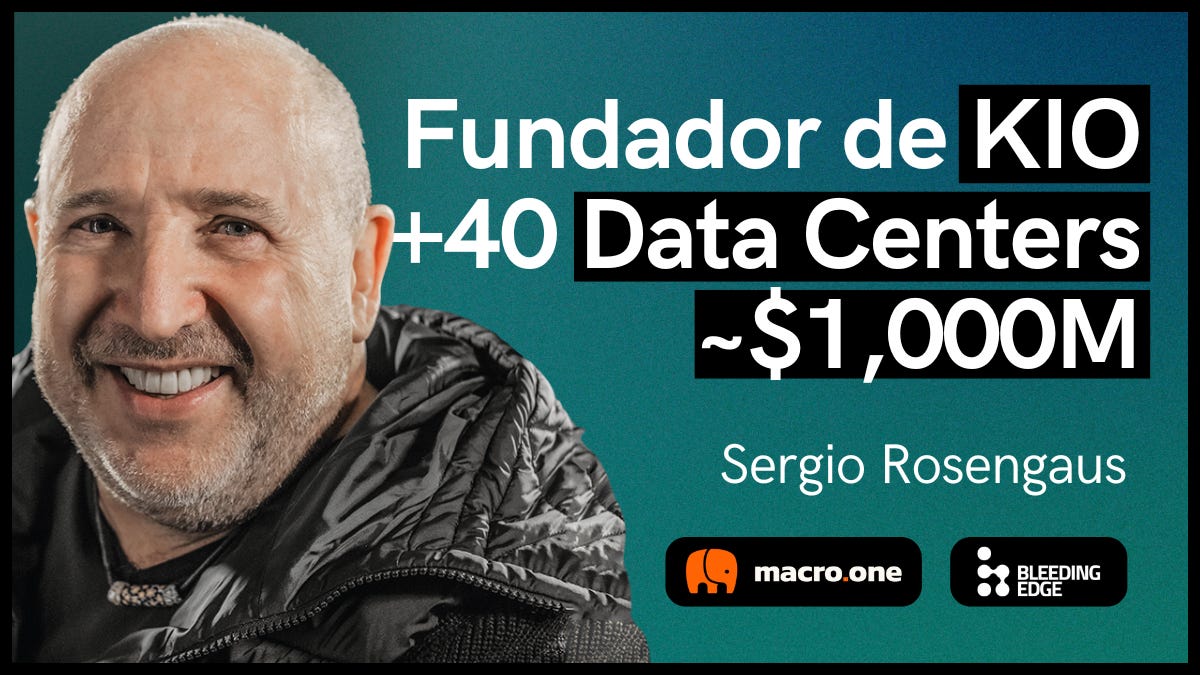
Today I spoke with Sergio Rosengaus, one of the most successful technology founders in Mexico. He founded KIO, one of the largest data center companies in Latin America, which came to be worth more than 1 billion dollars and was the first Mexican unicorn.
He sold it in 2021 and, at 60, decided to start over, betting everything on the next wave: the intelligence factories that AI runs on. For that he founded two companies, Bleeding Edge, which builds them, and Macro One, which invests across their whole supply chain.
His central thesis is that there is no bubble, and his argument is concrete: in the year 2000, dark fiber was left unused, and today there is not a single GPU turned off in the world.
We talked about why an AI data center is not a data center, about why Mexico could become the intelligence factory of the United States, and about which questions the CEOs he talks to are not asking.
Structure and Key Highlights
From the Railroads to Data Centers
- A power user of technology from a young age, he ended up spending fifteen years in construction out of necessity, living on his own from very young
- He studied briefly in the United States and went back to Mexico quickly because he got kicked out of school
- He joined an uncle’s construction company under strict conditions: one hour to get to the university and one hour to get back
- His professional mentor was the founder of that family company, from whom he learned how to attack problems that had not been solved before
- He never let go of the technology side: he automated what could be automated and put email on every desk at a construction company, before the internet
- He built track across Mexico, the United States, Argentina, and Chile
- He rehabilitated the Chihuahua al Pacífico, living in camps you can only reach by train
Humor as a Tool
- His counterparts in the railroad world were twice his age, and he was 20 or 21
- Bawdy wordplay was the language of the trade, and he learned to hold his own after losing many rounds
- His thesis: humor is a great way to build empathy, and you have to empathize with family, with kids, with customers, and with colleagues
- In his office you hear laughter every day, even though the work is high pressure
- His reading: when you have very analytical people in front of you, sometimes the way in is humor
Why He Went Back to the Same Sector, Which Is No Longer the Same
- He sold KIO in 2021 with the most robust infrastructure that had been built in a country where you could not depend on the ecosystem
- The contrast he mentions: there were facilities where the power went out twice a week, against installations in the United States where it has never gone out
- What they saw coming: the infrastructure for AI would be a different class, not a renovation
- His technical argument: if consumption goes from 10 to 12 you renovate, but if it goes from 10 to 150 the design variables are a different order of magnitude
- What the new company put together: infrastructure talent that came with him, plus partners with eight years in machine learning since 2014
- His nuance on the ChatGPT moment: it told the world about AI, not the people who had spent years in it
Data Center Versus Intelligence Factory
- The traditional data center stores, archives, and safeguards, with fixed compute from the day you bought it
- The intelligence factory does not store intelligence, it produces it
- Inside, they are industrial installations, full of chimneys that pull the heat out
- The equation: you put energy in, you run it through GPUs, you put the models in, and the output is tokens
- The analogy he considers better: intelligence is not software, it is consumed like fuel
- The practical consequence: if you used it a lot today, tomorrow the model is still there, but without fuel you do not produce intelligence
- The case most people do not see: a large organization connecting its systems of record to the models can ask one hundred million questions a day and spend hundreds of thousands or millions of dollars a month
Sovereign Compute, Properly Understood
- He clarifies that this is not nationalist sovereignty. It is that the compute sits inside your geography and nobody else controls it
- The equivalent he uses: having a single fuel supplier, with the risk of a shock or of a unilateral price decision
- The recent example that serves him: Fable shut off in twenty minutes after a call from the White House
- His line for explaining it: you cannot ask anyone for permission to think
- Why Fortune 500 companies hold back: they are not going to become totally dependent on something they do not control
- The other reason to control it: cost, because this responds directly to the Jevons paradox
What the CEOs Are Not Asking
- The current top of mind is that AI takes people away, and that is the obvious and rational thing for a CFO
- His correction: cost is the low hanging fruit, and the side you have to look at is growth
- The back office is going to automate itself, but what you want is to sell twice as much, win twice the customers, close in half the time
- His three conditions for it to work: that AI lives on the board, has a budget, and has accountability
- Why this is top down and the cloud was bottom up: programmers pushed the cloud by renting virtual machines, and this cuts across the whole organization
- What confirms the experience of founders who sell to companies: you start with the CIO and the CFO and the CHRO show up
- In his own organization they have an AI operating system that nothing sits outside of: finance, construction, operations, messaging
Why He Says There Is No Bubble
- On the Macro One website there is an elephant walking, because they want to get it out of the room
- The reference trauma is the internet bubble, with two symptoms: companies that were losing money, and infrastructure that went unused, the dark fiber
- His central data point: there is not a single dark GPU in the world, not even the ones that are ten years old
- His technical nuance: not all tokens are equal. There are cheap, mid, expensive, and ultra expensive ones
- How he describes his business: token refineries, with the analogy from fuel oil all the way to jet fuel
- Why the compute crunch does not close: token demand grows at the speed of software, and the infrastructure has to be built physically
- The difference with the year 2000: the hyperscalers are investing from the most profitable companies in history
- The other difference: agentification multiplies unit consumption by orders of magnitude, because each agent calls ten others and a swarm forms
- His napkin math on whether there is money to pay for it: world GDP is around 105 trillion, of which 35 to 40% is payroll, about 40 trillion a year
- His close of the argument: every chip that gets turned on gets consumed, and there is a source to pay for them
The Opportunity for Latin America
- He acknowledges the starting point: the frontier models and the chips are in the United States and in China
- His key distinction: training is on the cost side, inference is on the revenue side
- Training costs money, and nobody cares where it happens. The only way to monetize the model is for someone to ask it something
- His bet: inference will be 90% or more of the world’s compute, and it gets consumed in every geography
- How he thinks it will be distributed: capillary, by region, by state, by city, down to the neighborhood
- What other countries are already doing: France allocating intelligence factories for 15 billion euros, Brazil eliminating the import tax on the equipment
- The data point that gives the region room: in the United States, around 40 out of 100 projects get delayed or blocked by permits, energy, or community opposition
- On the water argument: modern factories do not use water, and watering a golf course consumes much more than a large data center
- Mexico’s specific advantage: proximity to the United States, an industrial sector, talent, and projects right on the border in order to do nearshoring of intelligence
- His historical parallel: joining this value chain is as important as the free trade agreement was thirty years ago for auto parts and aerospace
What Gets Underestimated About the Business
- It is a much more technical business, and more complex to operate, than a traditional data center
- That leaves more room to differentiate for a great operator
- What a leader in the industry said in Cannes, at what he calls the Super Bowl of digital infrastructure: the number one component is people’s ability to execute, above financial risk
- His practical test: if someone brings you a project, ask them to show how many they have put into production
- The filter NVIDIA imposes: without the necessary level of compliance they will not send you the chips even if you have paid for them, because they would rather give them to someone who can turn them on now
- The level of charlatanism he gets: people with a large piece of land near a substation who assume they already have a data center
What He Would Tell the Government
- That they understand this is not one more piece of software, nor an SAP migration
- His argument: changing the software at a company of 50 people is not a problem, at one of 50,000 it is, and this is something else
- His comparison with the cloud: that ended up cornered inside IT departments, and this is horizontal and vertical at the same time
- His race metaphor: in a normal Olympics there are eight lanes and you see who runs faster. Here there are seventy, and you cannot even see the one in twentieth place
- His conclusion: we cannot afford not to take part
Who He Thanks
- His wife, his partner for life, who was with him on the good projects and on the hard ones
- His observation on compounding: he has spent thirty years in the same industry without flipping a coin
- What he remembers about selling data centers in the year 2000: they would ask him how he was going to look after the servers of the third-largest company in the country
- His recommendation to anyone who works with him: be dissatisfied every day, no matter the success already achieved
- What he says about the opportunity today: there is more capital in the world than talent to execute things with it
Silicon Valley Glossary
| Term | Meaning | Context in the episode |
|---|---|---|
| Intelligence factory | An installation that produces tokens instead of storing data | The category he builds, distinct from a data center |
| Inference | The compute of answering, as opposed to the compute of training | Where he sees 90% of the world’s compute and the regional opportunity |
| Training | The compute of creating the model | Pure cost for the lab, and where the depth of capital in the United States is what rules |
| Token | The unit of consumption of intelligence | His analogy with fuel, and the unit that gets billed |
| Sovereign compute | Compute that sits in your geography and under your control | His answer to the risk of depending on a single supplier |
| Systems of record | A company’s primary management systems | What, once connected to the models, drives consumption to hundreds of millions of tokens a day |
| Jevons paradox | Making a resource cheaper increases its total consumption | Why the cost of the token tends toward zero and consumption toward infinity |
| Dark fiber | Fiber installed in the 2000s that went unused | The ghost of the bubble that he uses as the contrast |
| Compute crunch | The gap between demand for compute and installed capacity | Why it does not close even as trillions of dollars come in |
| Agentification | Each user setting off swarms of agents | The orders-of-magnitude multiplier on consumption |
| Nearshoring | Producing close to the destination market | His thesis for the northern border of Mexico |
| NIMBY | Not in my backyard, community opposition to building | One of the brakes on data centers in the United States |
| Token refinery | His way of describing a factory by the type of token it produces | From fuel oil to jet fuel, depending on the chip generation |
People, Companies and References
People Mentioned
- Sergio Rosengaus: founder of KIO, Bleeding Edge, and Macro One
- His wife: whom he credits with the drive behind his whole career
- His uncle: the person who gave him his first job in construction
- The founder of that construction company: his professional mentor, now deceased
- Jensen Huang: the person he credits with the intelligence factory category
- Enzo Cavalie: host of the podcast
Companies and Organizations
- KIO: the data center company he founded, sold in 2021, the first Mexican unicorn
- Bleeding Edge: the company that builds intelligence factories
- Macro One: the one that invests in the supply chain, with an elephant on its site
- NVIDIA: the compliance filter for receiving chips
- Colossus: the installations he mentions among the projects at that scale in the United States
- SoftBank: another player at that scale
- Mistral: the European example of a national open model
- GLM 5.2: the Chinese model he mentions as on fire
Data and References
- ~$1 billion: KIO’s valuation
- $105 trillion: world GDP, with 35 to 40% in payroll
- 40 out of 100: data center projects delayed or blocked in the United States
- 15 billion euros: what France is allocating to intelligence factories
- 2 million tokens a day: what his own office consumes