The audio and video are in Spanish. These notes are a translation.
A live Silicon Salsa episode, recorded minutes before a Spanish-language vibe coding event in San Francisco, with the room filling up with Latinos in the background.
It is also the first episode after I left Reach Capital after five years, the job that brought me to San Francisco.
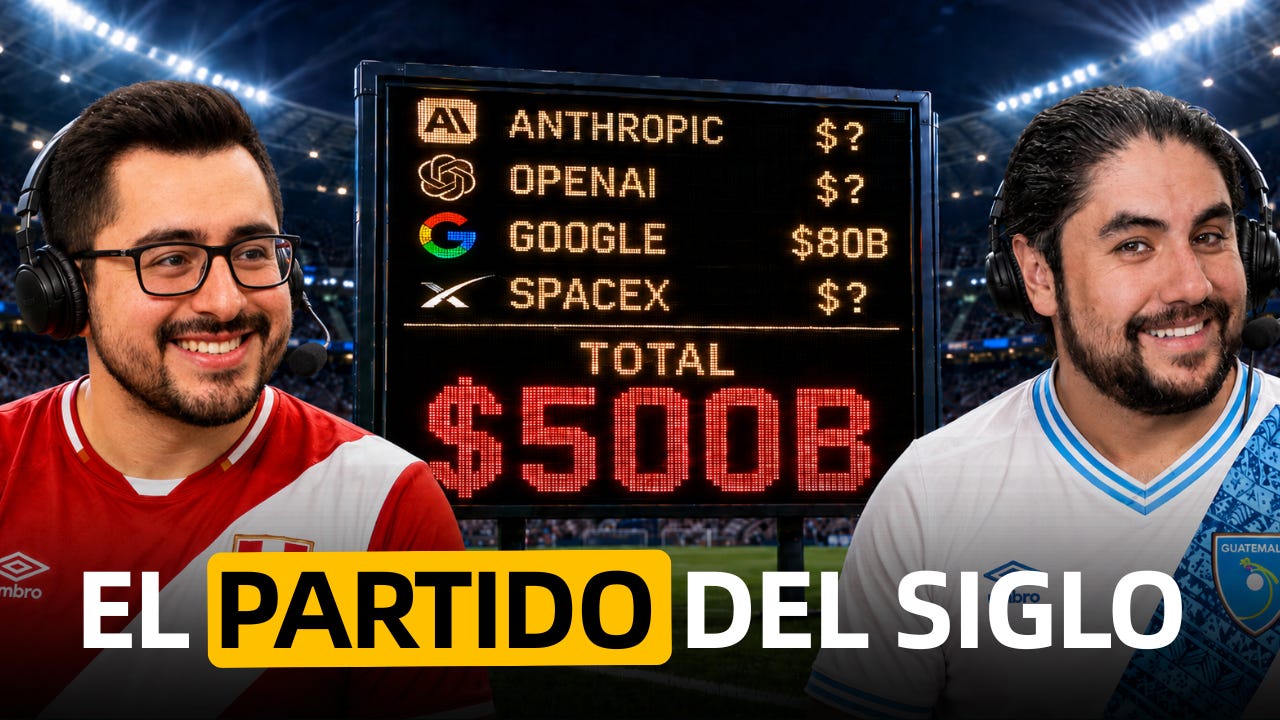
The conversation turns on one number: between Google, Anthropic, OpenAI, and SpaceX they are going to raise between $400 and $500 billion. And on what that means for anyone asking whether it is already too late to come.
We also talk about why today’s tools are turning the founder into a product manager, and why AI is more useful for distribution than for building product.
Structure and Key Highlights
Doing Things in Spanish in San Francisco
- The event that night is about hard technology, but in Spanish, something Cristian says did not exist done well
- His motivation: show that you can stay Latino in San Francisco, without flipping to English because you have to
- The tension Enzo recognizes living at the same time, while he pushes the podcast in English
- The difference from before: when this was his job there was a budget, and now people help for free because they want to
Leaving the Job
- Enzo left Reach Capital after five years, with the possibility of becoming a partner on the table
- It took him years to decide, and the team wrote him letters when he left
- The contrast Cristian points out: at American companies you say goodbye with an email and one day you just stop logging into Slack
- The first reflection of being on his own: he underestimated what a job gives you in direction, the calendar and the meetings that set it for you
The Problem Is No Longer Getting Started
- Cristian’s disagreement: the problem today is that everyone can build things
- Before: an app idea meant a frontend, wireframes, a team of five or six people
- Now: Claude Design, Claude Code, a domain on Cloudflare for $20, $500 in expenses, and a Stripe account, and the business is up over the weekend
- The inverse problem he describes: if you have ten ideas, you build all of them to see what comes out
- Enzo’s confession: ten hours in Claude Code on the ninth idea for automating the podcast, only to realize it did not have that much value
- His conclusion: strategy, which in tech got treated as trivial, matters more when resources are almost infinite
How Much You Spend on Tokens a Month
- The question Cristian uses as a thermometer of how deep you are in the ecosystem
- Enzo reports between $300 and $400 just between Claude Code and Codex, on Max and Pro plans
- Adding video models and assorted credits, between $500 and $1,000 a month
- His important nuance: in Latin America a thousand dollars is a lot of money, and what decides it is whether your company lets you spend it
The IPOs that Are Coming
- The setup: Anthropic, OpenAI, and SpaceX on the way to going public, with Google raising $80 billion for data centers
- The sum they are working with: between $400 and $500 billion across the four
- What had never happened before: there was a Google, there was an Airbnb, but not this many companies in the same category going out at the same time
- If they had to pick one: Anthropic, which is also the hardest one to get
- The concrete risk of secondaries: SPVs on top of SPVs, with Anthropic itself warning that you have to be careful
- Cristian found out he was inside a couple of additional SPVs without knowing it
- His way of sizing it: this changes my life or it is a terrible investment, but it does not bankrupt me
- The local effect: San Francisco rent is going to keep rising, and anyone with rent control should stay
Why Nobody Wants to Leave
- Even people who were left without a job after the layoffs stay, because leaving with so many opportunities open seems absurd
- Even though the market is not hiring as much, which creates a breeding ground of founders out of necessity
- The change in composition: before, most people worked at Meta or Google and the founders were the minority
- The hidden cost of bubbles that Enzo picks up from an investor: people who would make a great first employee end up starting companies, and the talent gets scattered across ideas that did not deserve it
- The problem from the capital side: with a thousand companies per batch at YC, the same funds cannot expand and there is no longer enough for all of them
- The warning about survivorship bias: you see twenty stories in TechCrunch and not the two hundred startups in each batch
- And the fact that sorts expectations: raising or not after demo day is not a great predictor of success
The Last Cycle of the Startup as We Know It
- Cristian’s intuition: the whole structure is changing, how you get customers, who you hire, how you build product
- His expectation: people who already have experience repeat the cycle with AI on top, and the new ones will do things differently
- What you can already see: more solo founders, and teams that answer how you program by showing five thousand agents
- The precedent Enzo cites: WhatsApp with twenty employees
- Where capital is still necessary: enterprise, because the CIO of JP Morgan does not pick up the phone for your agent
Pulsia and the Autonomous Company
- Cristian uses Pulsia, which is slop written backwards, and he calls himself a happy customer
- How he uses it: he gives it the clumsiest idea that still has potential, plus plenty of context, and for $50 a month he finds out whether it was a bad one
- What it does: it develops the plan, sends emails, runs ads, and if you give it Stripe, it starts charging
- His math: he pays it $50 and feels it consumes $100 in tokens
- The downside: the spam is intense, and it gets as far as doing partnerships with other companies’ Pulsias, which feed off each other
- His underlying conclusion: nobody is going to build a business without putting judgment, a plan, and a vision into it
Founders Are Turning into Product Managers
- Cristian’s observation: before they showed up with a dream and now they show up with what they built
- The symptom: every dashboard looks the same, the decks were made with Claude Design, and it does not matter
- His ask: tell me the dream, do not show me the prototype
- The other side Enzo sees: non-technical founders who felt like prisoners of their own company
- What they are doing now: building themselves, over a weekend, what the CTO had estimated for next quarter
- The uncomfortable consequence: some are cutting their engineering team in half after concluding it was holding them back
- The limit both of them recognize: when there is drama you need the responsible adult, because scaling is hard. The app that goes viral and is down for three days
The Bar for Raising Capital
- The investor’s classic question was what happens if Google does it
- The new one, according to Cristian: what happens if founder number 501 coming out of YC copies you
- What they are seeing in the big rounds: ideas about the future, not pure vertical SaaS
- The concrete examples: an insurer for AI agents founded by Spaniards, and Starcloud with servers in space
- His reading of the moment: there is a renaissance of the hard ideas, and if you have some hardware or deep tech this is the moment
- The advice Enzo gave a Mexican founder of agricultural robots: do not raise that idea from Mexico, and do it now because the window can close
On the SaaS Apocalypse
- The case of Alex Torrenegra, canceling SaaS contracts to build his own versions
- Enzo does not buy the extreme version: SaaS is doing fine in his portfolio
- His nuance: Monday and Notion are in complicated positions, but infrastructure layers like Snowflake or Datadog are going to get used more
- His conclusion: the market punished too hard and it is already recovering
The Lessons from the Vending Machine
- Cristian dropped the autonomous vending machine project two months ago
- It went viral without him doing anything to provoke it, because the concept was unique
- The detail of how something goes viral today: it worked when someone else told it in the third person, not when he posted it himself
- The timing factor: it coincided with the Open Claw moment, and without that it might not have caught on
- His main lesson: people are not ready to hand an AI that much power
- What people liked most was not the technical part: it was the visual, the ads, and that it managed its Instagram
- His new project along that line is an agent called María la del Valle
- What he found out about content made with AI: making video is harder than they sell it, and every minute really does consume tokens
The Final Advice
- Think about AI for distribution, not for creating product
- His warning: if you only use it for your product and your presentation, you are ruining it
- His reading of the moment: today it is still allowed for AI to be spammy, and he does not know how long that will last
- The precedent he cites: the friends who spammed when he was starting out, who never got banned, and who built marketing businesses
- And the answer to whether it is already too late: if they can make the effort to live the Renaissance thinking about AI, this is Florence
Silicon Valley Glossary
| Term | Meaning | Context in the episode |
|---|---|---|
| SPV | A vehicle for investing as a group in a private company | How demand to get into Anthropic is being channeled |
| Secondary | Buying shares from employees or existing investors | The way in before the IPO, with its risks |
| Management fee | The fee the fund charges for managing | What you can end up paying even if the investment never closes |
| Rent control | Rent frozen by local regulation | His practical advice given the rise they expect |
| Founder mode | The founder getting into the execution instead of delegating | What AI is reactivating in non-technical founders |
| Survivorship bias | Seeing only the cases that survived | Why the stories in TechCrunch distort the picture |
| Demo day | An accelerator’s final presentation | Where raising or not turns out to be a poor predictor of success |
| Copycat | Copying a product that already exists | A valid strategy that makes the young competition more dangerous |
| Slop | Low-quality AI content produced in bulk | The origin of the name Pulsia, which is slop backwards |
| Distribution | How you reach your users | The use of AI that Cristian considers underused |
| Deep tech | Technology with scientific or hardware risk | Where they see serious capital moving |
People, Companies and References
People Mentioned
- Enzo Cavalie: host of the podcast, just out of Reach Capital
- Cristian: co-host of Silicon Salsa, creator of the autonomous vending machine
- Alex Torrenegra: for his decision to cancel SaaS contracts and build his own versions
- Patrick Collison: mentioned in connection with the bar at the Stripe office
- Peter Thiel: cited tentatively for the argument about the cost of bubbles
Companies and Organizations
- Anthropic, OpenAI, SpaceX, and Google: the four that add up to between $400 and $500 billion
- Reach Capital: the fund Enzo just left
- Y Combinator: with a thousand companies a year and funds that no longer stretch far enough
- Pulsia: the agent that develops and sells ideas for $50 a month
- Starcloud: data centers in space
- Replit: compared with Pulsia on speed
- Cloudflare, Stripe, Claude Design, Claude Code: the weekend stack
- Monday, Notion, Snowflake, Datadog, HubSpot: the SaaS map they discuss
- Freepik and Runway: the bets on video generation they mention