The audio and video are in Spanish. These notes are a translation.
World Cup edition of Silicon Salsa, the format where an investor and a founder go through the latest in artificial intelligence and what it means for your business.
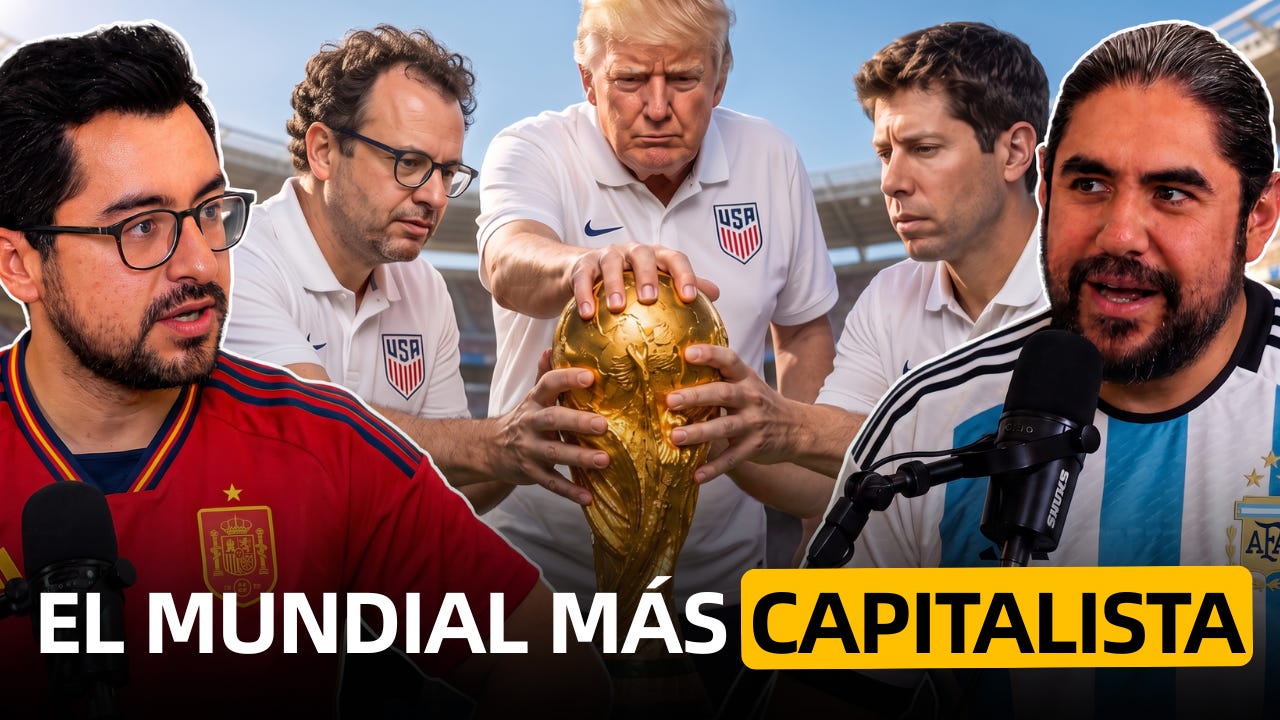
We recorded before the final, without knowing who was going to win. The first half is about the World Cup as a product: an event designed with the logic of American entertainment, sold with precision to the Hispanic market in the United States.
The second half is the usual: why Codex is gaining ground on Claude Code, whether open source can catch the frontier models, and how to split one hundred thousand dollars across the IPOs that are coming.
Structure and Key Highlights
The Most American World Cup of Them All
- The thesis: it is not only that it happened in the United States, it is how it is staged. Cameras, creators, how you get tickets, how they seat you
- The parallel with basketball: when you arrive in the United States, it is surprising to discover that a game is half show and half sport. Soccer felt more like that
- Rosalía playing at Spain’s celebrations, Bizarrap at Argentina’s matches, Penélope Cruz in the stands
- The closing show with BTS, Justin Bieber, Shakira, Madonna, and Coldplay. The absence people noticed: Bad Bunny
- The summary: package the world’s patriotism, sell it in a little box with an expensive label, and hand it back to you
- The political detail: FIFA did not want Spanish spoken at the press conferences, and it did not get its way
The Creators’ World Cup
- Comparison with Qatar 2022, watched from the United States: a thinner crowd of fans, in winter, still with a COVID hangover
- Now there is speed and creators everywhere, and soccer went mainstream to the point of annoying the purist fan
- The phenomenon of the FIFAs: people who never talked about soccer now do, and they ask for a documentary
- On the fan bases: Argentina gets the best cheering section, Mexico the best party
- The most Japanese data point possible: Japan sent a team to La Bombonera and to River Plate to learn the chants
- Paraguay singing the same as Argentina, with their own explanation: our culture is Argentine
- Honorable mention for the Airbnb ad, 30 emotional seconds and close to the brand
The Hispanic Market in the United States, Seen Through the Ads
- They watched the World Cup on Fubo TV, whose founders are three immigrants, one of them Cuban, Alberto Horcajo
- Fubo’s origin story: in 2015 they studied traffic to pirate soccer sites and discovered that 50% came from the United States
- A market hidden in plain sight, today a public company with revenue of around 1.5 billion
- The ad that caught their attention: Wells Fargo, a traditional hundred-year-old bank, mixing English and Spanish, with a lead who speaks Spanish with an American accent
- The reading: it is not for the English speaker or for the pure Spanish speaker, it is for someone in the middle
- Verizon advertising with Betty la Fea, and El Señor de los Cielos autoplaying right as the broadcast ends
- Bank of America with a Mexican-American player who did not make the draft, and the ad they had to change
- Nubank sponsoring Inter Miami’s stadium to reach Latinos
- The underlying observation: if a bank like that invests there, it is because it sees a real demographic opportunity
The Asset Almost Nobody Uses
- There are many more Hispanics and Latinos in positions of power than people believe from the outside
- CTOs, CIOs, VPs of engineering, and CEOs of public companies, tech and non-tech
- Cultural affinity works as a go to market lever in the early days, when someone gives you a pilot or a design partnership because they connected with you
- Very few Hispanic founders in the United States take advantage of it
Anthropic Versus Codex
- The personal shift: three months ago usage was 95% Claude Code, today it is half and half or tilted toward Codex
- The hypothesis: it is not that OpenAI has a better product or better models, it is that it has better infrastructure and can serve it better
- The diagnosis on Anthropic: a very good product that did not manage to scale, and the popularity ended up working against it
- The restrictions they put on Fable did not help
- The task split both of them describe: Claude Code for expansive thinking, writing, editing, discussing strategy. Codex for executing and following rules
- On Cursor: it is still useful for someone who wants to get their hands on the code, something you cannot do the same way in Codex
- The praise for the Codex CLI: the first product that works the same from the computer and from the phone
- Both report files deleted without warning by the agents
Chinese Models and the Harness
- They tried Hermes with GLM 5.2, from the Chinese lab Z.ai, which was said to match Opus 4.8 at 5 or 10% of the cost
- The verdict: Hermes did not convince as a harness, and the idea of having a machine running beside you convinces less than working in the cloud
- The other setup described: agents on a Mac Mini with access to Codex and Claude, using Fable to plan
- The conclusion on the category: we thought a new one was opening, and in the end they are all interchangeable
Open Source Versus Frontier Models
- The pattern they observe: frontier models are the tip of the spear, then others imitate them and surpass them for a while, and then something new comes out
- It has been three years like this, and until the pattern breaks you cannot claim that open source dominates
- The other possibility they raise: recursiveness, where the best models are used to improve themselves and the gap widens
- Why Red Hat, the Linux Foundation, or GitLab do not build an open frontier model: people underestimate how much money it takes, and there are not enough researchers
- The pattern observed in the Chinese labs: open until they reach the frontier, and then more closed
- On Europe: if it were easy, Mistral would already have done it
- On video models: the Chinese dominate on price, because the American ones are extremely expensive
Splitting One Hundred Thousand Dollars Across the IPOs
- The scenario: Anthropic is rumored for October, OpenAI probably the following year, plus SpaceX and the Chinese labs
- One answer: 50% to Anthropic despite not buying Dario’s narrative, and the rest split among OpenAI, SpaceX, and a chip company
- The argument for Anthropic: an absurd ability to attract technical talent, what Google was ten years ago
- The other answer: equal parts, because once they are already announced the edge is gone
- The search-engine analogy: betting on the whole category would have worked better than picking right between Yahoo and Google
- The underlying doubt: Google went public much younger, and today the question is whether a 20x or 30x is still left ahead
- On chips: it is hard to think that in ten years all the market cap will sit in NVIDIA
- The context data point: Stripe is still not public and wants to buy PayPal, which in its day was the equivalent of its Series B
The Critique of the Silicon Valley Narrative
- The viral video of Alex Karp, CEO of Palantir, accusing the models of wanting to keep your data
- The phenomenon they describe: inside San Francisco these companies are loved, outside they are not
- The survey they cite, with debatable methodology: ICE has better acceptance than AI in the United States
- Four out of ten data centers are delayed or canceled, and New York has already legislated against them
- Texas is going the opposite direction and just launched its stock exchange, based in Dallas
- The self-critique: in San Francisco they blame the people outside for not getting on the wave, instead of asking what is being communicated badly
- Their reading of Sam Altman and Dario Amodei: generational founders whose narrative does not inspire, because it sounds doomer
- The collateral damage: the San Francisco founders who buy that narrative and then go sell to a business owner in Texas or Wyoming, for whom the technology does not matter
- The alternative they propose: ask what problem you have, instead of telling people to use AI just because
- The missed opportunity of the World Cup: Google sponsored it, but Gemini does not show up on the field
The Real Cost of Using AI Seriously
- The monthly spend they report: between 500 and 1,000 dollars across Codex, Claude Code, some API, and Chinese models
- The open question: in two or three years, will half of that go to Chinese models?
- The possibility they do not rule out: that Anthropic hosts open source models and orchestrates them with Fable
- There is a price war, with Zuckerberg and Satya Nadella announcing prices per million tokens
- Their conclusion: great for the user, but using AI seriously still costs around a thousand dollars a month
Silicon Valley Glossary
| Term | Meaning | Context in the episode |
|---|---|---|
| Harness | The layer that wraps the model and defines how it gets used | Hermes, Open Claw, Codex, and Claude Code, which they conclude are interchangeable |
| Frontier models | The most advanced closed models from each lab | The center of the argument against open source |
| Distillation | Training a small model by imitating the outputs of a large one | How they describe Chinese labs reaching the frontier |
| Self-recursiveness | Using the best models to improve themselves | The scenario where the gap widens instead of closing |
| SPV | A vehicle for investing as a group in a private company | How demand to get into Anthropic was channeled |
| Secondary | Buying shares from employees or existing investors | The other way in before the IPO |
| Pop to draw | The typical move of a stock after it goes public | What they explain about the SpaceX drop |
| Time to creation | How long it takes to produce and publish a piece of content | What collapsed to zero during the World Cup |
| Long tail | The sum of small niches that beat the main market | Why the Champions League, the Argentine league, and MLS will grow at the same time |
| Design partnership | An early agreement where a customer helps define the product | What cultural affinity can unlock |
| Doomer | Someone who expects a catastrophic outcome from the technology | How they describe the public communication of the lab leaders |
People, Companies and References
People Mentioned
- Enzo Cavalie: host of the podcast
- Cristian: co-host of Silicon Salsa
- Alex Karp: CEO of Palantir, for his viral video about the models and the data
- Sam Altman and Dario Amodei: the leaders whose narrative they criticize
- Ana Botín: chair of Santander, selling Openbank as if she were a founder
- Mark Zuckerberg: for getting his X account back and for the price war
- Satya Nadella: for the announcement of prices per million tokens
- Alberto Horcajo: Cuban cofounder of Fubo
- Trevor Noah: for his World Cup watch parties
- Messi: the constant reference of the episode
Companies and Organizations
- Anthropic and OpenAI: the axis of the comparison between Claude Code and Codex
- Z.ai: the Chinese lab behind GLM 5.2
- Hermes and Open Claw: the harnesses they tried
- Cursor: the tool that survives for someone who wants to touch the code
- DeepSeek: another Chinese IPO on the way
- Fubo TV: sports streaming founded by three immigrants
- Wells Fargo, Verizon, Bank of America, Nubank, Airbnb, McDonald’s: the World Cup advertisers they analyze
- Texas Stock Exchange: the new exchange based in Dallas
- SpaceX, Stripe, PayPal, NVIDIA, Cerebras: the rest of the investment board
- Mistral: the European counterexample
- Notion and Dio: sponsors of the episode