The audio and video are in Spanish. These notes are a translation.
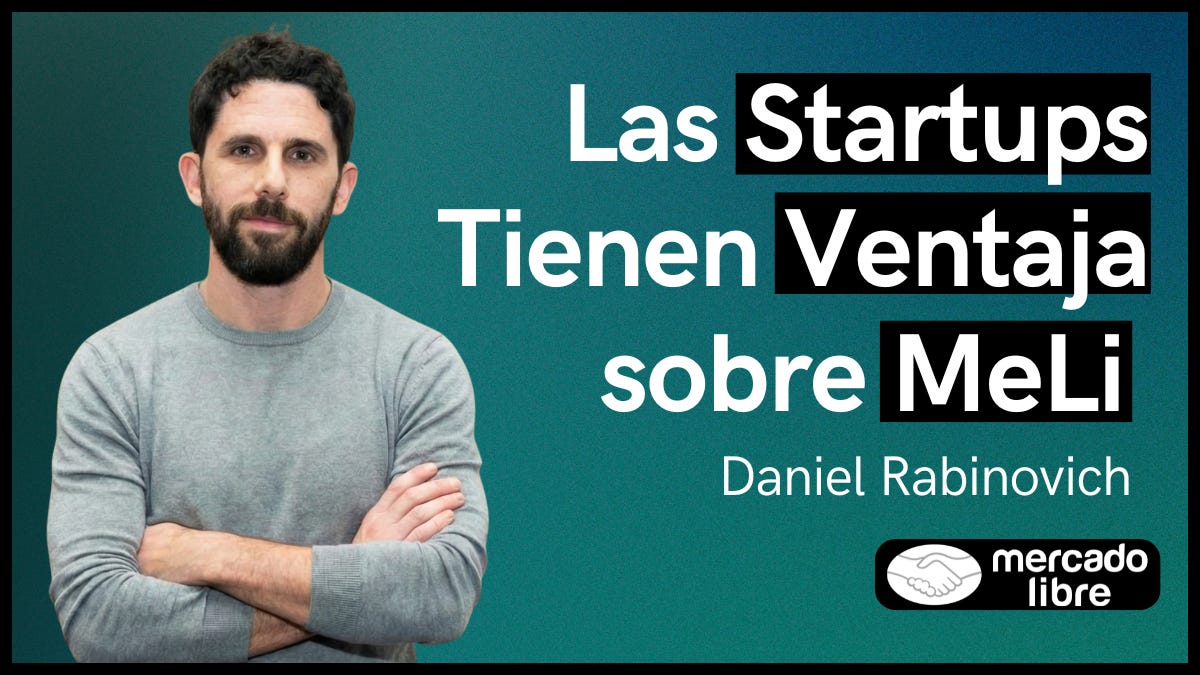
Today I interviewed Dani Rabinovich, who has spent 25 years at Mercado Libre, the most valuable technology company in Latin America, with a market capitalization of more than 100 billion dollars. He joined as a programmer in the year 2000 and never left.
In 2009 it fell to him to stop and rewrite the entire platform from scratch, a project they called Ground Zero. Today he faces something similar with artificial intelligence, with two differences: they were 400 people and now they are 20,000, and this time there is nobody to copy.
His most provocative thesis is that Mercado Libre is at a disadvantage against a startup that starts today. And that has him more excited than ever.
He is also a magician, a photographer, a musician, and a chess player. We talk about that, about working 25 years with Marcos Galperin, and about why AI is the most democratic technology in history.
Structure and Key Highlights
Wanting to Be Leonardo
- If he could choose who to be in history, he would choose Leonardo da Vinci
- His argument against specializing in a single thing: it seems fine to him for some people, but it is more fun to do everything, and those things end up touching and strengthening each other
- His reasoning is explicitly rational: what gives us humans the most pleasure is progressing, and learning curves move extremely fast at the beginning
- That is why he tries to always be the one who knows the least. When he plays bandoneón with a professional friend he is the worst by miles, and that feeling of progress is an inexhaustible source of pleasure
- A detail that matters to him: most of those things do not cost money. A deck of cards or a chessboard are cheap
- What it takes to get past the unpleasant part at the beginning: an obsessive trait. Wanting things to turn out well
- The distinction he learned from a magician: some things are learned in an extensive way, fifteen minutes a day, and others demand six straight hours or they never come out
- His defense of the useless: the practical usefulness of what one does is completely overrated, and there is pride in gaining skills of any kind
What Magic Left Him for Work
- There is almost no day when he does not use something he learned doing magic
- The most important part: working in restaurants, he had to arrive at a table and in milliseconds understand the atmosphere. Whether he was welcome, whether the couple was fighting, whether someone had a high ego and he had to subordinate himself to that person
- If you did not understand that before you finished saying good evening, they hated you and there was no tip
- A moment comes when that runs on its own, without occupying memory. Pure inference
- The second thing is speaking in public. And that is not trained alone. There has to be a day when 500 people are there
- His explanation of why it matters: when you are nervous, your head spends resources on that and you become more stupid, because less free brain is left
- The other effect: he was a nerd and magic opened a human dimension for him, and an environment with people very different from his own
On Imitating Other Leaders
- He agrees with the goal but not with the means. That was his journey and other people’s is different
- His analogy: the worst thing someone can do is imitate a comedian, because it works for the comedian by being himself
- He learns from others and has a long list of things he stole from them, but each person’s path of leadership is their own
- The question he believes a leader should ask, and that he finds extremely hard: why me. Why would anyone pay attention to you
- The thought experiment he proposes: if we all kept our memories and skills but forgot the formal structure of the company, would the organization that emerges look like the current one?
- What he does recommend: read biographies of people he admires, to understand what they have in common and how they have faced risk
Marcos
- The first thing he highlights is courage. Decisions of personal risk, and of going for it in order to win in the long term
- The second: for him intelligence is one more tool. He never gives things one extra turn, and he speaks in an incredibly simple, clear, and direct way
- His contrast with himself: he likes to digress, to insert parentheses and interludes
- On stopping working with him after 25 years: he is going to miss him a lot, especially how sharp he is
- Why a very demanding boss can be loved: demand on its own should not bother you, and if it does the problem is more in you
- What does explain it is the dynamic. His greatest motivation at work is the honor of earning the respect of his colleagues
- His example: four colleagues went to China for twenty days and they preferred to stay and work at the hotel rather than go to dinner on the 140th floor. The hosts could not believe it
- And his clarification: it is not self-denial or sacrifice, he enjoys it
The Hardest Moment Was Not a Crisis
- The technical crises were hard but not the worst
- The hardest were the moments when he felt he could start to get bored, before Amazon arrived, when they were leading comfortably everywhere
- What he saw appearing: superfluous conversations, the thing you see in companies that are doing too well and have gone a long time without a rock landing nearby
- Luckily formidable competitors appeared on all sides and today he is happier than ever
- His analogy: asking Federer whether he would have liked Nadal not to exist. Messi does not exist without Cristiano
The Last 18 Months of AI at Mercado Libre
- They built a first platform before MCPs, tool calling, and agents existed, when there were only completion APIs
- That product started out being very useful for customer service. When the agents came out, over a weekend they wrote a new version and put it into production
- Then they saw it was not going to scale and created a second version
- Today that deflects 90% of customer service requests with a better NPS than before
- The project was called 10K: the promise of never going above 10,000 representatives, no matter how much the business grew
- Two years ago they were on their way to 10,000, and at the growth rate today they should be about 15,000. They have 7,500
- But a few months ago they concluded that this did not transform anything fundamental: it worked for customer service and marginally for users, and the whole beast of applications stayed the same
- His reasoning: if you have the same thing as before and also this new thing, now you have two things where there was one. And the goal is to reduce complexity
One Hundred Thousand Lines of Specification
- They spent several months building a version whose technical specification reached about 100,000 lines of code
- His reaction twenty days ago: how can a technical specification have 100,000 lines. The details are in the house, not in the blueprint. If the blueprint has all the information about the house, something strange is going on
- Anthropic released skills, that gave them an idea, and that idea gave another
- In the last fifteen days he rewrote that entire core by himself again, with 90% less information and far fewer parts
- Why it can be redone now: before, redoing 50 parts that were already built was extremely expensive, so it was almost never done. Now they are not the ones programming
- The chain effect: when an idea appears that eliminates one part, you start asking yourself which other three you can eliminate, and then others
- His go-to quote, which they had printed on the walls for years: perfection is achieved not when there is nothing more to add, but when there is nothing more to take away
- And his observation about the conflict that creates: taking things out looks like a bad vibe inside a team, so everyone adds and the result ends up a Christmas tree
Why It Is Not 2009 Again
- In 2009 the system was small and monolithic and they had stopped innovating. It required dropping a bomb, and that is why the project was called Ground Zero
- Today he does not feel they have to drop a bomb. They have an incredible system, an incredible team, and an incredible product, only built on the premises of the previous industrial revolution
- The practical difference: in 2009 there was someone to copy. Facebook had already specified how to build websites and mobile apps on the same API layer
- Today there is no foothold. The only successful product based on AI that he knows is ChatGPT, a general-purpose chat that does not apply to what they do
- Code agents seem fabulous to him, but they resemble something else: supervised creative processes, slow, that can go diametrically wrong
- They went to China and to Europe looking for references and did not find a ChatGPT applied to something else
- So they are reinventing all of it: how applications work, how you develop a frontend, a backend, a middleware, what has to be specified and what should happen on its own
- His description of the moment: the feeling is like the internet in 99, when web frameworks were awful
- His prediction: Mercado Libre and its competitors are going to look very little like the ones of today, only it has not catalyzed yet. People underestimate how long change takes and underestimate how much it changes
What Worries Him
- That someone believes they are doing very well. His correction: we did very well, in the past tense
- Being the most valuable company on the continent is showing the combat medals, not a certainty about the next 30 matches
- If someone explores this better than they do, that person is going to beat them. And it would be fine if they did
- What he is grateful for about his industry: whoever plays better wins and the consumer decides, something not every industry can say
- The parallel he uses is Nadal: he knows what his weak points are, what the opponent is going to do to hit them, and what he has to do to win. That is his only obsession
AI Native as a Useless Expression
- He does not like the expression. He spends between 50 and 70% of his day interacting directly with these tools, and that is what works for him
- His central distinction: AI is never a method, it is a tool
- The mission is for users to be happy, and everything else is means
- His recurring complaint: the number of times someone tells him that something was done with a given methodology. When you are buying shoes you do not care what temperature the warehouse was
- The underlying problem he sees: the tool seems to excuse you from blame for having lost the match
- His explicit permission: if you want to raise money using the hype, you have the right. Only, the only thing that matters is your objective, what you consider winning
- That is why he is not sad about having thrown a great many hours in the trash. If it was 100 wrong paths and the 101st was the right one, he is happy
- His favorite example: James Dyson made thousands of failed prototypes before the vacuum that worked
What Changes for a Technical Executive
- His strategic work, deciding where to put the resources, did not change and he does not believe it will change
- What did change: he had gone fifteen years without programming, because on a team of 20,000 what two hands can do is irrelevant
- Now what one person can do is much more, and the technical effort to try something evened out
- His reading of what matters today: encyclopedic knowledge of tools and versions is worth less and less, and raw intelligence is worth more and more
- Understanding the problem and connecting it with the solution. And as complexity is reduced, the user ends up closer to everyone
Why Current Systems Get in the Way
- The code is designed for armies of humans. Agents shine in greenfield and get stuck in a brownfield with hundreds of millions of lines
- Worse still, a lot of information lives only in the heads of the people who work there and is not written down anywhere
- His concrete example: if a thousand people draw buttons, the logical thing was to make a central library that everyone calls. Today you can tell an agent to change the thousand places at once
- And there is an extra problem: the models do not know your internal library, because your source code is secret and was not in their training
- Mercado Libre has more than a billion lines of code. It can take a person hours to read a thousand
- The tension that creates: his goal is to reduce complexity and size, and the tool he has at hand writes code in industrial quantities
Design and Interfaces
- What good design is will never change: the best expression of the tools needed so that whoever uses it is as happy as possible
- His reading of chat: it was a fortunate accident. Something appeared that resembles something intelligent, and it just so happened that it exploded with natural language
- What a chat is fantastic for: finding the task you want to do among a huge number of tasks. There is nothing better
- What it is terrible for: visually navigating a lot of data, or buying clothes
- His critique of the reflex to copy: it always happens. With the internet, with the apps, and now everyone puts in a chat
- His reminder about current interfaces: radio buttons are called that because of the buttons on old radios. Everything is built on the technology that kept appearing
- What does lead him to act: asking himself how interfaces have to change now, so that their users are happier
- His honesty about the current state: he would not trade his two applications for a chat, however intelligent it was. But it is obvious that his interfaces still do not know what ChatGPT knows when it researches before a purchase
- And his observation about the ecosystem: the companies that make the UI components we all use are also in crisis, reinventing themselves
The Most Democratic Technology in History
- All the big technological changes were used first by the military, by governments, and by megacorporations, and by miles, at the end, ordinary people
- This is the first time the opposite happens. Apple, Google, and governments do not have the slightest idea how to use AI to win a match, and the man working out there uses ChatGPT every day
- His historical reminder: we write dot com because commercial internet was enabled years after the military internet
- That is why his conclusion about Mercado Libre: with hundreds of millions of lines of code they are at a disadvantage against a startup that starts today
- And their millions of sellers have access to the same thing they do, with the advantage of being smaller and more agile
Who He Thanks
- Two lessons, both learned the negative way
- The first from his former boss, who brought him to Mercado Libre and has already passed away. He saw decisions that made him suffer, and they served him to know what he did not want
- The second from the former prime minister of Ireland, whom he met in a program at Stanford, in the conversations that were still going at midnight
- Both point to the same thing: the work on the ego, and understanding what your true professional and personal motivations are
- The distinction he cites: there are people who like to read and people who like having read. Liking to climb mountains is not the same as liking having climbed them in order to tell about it
- And the bias he mentions, from Kahneman: when you reflect on your own happiness, the remembering self activates, not the experiencing self
Silicon Valley Glossary
| Term | Meaning | Context in the episode |
|---|---|---|
| Greenfield and brownfield | Building from scratch, or on top of a system that already exists | Why agents shine in demos and get stuck at Mercado Libre |
| NPS | How much users would recommend the service | It went up while the customer service team was shrinking to half |
| Tool calling | The model being able to invoke external tools | What still did not exist when they built their first platform |
| Skills | Structured instructions that guide a model | What unlocked the simplification of their core |
| Technical specification | The blueprint of what has to be built | Theirs reached 100,000 lines before he decided to start over |
| Ground Zero | The name of the project that rewrote the platform in 2009 | His reference for comparing the current moment |
| Deflect | Resolving a request without it reaching a human | 90% of customer service requests today |
| AI native | A company built around AI | The expression he says does not work for him |
| Reduce complexity | Taking parts away instead of adding them | His stated goal, in tension with tools that write a lot of code |
People, Companies and References
People Mentioned
- Dani Rabinovich: 25 years at Mercado Libre, joined as a programmer in the year 2000
- Marcos Galperin: founder of Mercado Libre, with whom he worked all those years
- Hernán Kazah: cofounder, cited for remembering him as shy and introverted in his early twenties
- His former boss: who brought him to Mercado Libre, and from whom he drew a lesson the negative way
- Daniel Kahneman: for the distinction between the remembering self and the experiencing self
- James Dyson: the thousands of failed prototypes before the one that worked
- Antoine de Saint-Exupéry: the quote about perfection that they had printed on the walls
- Rafael Nadal and Roger Federer: his example of why competition is necessary
- Enzo Cavalie: host of the podcast
Companies and References
- Mercado Libre: more than 100 billion in market capitalization and more than a billion lines of code
- Ground Zero: the 2009 project that rewrote the platform
- The 10K project: the promise of never going above 10,000 customer service representatives
- ChatGPT: the only successful product based on AI that he says he knows
- Anthropic: for the skills that unlocked their simplification
- Amazon: the competitor whose arrival ended the boredom
- Leonardo da Vinci: who he would like to be if he could choose