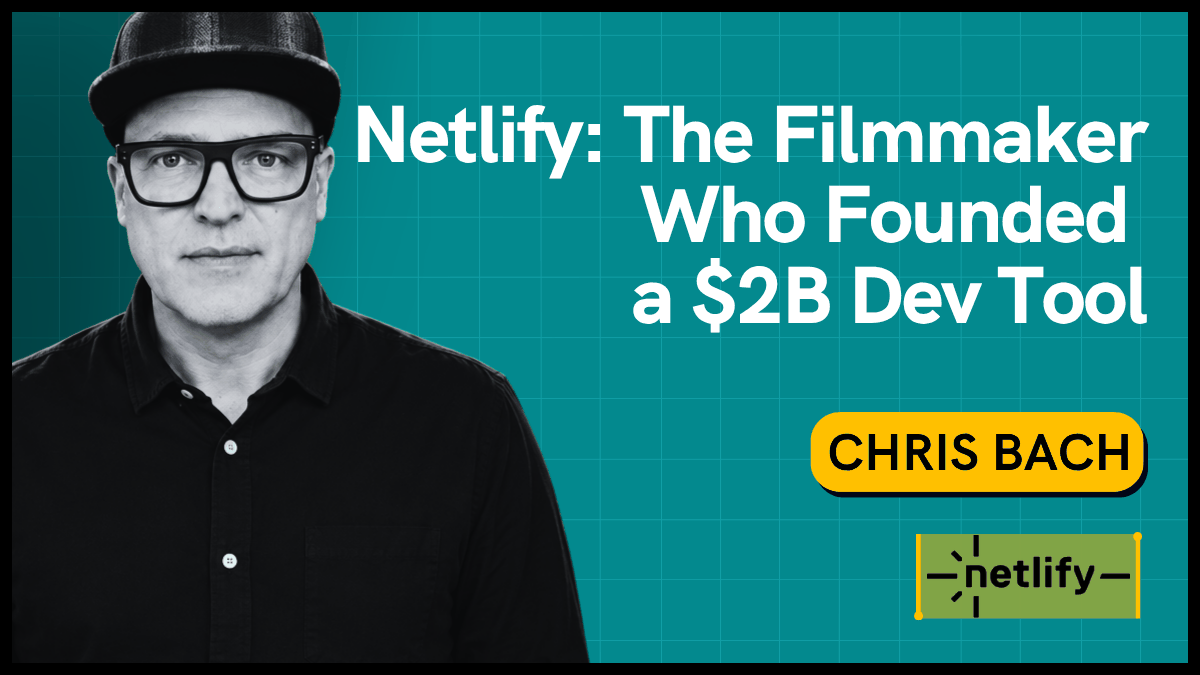
Today I interviewed Chris Bach, cofounder of Netlify, where more than 10 million developers, and now their agents, ship and run web apps. The company was last valued at $2 billion. He studied film in Copenhagen, dropped out to run a Flash studio, and is still not a developer.
He got to Silicon Valley after stage three Hodgkin’s lymphoma, with a wife and a kid, and a cofounder who was not a Stanford mold either. YC said no. The pitch that worked was not hosting. Hosting, he says, could not have raised a dime.
The turn for founders is the chain he keeps using. An insight has to become a product people adopt, then a business, then something that scales. Developers hate being marketed to, so the motion was a live site in seconds. AI, in his telling, gives good developers superpowers and also lets about three billion people program without knowing how to code. Software got cheap, which is why what he is building now can show real use before a raise.
Structure and Key Highlights
A Creative Family in a Welfare Country
- Copenhagen, then a little over a decade in the Valley. About 50 countries. Latin America was blank until recently: a Rio trip in 2010 he barely remembers, then Chile, Brazil, Mexico, and Peru
- Denmark, as he describes it, is a welfare country. Healthcare and education do not look like the US, and entrepreneurship is not what the place rewards first
- His father is a pianist and composer. His mother acted, then became a therapist. His sister is an actress
- In high school he thought he would be a doctor, until he pictured a life of sick people. The identity sounded good. The work did not
- He taught himself computers and office networks, then landed in a film studio by chance
Film School, Then a Flash Studio
- Commercial editing and line producing, not motion pictures. He went back for film and media science, including film history
- During school he started a hybrid studio, when Flash could drop a semi-transparent video into a page. His cofounder wanted more film. Chris wanted the web
- They were the only ones doing it, then the category exploded and the clients were the large agencies. He dropped out, never finished the degree, and sold the company
- Flash died. He left film as a job and stayed in digital marketing until Netlify. He still studies film. Todd told me it never stopped
What the Valley Can Take from Film
- The companies he respects pair a technical insight with someone who can make other people take the risk: invest, join, stay
- What he carried out of the studio is a chain. Insight, product, adoption, a business, then scale. The story has to hold together
- The medium he trusts for emotion is moving image plus sound. He thinks more of the Valley could use it
- The miss is the founder who thinks the best product is enough, and never asks who uses it or what it sits next to
If You Build It, They Might Not Come
- “If you build a good product, they will come” gets taken too far. A purist version can work for a small open source project with one kind of user
- For anything else, the product is missing a piece from day one
- The line he reaches for, and he has forgotten who said it: it takes a hacker and a hustler
The YC Question, Answered in Zambia
- YC said no. Matt told me to ask about the non-computer hack. Chris has known him 25 years
- After high school, about a year backpacking, eight months in Southern and Eastern Africa, age 19 or 20. In Zambia the piers were flooded. His boat had a hole. He shoveled water for two hours
- They nearly arrested him for lumber, because no tourist comes that way. He pitched his tent in the police courtyard. The Lozi are known for hospitality. He met the king and saved the rest for a beer
Chemo, Then If Not Now
- Before the move: stage three Hodgkin’s lymphoma, in the lung cavities and up the neck. Sixteen weeks of chemo
- Matt was building a fully hosted CMS and thought the trends pointed the other way. A page assembled for every visitor was a bottleneck and a security problem. Separate the front end, build the site once
- Chris was not going anywhere during treatment. He asked, in his words, a trillion questions, and the worldview got him invested
- Moving waited until he was okay. He was married, they had a kid, and the job was comfortable. He does not think he makes that leap without the diagnosis
- The line he kept: if not now, then when
Why the Company Could Not Start in Copenhagen
- The decision sat at the end of 2014, about 12 years before this conversation. He moved 11 years ago
- They wanted a platform for a web architecture the ecosystem was not ready for. Early use was limited. That is category building, which means venture capital up front
- The pitch was a platform that did not exist, for a category that did not exist, from two people who were not a Stanford MBA and a Stanford computer scientist. In Europe then, he says, too much moonshot
- San Francisco had a relevant meetup almost every night. Copenhagen, being generous, one a quarter. About 90 to 1
- Matt was already here. Chris was born in Copenhagen and did not try to start it there
Small Markets Saturate, Then Stop
- Team, capital, the talent that capital reaches, and where the clients are. The one he leans on is market size
- Denmark is about 6 million people. Saturating it is not 2% of the US job. Maybe 40% faster, then you are finished in a much smaller market
- From the outside Latin America looks like one place. Chile, he thinks, is about 20 million, and a product built only for those peculiarities loses time
- Europe grew by increments inside old industries. A lot of a Latin American Fortune 50 was already there a century ago. In the US the list turned over
- Denmark’s largest companies average about 103 years, maybe 104 or 105 now. Germany about 106. The US about 30, and every one of them took venture capital
- Copying the Valley will not close it. The local version still has to take more risk
Raise Without the Stanford Mold
- At home people knew the agency, and that he had become, as I put it, its chief data officer. In the Valley he had no network
- The comfortable founder was two people out of Stanford, an MBA and a computer scientist. He calls that bias unconscious
- Christian and Matthias became Chris and Matt, because it sat closer for the person across the table
- They wanted traction and a market that was moving. At the raise, a CDN built for small sites was doing a quarter billion requests a month. WeWork paid. So did Sequoia Capital
- Smashing Magazine ran about an article a day. Theirs on site generators was, by his memory, the second most read that year. The phone rang. Without that, he thinks the raise does not happen
Hosting Could Not Have Raised a Dime
- Pitched as hosting, Netlify is a mature zero-sum market. No dime, he says, in the Valley or anywhere else
- The category had to be real. Git, mature browsers, JavaScript frameworks, each moving from niche to growth or growth to mature
- The line: this is the category, it is up and to the right, and the bets a firm already has there get better because they sit inside it
- A world where they pitched the next hosting platform is a world where this company does not exist
The Non-Developer in a Developer Company
- He was not sure he should join. He had managed developers. He was not one
- One cofounder has to build for the user. That was Matt. Chris’s side was everyone else who touches it, including whoever pays
- The agency scar is the Drupalpocalypse. drupal.org said that if you had not patched within seven hours, assume you were hacked. Patching was not a daily habit
- Hosting was a guess. A mid-size agency, he says, over-provisioned by about 700%, because a nine-dollar plan is only fine if you are never wrong
- He felt that as the CDO. The new workflow would not arrive as one integration. It could still take those problems apart. You need the hacker and the hustler
Three Billion People Who Can Program
- Both sides are true, he says. Good developers get superpowers, because agents multiply what they ship. And the audience is not 70 million developers. It is about three billion people, because you can program without knowing how to code
- He had just heard DHH on maintainers complaining about agent-written pull requests. Chris takes the mess as a gift. People who think differently get in
- Flash and ActionScript 3 are the older version. Designers and animators entered, and the sites got more beautiful than developers alone would have made
- A business unit no longer waits on one bottleneck. He also expects faster decisions, because the data arrives organized
Developers Hate Being Marketed to
- Before Netlify he was deep in content marketing, on the road with the chief creative officer for Google in the Nordics, pushing YouTube as a place to make something, not only to buy attention
- An ad can qualify the product and stretch the time with the brand, instead of a pop-up
- Developers hated being marketed to the most. So it was not marketing. Here is how to start with Jekyll. Click, and you have a live site in seconds. Angular versus React was not his argument
- A category needs shelves. staticgen.com, which he calls the largest open source directory of site generators, plus headlesscms.org and jamstack.org. Jamstack was the name, before it meant everything
The Agent Changes. The Place It Runs Should Not
- Hosting and building are folding together. Vercel launched v0. Replit has both. Netlify started down that road
- Teams are not married to one agent. Once the thing exists it still has to run, stay secure, and carry access. That home should not change every time the agent does
- He says the focus has been agent experience, so work can arrive from more than one place. He does not believe in one agent provider forever
- The old default was a JavaScript framework first. More people now pick an agent, and the agent picks the framework
- Every abstraction since the 1940s has produced more software, not less. A Fortune 500 site used to ship one to three versions, and a marketing team maybe 10 or 15 URLs. A Notion page becomes a web app. A PDF becomes a site
- Bundling fits whoever only cares about the screen. A mission-critical result should not sit across 20 providers
Software Got Cheap, So Prove It First
- He left the operating role a couple of years ago, not the year I guessed, and he still sits on the board. Angels, boards, nonprofit
- Software is cheap, so you can prove use before you raise. He sets aside rockets, and the lab work that needs hundreds of millions in compute before there is anything to show
- A small team gets further before the inflection. A lot of what he does differently is just what Netlify taught him. The part he credits to AI is how much of the product you can build first
TalentStar, and a Lab That Forecasts
- TalentStar is an all-in-one platform for soccer players. He puts the sport at 265 million active players. The commercial machine serves the professionals. The other 99.9% are thin on communication, development, and discovery
- It is a network on software, distributed through clubs and academies. They onboarded 90,000 players and locked seven figures of ARR before raising
- Predictive Text Labs, also PTL, is a research lab on forecasting. It needs time-based data, and there has not been much of it
- Statistical reasoning carries a pattern forward. A judgmental forecast combines sources that do not look alike
- They check it in prediction markets, as their own customer. No go-to-market yet, and no product for sale
A Full-Service Company Can Scale Now
- SaaS had become a formula: bottom-up or top-down, developer-first or enterprise. At Netlify he was told to stop selling hours. The old contacts could have quadrupled revenue and eaten the focus
- A lot of that work is what agents do now, so a full-service company can scale. He does not buy the death of software. AI is software. The business model is what broke
- Next, the marketer shows up with a plan and the model picks the execution. The shared page gives way to something rendered on the fly
- VCs walked away below an 80% gross margin. He thinks the bill moves from seats to consumption, and a 30% margin can win on volume
Democratized, and Still Concentrated
- One-person companies on one side. On the other, the labs, customer support, and compute that is expensive and closed
- AWS already held a layer 10 or 15 years ago. Azure, GCP, and the neo clouds came later, often on top of the older providers. Europe, he says, still has very little public cloud and one foundational-model player. An application unicorn does not set the direction
- Google owned access through search while startups exploded. I add SpaceX next to Azure and GCP. The jumps between models may stay large, or turn incremental and give open models a door
Competitive, and Still Humane
- Todd invested before he joined. He left the first Hacker News comment when netlify.com left private beta, and he cofounded Rackspace Cloud. That was also their first angel conversation. Later he asked to come work
- What he told me: competitive and humane reinforced each other, and Chris held it
- A lack of empathy is almost celebrated now. The older move was to know the gap and hire around it. The new one is to double down on the lack
- He still wants results. The path he trusts runs from vulnerability-based trust, to being heard, to accountability
- Most stress he sees is abuse, or work with no impact that gets thrown away. Letting people go is part of the job. A healthy culture is alignment, not only more time off
A Biology Teacher, and Matt
- Nils Ulrich taught biology and geography. Flagrant ADHD, half sentences, pure enthusiasm. That is how Chris learned that he learns: someone loves a subject, and his antennas are out
- The other is Matt. The audacity to build a platform and a company, and the faith in Chris. Paul Graham’s phrase is relentlessly resourceful, and Chris does not know many people who match his cofounder
- He says he would not be here if Matt had not suggested it
Silicon Valley Glossary
| Term | Meaning | Context in the episode |
|---|---|---|
| Jamstack | Sites built with JavaScript, APIs, and markup, served already built | The category they claimed, before the word meant everything, and why jamstack.org existed |
| Static site generator | A tool that builds pages ahead of time, instead of per visitor | The Smashing Magazine piece, and staticgen.com, the shelf they built for it |
| Headless CMS | Content stored in one place, drawn by something else | headlesscms.org, so a developer found the ecosystem instead of an ad |
| CDN | A network that serves files from close to the person asking | Theirs, for small sites, at a quarter billion requests a month when they raised |
| Category creation | Putting the company in a market that is still growing | Hosting could not raise. Git, browsers, and JavaScript frameworks could |
| Hacker and a hustler | A builder, plus someone who gets the thing used | Why a technical cofounder is not the whole company |
| Drupalpocalypse | A Drupal hole, with a public warning to assume you were hacked | Seven hours on drupal.org, and patching was nobody’s daily work |
| Agent experience | Building for the agent that ships the app, not only the human | Where he says Netlify put its weight, so the result can run whoever wrote it |
| Best of breed | A specialist for each job, not one suite for the chain | The tension with v0 and Replit, which bundle building and hosting |
| Judgmental forecast | A prediction that combines unlike sources, the way a person does | The problem Predictive Text Labs is built around |
| Prediction market | People trading on what they think will happen | How the lab checks the work, by being its own customer |
| Gross margin | What is left after the direct cost of serving the customer | The 80% bar he remembers from VCs, and the 30% company that can still win on volume |
People, Companies and References
People Mentioned
- Chris Bach: cofounder of Netlify. Film in Copenhagen, a Flash studio, then the Valley. Still on the board, building TalentStar and Predictive Text Labs
- Matt Biilmann: cofounder. Christian and Matthias on paper, Chris and Matt in the pitch. Chris has known him 25 years
- Enzo Cavalie: host of the podcast
- Todd: first Hacker News comment when netlify.com left private beta, cofounder of Rackspace Cloud, an early angel who later joined
- Nils Ulrich: high school biology and geography teacher, whose enthusiasm taught Chris how he learns
- Paul Graham: the YC founder he cites for “relentlessly resourceful,” the trait he gives Matt
- DHH: the open source voice objecting to agent-written pull requests, which Chris takes as a gift
Companies and Organizations
- Netlify: more than 10 million developers, last valued at $2 billion, and where he says an agent’s output should be able to run
- YC: applied, did not get in. The question Matt wanted asked was the non-computer hack
- WeWork: a paying client on the CDN at the raise
- Sequoia Capital: a paying client on that same CDN
- Smashing Magazine: about an article a day. Their site-generator piece was among the most read that year
- Jamstack: the category name, and jamstack.org
- Drupal: the hole, and the seven-hour warning on drupal.org
- Flash: the studio he dropped out to run, and the ActionScript 3 comparison
- Jekyll: the “here is how to start” example
- Vercel: launched v0, bundling build and host
- Replit: the other product I name that does both
- TalentStar: 90,000 players and seven figures of ARR before a raise
- Predictive Text Labs: the lab, also PTL. No product for sale yet
- Rackspace: the cloud Todd cofounded
- Hacker News: where the first comment landed
- Google: the Nordics team he was on the road with
- AWS: his picture of an earlier concentration that later got company
- Azure: one of the clouds that followed
- GCP: the other he names
- SpaceX: the name I add next to Azure and GCP
Data and References
- $2 billion: last valuation in the open
- 10 million developers: the user base in the open
- 16 weeks: the chemo
- Stage three: Hodgkin’s, lung cavities and neck
- End of 2014: the decision to move, about 12 years before this conversation
- 11 years: when he says he actually moved
- 90 to 1: meetups, San Francisco against Copenhagen
- 6 million: Denmark
- 20 million: Chile, as he sizes it
- 103 years: largest Danish companies, maybe 104 or 105 now
- 106 years: his figure for Germany
- 30 years: largest US companies, all with venture capital in the story
- Quarter billion requests: a month, on the CDN, at the raise
- 700%: mid-size agency over-provisioning, in his telling
- Seven hours: the Drupal window
- 3 billion: people who can program without coding
- 70 million: the developer count he sets against that
- 265 million: active soccer players
- 90,000 players: onboarded before the raise
- Seven figures: ARR locked in first
- 99.9%: players who are not professionals
- 80%: the gross margin he remembers VCs wanting
- 30%: a margin he thinks can win on volume
- 25 years: how long he has known Matt
- 1940s: his marker for abstractions that produced more software