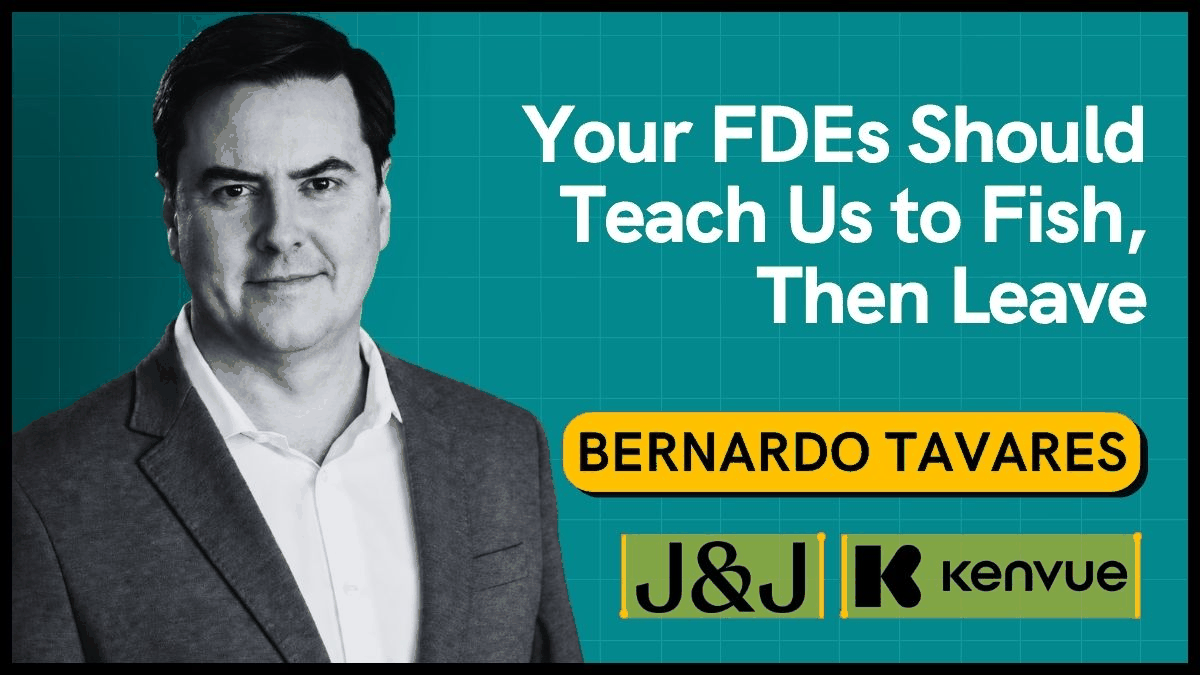
Today I interviewed Bernardo Tavares, founding chief technology and data officer at Kenvue, the company behind Tylenol and Listerine. He led the separation from Johnson & Johnson: 3,200 systems, 700 contracts, 230 sites, and 800 people hired, in a business he calls a $15 billion startup.
He grew up in Belo Horizonte, the youngest of five, and built the career between Brazil, the United States, and the United Kingdom. The turn for founders is what he wants as the buyer. Agents have to replace software, not just people. A forward-deployed engineer should teach the enterprise to fish and then leave. A pilot that worked is not a purchase until someone can name the workflow that disappeared.
Structure and key highlights
A Year in Twin Falls, Then Wings
- Youngest of five. His father, a chemical engineer, wanted each child abroad for at least a year of high school
- No social media, and calls were expensive. A sibling came home with a new language, a Pink Floyd album, and a Texas Instruments calculator
- His year was Twin Falls, Idaho. He interned on circuits for early car phones, and saw the first Mac in a store. He calls it his 1984 moment
- Back in Brazil: the University of São Paulo, then IBM’s product development group
- The moves were a shared cost. The kids were born nomads. Heloisa, his wife, ran a small business and had to stop it each time, and was still the first to say let’s go
- They voted for wings over roots. It gets harder with age, not easier
Latin America Was the Training
- Ludmila had told Enzo he thinks of himself as a global citizen: Brazil, the US, and the UK, in regional and global jobs
- Latin America, he says, is not for beginners. Hyperinflation, shifting rules, scarcity. That resourcefulness was the training
- The US had resources and more complacency than he expected. He had assumed the US and Europe held the modern answer
- Be a little less humble, and figure it out together. From a country, the center looks all-powerful. From a global seat, the org chart is not how power works
- The question he learned: how can you help me help you. Followership beats authority on paper. Stay yourself instead of mirroring a corporate style
Five Phases on One Slide
- Maker: engineering school and six years at IBM in Brazil. Medical devices, MRI software, early wireless, a fiber-optic switch. Sometimes you only had the red book. Sometimes you wrote it
- Unilever, 16 years, from chips to detergents and shampoos. A pendulum between decentralized businesses and regional or global systems. Smarter, not automatically central. He led teams on both sides of that
- Johnson & Johnson: scale and healthcare. The consumer and the patient are the same person, across devices, pharmaceuticals, and consumer health. Data work, before AI, is what prepared him. It led to a divisional CIO role
- Kenvue is the phase he calls fun. The fifth is a happy question mark: AI at the core, trust at the center, advising startups, and boards
Kenvue, a $15 Billion Startup
- Untangle from Johnson & Johnson, ring the bell on Wall Street, then 3,200 systems, 700 contracts, 230 sites, and 800 hires
- Separate and optimize, not a copy. M&A too big to fail, driven home through late last year
- Born in the 2023 ChatGPT window. AI compressed time. It exposed how much process knowledge had been given to outsourcing
- People had become contract managers. Department-by-department firefighting worked until the opportunity was end to end, and someone had to own the model’s decision
- The fix was engineering back at the center, a real grasp of ERP, HR, and CRM, and a two-in-a-box pair with the business owner. AI is the answer. What is the question?
They Designed for Humans
- Migrate or clone 3,200 applications and 700 suppliers, then ask if agents make half of that unnecessary
- In 2023 they designed for humans and planned to add agents later. That makes a bad process faster
- Where they owned the decision they leapfrogged: network, cloud, cyber, FinOps, the development pipeline. Data needed a lakehouse. It was not AI-ready
- Business apps were fragmented, and too many startups claimed the answer, so they stayed selective during the split
- He would now push harder on heavy planning and forecasting. Revenue growth management (trade promotions, assortment, mix) can be lighter and built. It was early. He is not sure the products were ready
Heritage Stays, Baggage Goes
- Heritage you bring. Baggage you drop. They did not always know which was which. A new layer means something else comes off
- What stays is the truth: ledgers, ERPs, regulatory systems. After 30 years of doing everything, they may need a fitness program
- Decision intelligence plus agents means less classic BI. That trade is how you self-fund, and how AI improved the vendor deals
Build the Moat, Buy the Commodity
- The spinoff was the moment to hire strong engineers in each domain, so building was a real option. He would not build an ERP. He wants the skill to change the core, so a partner knows you are not captive
- Infrastructure became software. Data became software. Buy the commodity. Build the secret sauce
- On-shelf availability is the one they built: about $100 million a year helping retailers predict empty shelves. A vanilla model was for sale. They kept the IP
- Drop that ambition and the CIO is back office. Shadow AI is welcome. Dead code and the attack surface are the cost. Join early and you can say yes. Join late and you only say no
Agents Replace Software, or You Are the Bad Guys
- Cutting headcount to fund agents burns the social license to be AI-first. It is a fear story
- Planners who have run IBP their whole lives will second-guess an algorithm that is introduced as their replacement, then touch it and make it worse
- About 80% of the challenge is people. The model is 10 to 20%. Fund the work by removing human middleware, the person retyping one screen into another system
- Tell the board to fire 100 people, then 100 more, and technology is the villain. Agents have to replace software, not just people
- Judgment gets scarce if you stop hiring people who learn why a decision used to be made. Trusting the agent by default is not a plan
Eighteen Workflows, Then One
- Labeling runs through medical, legal, regulatory, marketing, and brand. A supplement or a beauty product can become a medicine if the words are wrong. The cycle took months and slowed share
- AI on top of 18 workflows and hundreds of handoffs did nothing
- Process first, 18 down to one. Then the automation factory in India. Then the labeling model, because there was finally something to plug in
- An agent is a slice of people, system, data, and risk. Accountability does not go with it
Show Me the Workflow You Eliminated
- A pilot that “worked” is often an alibi: momentum, no outcome, no move in the P&L
- The bar he wants is the workflow you eliminated. A hundred people saving 20 minutes leaves the dead time between handoffs. The process can still take two months
- Year two, keeping models current, is a good problem. The startup’s job is to help draw the target architecture, which for him means optionality
Your Rails, Then an App Store of Agents
- Prefer open source Kafka and your own APIs over middleware you cannot leave. Own the microservices and you can plug and play
- Give AI partners a common way to expose data and be orchestrated, and the layer starts to look like an app store on the business operating system
- He wants the observability. He also wants SaaS repriced. Pay-as-you-go plus tokens does not math for a company that is not a tech company
- The founder he funds is the one who will sit in that architecture and put the other layers back. That frees budget without a layoff
Councils, OKRs, and a P&L That Does Not Move
- AI buying looks newly horizontal. He says mature CPG companies already ran investment councils and funded strategies, not piles of projects
- His example: revenue growth management gets 8% of the money and grooms its own backlog, with architecture, privacy, and security in the loop
- The failure mode is adhocracy, whoever shouts. A real allocation means a startup meets less central red tape
- Do not reorg first. A reorg is who and how. Start from impact (growth, margin, share), then an outcome such as order to cash at 90% touchless. That figure is his example, not a result he claims
- Data is not the new oil. It is the output of a workflow you own. Put the OKR on the value stream, because product life cycle cuts across quality, R&D, and sales
- Lose that chain and the survey says 40% more productive while the P&L does not move
Do Not Stampede Into Tokens
- Enzo’s friend in ML at Meta was at about 20,000 tokens a month. Bernardo will not extrapolate that to a CPG. He does not know the number
- He fears a stampede led by the companies selling tokens. Incentives work. Tell people to burn tokens and they will
- Push back the way he pushed back on SaaS: own iron, tune models, get a price that fits. Otherwise you inherit dead code, open doors, and a team that cannot absorb the output
- A model from scratch is a tall order. Fine-tuning is the path when the model is close to the core
- At Kenvue they tuned a voice per brand, Neutrogena and Zyrtec among them: guidelines, message, audience. Not incredibly expensive, and worth protecting because the IP was theirs
- An insurer might build a risk model. A CPG should not assume it has the same problem
Real IP, a Scar, and a Values Fit
- Enterprises, he includes his own, are bad at startups. A pilot at every door, then a no, and his credibility pays for it
- A venture firm in the middle fixed the flow. He names the Empower program: curated companies, in domains they chose, so the team heard more than the pitch
- Four domains: cloud, cyber, AI, and digital experiences, including e-commerce. With that frame, his teams bought more
- Three tests. Real IP, not a slide. Operators who have felt the pain in CPG or supply chain. Values that can live with the harm a system can do
- Aggressive can still be a no. Love it, but not for me
Teach Us to Fish, Then Leave
- Forward-deployed work is not new. Accenture, Salesforce, and SAP have done it for decades. An ERP program was years and hundreds of millions. What changed is cycle time: a couple of days
- He likes it in moderation, because it admits the product is nothing without his context
- Training the startup in his industry is a gift they can resell. He asks why he should not forward-deploy himself, and put a pod on the workflow with people who already know it
- Services revenue is the trap. Teach the company to fish, then leave. No end date, and you have a dependency that looks like a consulting firm. He is already asking how many of those he is paying
You Pay Twice, for an Alpha You Cannot Name
- Viral posts, Satya Nadella’s among them, warn enterprises about handing knowledge to AI providers. He agrees with the diagnosis more than with the remedy
- One version: you give away your alpha, the operating intelligence. Satya’s version: you pay twice, in tokens and in the know-how you donate
- Data can be locked down. Intelligence leaks when people correct the model, a million times a day
- Most companies cannot name the two rules that actually separate them, so they do not know what to protect, or how to use it. Palantir will sell an ontology. He would rather start with process owners
- A process owner improves the work, not only runs it. Broken data is usually a bad process. Mark it enabling, core, or support, and that owner keeps the data
- The risk is asymmetric. One bad decision can ruin the company. A million good ones might buy 1% of share
Sell to the Hub, or to a Darling Market
- Spoke or hub, headquarters or a country. Both can work. Headquarters still needs a country to pilot. A country only works if the company already cares about it
- In his career those darlings were India, China, Brazil, or Mexico. Right now, his example is China for e-commerce and India for trade
- Use both doors: the local sales director and the corporate owner, in one conversation. Market only, and the pilot may not renew
- Skip the chaotic company, and check that the person offering budget actually has it. Consulting firms read that matrix well. Startups should learn the same move, which is forward-deploying into the culture
A Whiteboard, Not a Podium
- Ludmila, on the Johnson & Johnson LATAM team, called him a professor CIO. He thinks the word lands differently in Portuguese or Spanish. He will take it, and he does not want Mount Olympus
- Whiteboard, not a lecture. He borrows Steve Jobs: do not say this is wrong, do it that way. Ask why they cannot see the answer
- Hiring 800 people, he tried to know them. There is still room for tough love. The followership he wants is intellectual ambition: learn it well enough that it is right the first time from then on
- The job has already moved. Chief technology and data officer, business leader first. House in order, then forward-deploy into the business. Some shadow AI, then the cyber conversation. Do not show up only to guard the budget or to say no
Begin Again
- Asked who pushed him, he picks Heloisa. He hesitated on the first move. She closed her business, packed, and did it again, without saving the complaint for later
- Begin again after an exit or a failure. The line he likes: fall down seven times, stand up eight
- João Pedro studied and worked in the UK, then went back to Brazil to open a consulting firm. The youngest son is in New York and wants to stay. Comfort is not a career strategy
Silicon Valley glossary
| Term | Meaning | Context in the episode |
|---|---|---|
| FDE | A forward-deployed engineer, inside the customer so the product can work | He likes it only with an ending: teach them to fish, then leave |
| CTDO | Chief technology and data officer | His Kenvue title, which he will translate back to CIO |
| System of record | The system that holds the official version of a fact | Ledgers, ERPs, and regulatory systems, the layer he would not rip out |
| Two-in-a-box | A business owner and a technology owner deciding as a pair | How Kenvue chose whether a process needed AI or something else |
| Human middleware | People copying one screen into another system | The work agents should remove so the budget is not a layoff |
| Value stream | The end-to-end flow that produces an outcome, across functions | Where the OKR goes, because a department cannot see past itself |
| Order to cash | From a customer order to collected money | His example outcome: 90% touchless, tied to a real impact |
| Investment council | A group that funds strategies instead of tiny projects | How the CPG companies he admired split the IT budget |
| Adhocracy | Budget that follows the loudest voice | What a council is there to replace |
| Shadow AI | Tools people adopt outside the official stack | Welcome, if the CIO is in the room before year two |
| Alpha | The operating know-how that actually separates a company | What you donate each time you correct a model |
| Ontology | A map of how a company’s concepts relate | What he says Palantir will sell you to protect that alpha |
| Fine-tuning | Adapting a model to your own voice or data | The brand brains for Neutrogena and Zyrtec |
People, companies and references
People Mentioned
- Bernardo Tavares: founding chief technology and data officer at Kenvue, before that Unilever and Johnson & Johnson
- Enzo Cavalie: host of the podcast
- Bruno Vigo: opens the episode on the buyer, Tylenol, Listerine, and paying twice
- Heloisa: his wife, who closed her own business so the family could move
- Ludmila: former colleague on the Johnson & Johnson LATAM team, who called him a professor CIO
- João Pedro: his son, back in Brazil after the UK, building a consulting firm
- Steve Jobs: the line about helping people see the answer instead of dictating it
- Satya Nadella: the “you pay twice” warning, tokens plus the intelligence you donate
Companies and Organizations
- Kenvue: the consumer-health company he helped separate and stand up on its own
- Johnson & Johnson: scale, healthcare, and the company Kenvue left
- Unilever: 16 years of technology inside a consumer business
- IBM: six years in product development in Brazil
- Tylenol: a brand the cold open uses to say what Kenvue is
- Listerine: the other brand in that frame
- Neutrogena: a brand voice they fine-tuned into a model
- Zyrtec: the other brand he names for that brain
- Palantir: will sell you an ontology for the alpha you are leaking
- OpenAI: one side of the platform-versus-startup choice
- Anthropic: the other lab in that choice
- Accenture: decades of forward-deployed work, in his telling
- Salesforce: the same pattern
- SAP: the ERP programs that took years and hundreds of millions
- Meta: where Enzo’s friend was spending about 20,000 tokens a month
- Kafka: the open source connection he wants instead of captive middleware
- Empower: the venture program that curated startups before they reached every door
- Wall Street: where he rang the bell as Kenvue stood alone
Data and References
- $40 billion: how the cold open sizes the company behind Tylenol and Listerine
- $15 billion: the revenue he and Enzo use for the business he built like a startup
- 3,200 systems: applications to migrate or clone in the separation
- 700 contracts: suppliers and partners in that same review
- 230 sites: the standalone footprint
- 800 people: hired at Kenvue
- 16 years: Unilever
- $100 million: a year, the on-shelf model they built instead of buying
- 18 workflows: labeling, before they cut it to one
- 80%: the share of the AI challenge he still assigns to people
- 90% touchless: an order-to-cash example, not a result he claims
- 40%: productivity people claim in surveys while the P&L stays flat
- 1% of share: what a million good decisions might buy, against one bad decision that can ruin you
- 20,000 tokens: a month, the Meta contrast Enzo brings