The audio and video are in Spanish. These notes are a translation.
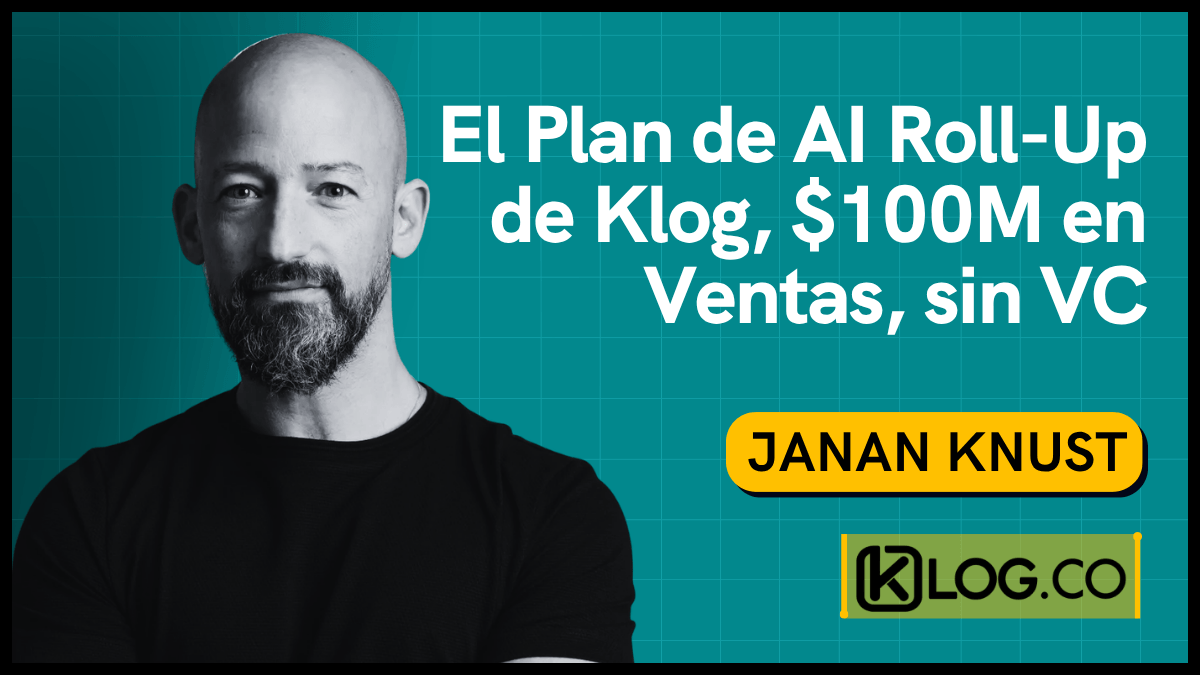
Janan Knust is founder and CEO of Klog, a digital freight forwarder. He moves containers for more than five thousand companies: he buys volume from the shipping lines and resells it. He sells more than one hundred million dollars, without a dollar of venture capital and without bank debt.
In 2020 and 2021 Flexport and Nowports raised hundreds of millions. Janan corrects that: billions. Klog had a $70M term sheet. With the thresholds (500 people, more countries) they were a unicorn and the round could go past $200M. They did not sign it. The incentive was to grow without stickiness, and his moat is the people.
The plan now comes out of that. Give the technology away, because the customer would not pay one more dollar for software. Double the company in two or three years with the same people. And buy traditional forwarders to put Klog’s system and culture inside them. Kuehne+Nagel, DHL, Schenker and Kerry Logistics only grew by buying.
Structure and Key Highlights
The Same Person on the Plane and Washing Dishes
- Born in Israel. At four he moved to Chile. Mother from Morocco, father German. Twelve countries. Mexico is the first time the family moved to look for another horizon
- The same range: a private plane with Donald Trump (he clarifies it was a different Trump, years ago, alongside Richard Branson, Martha Stewart and the president of Deloitte) and washing dishes. He was the butler of a Russian billionaire
- It does not change who he is. He looks at what responsibility the person in front of him was given, and how they use it. The most successful person, he says, is the one who gives the most
Money Is a Vessel, Not a Destination
- Same pains, same needs. You are a vessel for money, wisdom or connections. If it does not flow, it breaks
- He saw it up close: people stick to money and power. It seemed absurd to him that one person could have three billion dollars in cash, for what can be done with it, for good and for bad
Understanding, Conviction, Vibration
- Three stages: you understand why things happen to you, that becomes identity, and only then the right people stick to you. It takes time
- Trust, the kind in his book, is built or broken with authenticity, logic and empathy. If you say it and do not do it, you lose trust. Enzo calls it coherence
- Empathy is the month-end close: saying “I am always available” and not having time destroys trust. Dropping your urgency because the other person matters builds it
- He falls 50% of the time. His father, after a heart attack, will not eat a chocolate: one exception gets repeated. You have to be square
Nikita: Sell Without Selling
- Gabriel Gurovich told Enzo to ask about the Nikita parties. Janan asks if the podcast is 18-plus
- A childhood friend started them in Chile. Janan was in Paris, just out of the job with the Russian, burning his savings imitating first class. His former boss owns Russian Standard and was spending hundreds of thousands on clubs where nobody knew which vodka they were drinking
- Nikita: only that vodka, free parties for companies (the example is Samsung) in exotic places, and from midnight he charged entry. The Louvre, a boat, Maxim’s, a circus
- A hit and, he says, depressing. From 26 to 30, in bed at five. He got married to have a ground wire and went back to Chile
No Ships: The Business Is the People
- A digital freight forwarder: he buys volume from the shipping line in Latin America and resells it. Zero ships. Talent, technology and customers
- The moat used to have to be a rail nobody could copy. Today, with technology and with money, they copy everything, and faster every time
- People deliver the service. That is going to be the moat: culture, and who is behind it. He saw it from day zero in logistics and in everything before
Systematize the Predictable
- At Four Seasons the cost of the experience did not matter. He cites Unreasonable Hospitality, by Will Guidara: how unreasonable you can be in order to extend the other person’s expectation
- Klog’s line: systematize the predictable to humanize the exceptional. If B follows A and C follows B, a machine does it. The point is the interaction that does not fit in the process
Steven Tyler’s Robe
- Four Seasons Palm Beach. He washed dishes and on weekends worked as a waiter’s assistant. Aerosmith at the main table. Steven Tyler was coming from the pool with no shirt and no shoes. The sign forbade it
- He was 21. He ran to the kitchen, room-service robes and slippers, and got there before the manager: “Mr. Taylor, for your comfort”
- It was not only the gesture that stayed with him. It was Tyler’s face. Being present. The same logic, he says, with the people in the company
KBank: Zero-Interest Loans
- More than ten years. More than a million dollars in loans, and he talks about millions already passed through that internal bank. Interest: zero. Defaults: zero
- Lucía was crying over a debt with a Chilean compensation fund, at rates he calls abusive. They lent her the money so she could pay it off and repay them with no interest
- You never beat the cash flow. If you turn a lot of money over, give it to the people. Every company, he says, should have a KBank
The $70M Term Sheet
- In the pandemic the sector was as hot as it gets. Flexport and Nowports raised billions. Several did not grow to the level of the capital that went in
- The investors were not wrong: it was timing. Money was free and the industry moves a couple of trillion dollars. Analog, opaque, with billionaire players
- Klog had a $70M term sheet. The thresholds were about execution: 500 people, more countries, and a round of more than $200M. A unicorn. With infinite money, building the network is execution
- None of those companies reached the IPO or the exit that was expected
Why the Perfect Thesis Did Not Close
- Low margin, lots of relationships, the backyard of the company. Logistics shows up in the exceptions: if everything works, you do not notice it
- The path was not grow like crazy. A solid team, organic growth, efficiency. That clarity was not there, and the incentive was to grow without stickiness
- Stickiness comes from an efficiency that also creates reach. If sales only brings customers or only buys companies, nobody looks at how automatic the process is. They had time. The VCs were not asking for it
The Moat the Funds Did Not Believe
- Harvard studied them: how they keep growing, putting technology in, without a peso of capital and without bank debt. “It does not even make sense”
- He does not think he is a better executor than the founders who raised hundreds of millions. He would have done what the investor asked. The result would have been the same or worse
- What was different was the conviction that the moat was culture. To the top funds he talked about rails and platform, and he watched their faces. A sexy speech, not the one he believed. If you do not vibrate on that, you attract the wrong people
They Gave the Technology Away
- Enzo puts it next to accounting and legal, and next to the AI-native services thesis. Emails, documents, calls: why could it not be done before?
- Everyone believed the customer would pay one more dollar for technology. It did not happen. Klog gave the software away and competed on price and service. More volume, a better buy, and that comes back in the price
- The wheel, he says, has already broken. AI speeds it up. Without culture it is not enough: there are a lot of analog people and the ship does not turn. That is why millions get spent on tokens with no ROI
- The return is both things: less repetitive work and more business, with the same people or with fewer. In logistics, with so many stakeholders, that is still up in the air
Ask for Forgiveness, Don’t Ask for Permission
- It is not an AI-first sticker. They have spent ten years on the same question: how to make the process easier, more efficient and more precise
- Today anyone is an architect. “Give me time in the backlog” is over. The line is: ask for forgiveness, don’t ask for permission
- The goal: double, in two or three years, a company of more than $100M, with the same people. So they earn more and drop the repetitive work. From selling around 120 to selling 250. They already spend the money on the people, and that is why they can ask for it
From 5% to Half of Gross Profit
- An analog forwarder lives on 5% if it is lucky. Enzo was guessing 10 or 20 of operating profit
- Today 20% of gross profit reaches the bottom line. They are aiming at 50%. They do not control the rate: the shipping line, the airline or the trucker sets it, and they pass the cost through. At $10,000 the margin in dollars goes up even if the percentage does not. Last month they sold $18M
- The business should leave them a gross profit of 35, 40 or 45%, and then 20%, or half of that gross profit, in EBITDA. Three or four times the traditional business
- This year they close at about 40,000 TEUs. Volume cannot stop. For $50 the customer switches: there is error, the carrier is responsible, there are shocks you do not control. One, two or three extra points, if the service retains, are an enormous gross profit
- That is why he wants to open China, keep hiring in sales, automate the sale and train until this runs like a luxury hotel: someone arrives without a hoodie, and someone runs to get them the robe
The Roll-Up: Buy the Analog Company
- If you build a better business, you can buy the smaller one that already has a book of customers. He thinks it will happen in legal and in accounting too. Private equity is looking at fragmented, analog sectors, where AI raises efficiency
- They are building their own ERP and their own replacement for HubSpot. About $200,000 a year, three or four months, tailored
- An analog company doing $5M a year, at a 5% profit, he can double, triple or quadruple. It is not only one manager and one system: the process, absorbed by his technology, should be two or three times more efficient
- Kuehne+Nagel, DHL, Schenker and Kerry Logistics grew by buying. They already have several targets in view. It is the first company he buys, and he says they need help
- What he kept from the VCs was the advice: several countries, people from outside the industry, CAC and LTV, metrics that did not exist in this industry. They executed it at their own pace. Today they put in their own money. With $200M he sees a real move in the bottom line
Culture Does Not Go on the Wall
- That is why he wrote a book. He never wanted the values on the wall: attitude, focus, discomfort, resilience and study. Where there is a line, it says “A failure”, so it is not a poster that says “we are resilient”
- He wants you to live it. Resilience, when you are on the floor, is who you get up with. When hiring he prefers curious people to enormous resumes
- About 70% of Klog came in as trainees and had to be taught from zero. The other 30% know the business and structure it. The one who wins is the curious person who questions. The book is the filter: if it makes sense to you, we talk
- They have opened five countries with no outside capital and no outside person. He moved to Mexico with his family and with several others, for the market and so the culture would spread
- A house and flights for six months, and they are doing it in every country. People from Chile, Peru and Bolivia. It takes time. If the culture does not match, buying gets hard
What You Are Buying, and How the Thesis Breaks
- The main asset is the customer book. Also the people, because they are relationships. A lot of small businesses are a one man show and die once they pass about 15 people: that is when you need cash, structure and shipping lines
- Klog’s ramp-up was COVID. They had the platform to see where the cargo was, they were in the press, and they reinvested the margin in technology and talent. A company of their size, he says, takes ten years to do that
- For the M&A-plus-AI thesis to fail, his first answer is that he does not want to do it. It takes capital and a decision
- Three risks. Own cash: a bad acquisition that drags the rest, and not knowing when to cut. A bank: you take too long to pay it back, you consume what you generate, and you go backwards. A partner: he wants A and Klog wants B. You have to be clear on the destination before you sit down
- They created a new role. Someone very senior is moving from Peru to Mexico to kill the manual processes: get in, plant the chip, and teach each person to kill their own
Why Replace HubSpot
- $200,000 a year does not move the P&L. It moves where he wants to go: contacts, recurrence and churn, without asking a third party for tweaks
- Whoever they buy may be on Salesforce or Pipedrive. They arrive with a system from the logistics business, not a generic CRM. If a partner solves it in two minutes, there is no reason to build it
- The standing argument in the sector is build from within or buy outside. Most went to the giant systems
- WiseTech and its CargoWise: he puts them at about twenty billion dollars, with the stock depressed after a peak in the twenty-somethings. They are the operating system of many forwarders
- In a couple of years, he says, you feed a couple of licenses into Claude, the emails and how the customers behave, and it builds about 70% of the system of a forwarder in Chile. The moat is not that money. It is the people who know the process and become architects
Sharon and the Two Little Papers
- Sharon, his wife, told Enzo that Janan repeats the same thing: he wants to change the world however he can. If he thanks someone for pushing him to think bigger, it is her
- Nobody changes the world, he says, only God. Believing otherwise is ego. You can change yours, and from there a leap of faith toward others
- This last year was one of the hardest, personally, in the family and in the business. He tried to throw in the towel a couple of times. Sharon did not let him: you are not changing your world or your children’s
- Two little papers. Right hand: “I am nothing”. Left hand: “The whole world was created for me. Go on, eat it.” In bed, not wanting to go to work, the left one. On the podcast, under the lights, the right one
Silicon Valley Glossary
| Term | Meaning | Context in the episode |
|---|---|---|
| Moat | A competitive advantage that is hard to copy | The funds asked for software rails. He says those already get copied, and that the moat is culture |
| Freight forwarder | Someone who moves cargo from A to B without owning the ship | Klog buys volume from the shipping line and resells it |
| Roll-up | Buying companies in a fragmented sector and running them together | The plan: acquire analog forwarders and put Klog’s system inside them |
| Term sheet | A preliminary agreement with the terms of an investment | The $70M one they did not sign. The thresholds would have made them a unicorn |
| Stickiness | How stuck a customer or a team stays | The mistake of the VC wave: growing without stickiness with the customer or the team |
| Gross profit | Revenue minus the direct cost of delivering the service | Today 20% of that gross profit reaches the bottom. They are aiming at 50% |
| EBITDA | Earnings before interest, taxes and depreciation | What should be left if labor, errors and delays do not eat the gross profit |
| TEU | A unit equal to a twenty-foot container | This year Klog closes at about 40,000 TEUs |
| CAC and LTV | What it costs to win a customer, and what that customer is worth over time | Metrics the VCs demanded, which did not exist in this industry |
| Churn | Customers who leave | Why the CRM is core: contacts, recurrence, and avoiding churn without asking a third party for tweaks |
| Build vs buy | Building the technology inside or buying it outside | The sector’s argument. Klog is moving to its own ERP and CRM |
| ROI | The return on an investment | What companies do not see when they spend millions on tokens without changing the culture |
People, Companies and References
People Mentioned
- Janan Knust: founder and CEO of Klog. From washing dishes and working as a butler to a forwarder above $100M, with no VC
- Enzo Cavalie: host of Startupeable
- Sharon: his wife. The person he thanks for pushing him to think bigger
- Steven Tyler: of Aerosmith. At the Four Seasons in Palm Beach, Janan at 21 put a robe on him before the manager could stop him
- Lucía: at Klog. A debt with a Chilean compensation fund was the origin of KBank
- Donald Trump: the private plane from years ago, a different Trump from today’s
- Richard Branson: one of the businesspeople he served as a butler
- Martha Stewart: the same scene on the plane
- Will Guidara: author of Unreasonable Hospitality
- Gabriel Gurovich: a friend who pointed Enzo to the Nikita parties
Companies and Organizations
- Klog: Latin American digital freight forwarder. More than $100M in sales, more than five thousand companies, no outside capital and no bank debt
- KBank: Klog’s internal bank, at zero interest. More than a million dollars in loans, not one default, for more than ten years
- Flexport: a reference for the wave that raised billions in digital freight forwarding
- Nowports: another from that wave. Janan says none of them reached the IPO or the exit that was expected
- Four Seasons: where he learned unreasonable hospitality, in Palm Beach
- Russian Standard: his former boss’s vodka. The Nikita parties were the sponsorship people actually noticed
- Aerosmith: the main table in the restaurant the day of the robe
- Harvard: studied them as a case of growth with no capital and no debt
- Kuehne+Nagel: one of the giants that grew only through M&A
- DHL: the same acquisition playbook
- Schenker: another of the top ten he cites as proof that the industry consolidates by buying
- Kerry Logistics: the fourth name on that list
- HubSpot: the CRM they want to replace with their own. About $200,000 a year
- Salesforce: what a company they buy might be on, and what their system would have to absorb
- Pipedrive: the other generic alternative he mentions
- WiseTech: owner of CargoWise. He puts it at about twenty billion dollars
- CargoWise: the operating system of many forwarders. He thinks in a few years it gets rebuilt, about 70%, with something like Claude
- Claude: the example of “build me the system from my emails and my customers”
- Deloitte: the president of Deloitte was among the figures he served
Data and References
- >$100M: annual sales. The goal is to double them in two or three years with the same people
- $70M: the term sheet they did not sign. The next step went past $200M if they hit the thresholds (500 people, more countries)
- $0 of VC and $0 of bank debt: the fact that caught Harvard’s attention
- 5%: the profit an analog forwarder lives on, he says, if it is lucky
- 20% to 50%: of gross profit that reaches the bottom line today, and what they are aiming at
- 35% to 45%: the gross profit they expect, to leave ~20% or half of that gross profit in EBITDA. Three or four times the traditional business
- $18M: what they sold last month, with rates at $10,000
- 40,000 TEUs: containers they expect to move this year
- $50: what it takes, in a rate-driven business, for the customer to switch
- $200,000 a year: the saving from leaving HubSpot, in a three or four month build
- $5M at 5%: the kind of analog company he thinks he can double, triple or quadruple
- $200M: the figure at which, with their own culture and system, he sees a serious roll-up
- ~70% trainees: Klog people who came in without knowing the trade. The other ~30% structure the business
- 5 countries: opened with their own capital and without one outside person
- 15 people: the size at which, he says, most one man shows in the sector die
- Unreasonable Hospitality: Will Guidara’s book behind Klog’s line