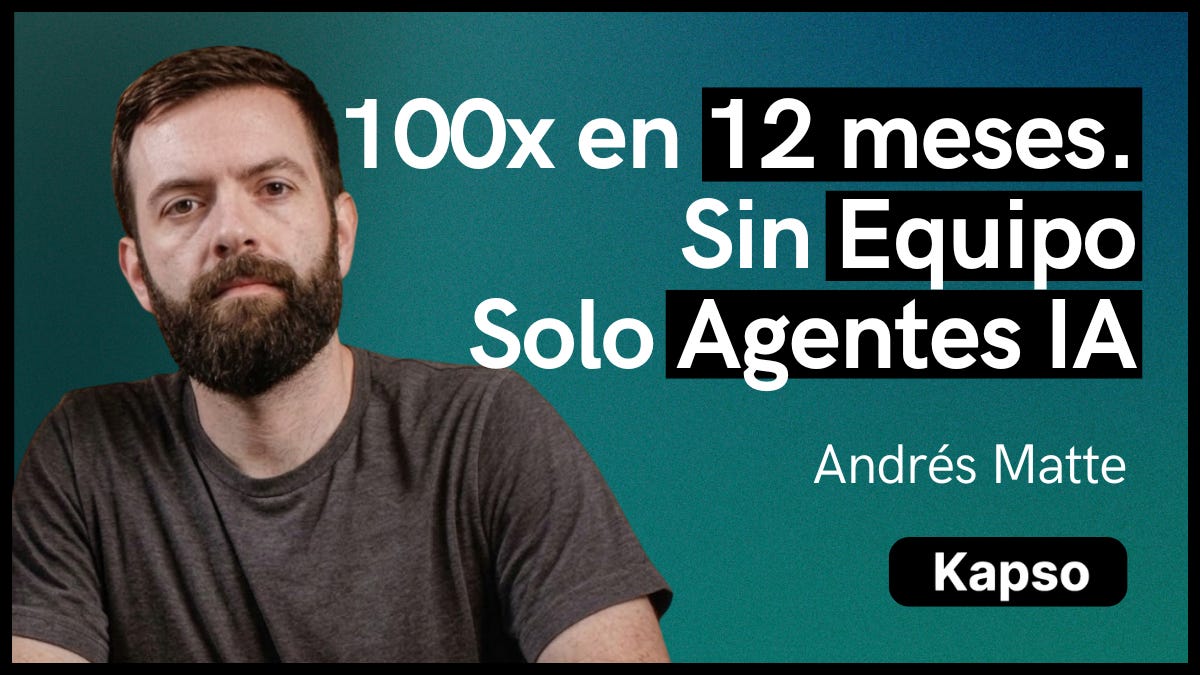
The audio and video are in Spanish. These notes are a translation.
Today I interviewed Andrés Matte, founder of Kapso, the platform more than 13,000 developers use to integrate WhatsApp. He runs it alone, with his agents. Before that he cofounded Platanus Ventures.
His most counterintuitive data point: Kapso’s biggest user is not the developers or the people, it is the coding agents. They are the ones who integrate the product.
It is also a conversation about why this product did not come out of Silicon Valley: working on WhatsApp feels unsexy from there, and that is exactly why the gap existed.
Structure and Key Highlights
Two Different Motivations
- The first version of Kapso was a health and fitness product, motivated by his father having a stroke when he was 14
- The company did not work, but the message stuck: people who even today tell him they remember the muscle-mass thing
- The motivation for the current Kapso is different: from Platanus he saw many CTOs suffering to integrate WhatsApp
- His view of the personal-motivation stereotype: it is overstated
- What does define the founders who are doing well: a drive to generate impact, and that once things start going well for you that is entertaining enough on its own
Stopping Being an Investor
- When they invited him to cofound Platanus he did not want to be an investor, he wanted to build a digital product
- The context: he was 26, he had never built anything or invested a peso, and he decided to trust his partners’ judgment
- What made him leave: if he did not catch the AI wave he was going to regret it for the rest of his life
- His calculation: he had no kids, he had financial flexibility, and this wave may be bigger than the internet
- The hard part of leaving it: being an investor gives you a status you almost never deserve, and he was comfortable
- He did the path in reverse: most founders end up as investors, and he started as an investor
You Do Not Have to Build Agents
- His nuance: you can build around them, tools for agents, which are going to grow just the same
- The example is his own: he does not sell AI, and his biggest users are coding agents
- The metaphor: it is not only the gold, it is the picks and shovels
What Kapso Is and Why It Did Not Exist
- Kapso is WhatsApp for developers: it makes it easy to integrate WhatsApp for agents, notifications, collections, or complete products
- Platforms to integrate WhatsApp already existed, but focused on enterprise, not on the individual developer
- His strategy is product-led growth, bottom up, like Supabase or Vercel
- The gap he saw from Platanus: CTOs ended up using unofficial solutions that simulate a WhatsApp Web session, which work at low scale and get your number blocked
- And the official solutions were very hard to integrate
- His diagnosis of why nobody did it before: this kind of product comes out of San Francisco, and WhatsApp is not used there
- His line: working on WhatsApp feels a bit third-world, it sounds small and unsexy
- That is why it makes sense for it to come out of Latin America, India, Indonesia, or Africa
On Meta
- His reading: Meta is not seeing that WhatsApp can be its way to win in AI
- He has thought about writing a tweet asking to get through to Mark Zuckerberg so he can pitch him
- Enzo suggests that the person who might understand it better is Javier Olivan, Meta’s number two, who is Spanish and uses WhatsApp with his family
- Kapso is now an official partner inside WhatsApp’s partner program
- What he would do if he were Mark: position WhatsApp as the AWS of messaging, the infrastructure layer others build on
- His argument: there are giant businesses built on AWS that only make the experience easier
WhatsApp Against SaaS
- His thesis: a lot of software should not exist and should exist only through WhatsApp
- Many applications should not be interfaces, only databases
- What he is already seeing: founders with mobile apps in production and hundreds of thousands of users who are deleting them to go 100% to WhatsApp
- The reason: getting the user to download an app and create an account is huge friction, when they already have WhatsApp open
Building for Agents
- His answer: it is pretty similar to building for developers. Good APIs, good documentation, and a well-documented terminal tool
- Why new products grow faster: they were already built that way from scratch, while existing businesses have to change their architecture
- The message he got from a user: he did not read the documentation, he passed the link to Claude Code, and he already has it integrated without understanding how
- The small technical difference: readable information serves the human, and JSON works better for the agent
- How he iterated his CLI: he built the initial version, opened another session of Claude Code or Codex asking it to use it and give feedback, and passed that to the first one
- When he knew it was ready: when the amount of feedback dropped
- The launch reached 700,000 views and founders from all over the world wrote to him
The Folder Is the Agent
- The pattern he discovered doing manual support: he kept going into Meta’s portal again and again to check the same thing
- His solution: a folder on his computer that he opens with Claude Code and asks for the information
- The conclusion he drew: we are going to have folders with scripts and documents that are going to be the company’s new workers
- The reference Enzo brings in: Dan Shipper, of Every, writing that the folder is the agent
- Why it matters that it is a repository: the next employee clones it and automates their work the same way the founder does
- His marketing repository has the landing context, the styles, the typography, the tone, and every video project made with Remotion
How He Works
- He started a year ago with Claude Code just out and Sonnet 3.5, then 3.7
- He went through Cursor, then Claude Code, and for the last four or five months he mainly uses Codex
- His method: he does not prepare a perfect prompt, he gives a very raw idea and discusses it
- His reason: that way the agent understands your thought process and can propose something better
- The principle behind it: it is much easier to detect quality than to create it from scratch
- His reading of the current state: implementation is already solved, the hard part is defining the what and the how
- On Codex versus Claude Code: Codex is less brave, it has no problem walking the entire repository to answer in two lines
- Claude Code has more confidence in itself, looks at two files, decides, and sometimes duplicates code
The Two Types of Developer
- The one who enjoys the final result, the feature working in production
- The one who enjoys the quality of the code, that the file looks perfect
- His observation: the second one joined the wave later, because at the beginning the models wrote ugly code
- The parallel: the same thing happened with designers and the first image models
- His advice: get used to it now and learn to let go, because later it will be harder to adapt
How He Runs the Business Alone
- Support is essential in products for developers, and it came to take up 90% of his day
- First layer: an agent on the web with the context of your project, that can build automations for you
- Second layer: a support agent over WhatsApp, built on Kapso, which makes him his own user
- What that agent does when it does not know: it asks him on Slack, he replies in the thread, and the agent continues with the user
- The administrative part: he gave ChatGPT Pro all the legal context, the documents, and the threads with accountants and lawyers
- It thought for two hours and returned a six-sheet master Excel with all his tax obligations by country
- The contrast: the version his United States accountants sent him afterward was much simpler
On Evals
- He does not have them: they are a lot of work, they change a lot, and running them is expensive in tokens
- His underlying argument: evals do not simulate reality well, because the human is much messier
- What he did instead: four weeks reviewing every user chat and improving the prompt where it failed
The Repository that Improves Itself
- Kapso Knowledge is a repository with no human intervention, that runs every four hours reviewing sources
- It decides what it should remember in the future and writes it into markdown documents that only the agent controls
- It stores syntheses, not primary sources, with references so it can go find the original
- It is connected to the support agent, so a rare case with a playbook already written resolves on its own
- His reading: the real explosion arrives the minute you take yourself off the helm
- What it demands: letting go, accepting that sometimes the repository will have bad information, and trusting that it corrects itself
The Limit Is Attention
- Many developers run features in parallel, and that strategy never worked for him
- His reason: he needs to be there for the product to turn out good, and he does not delegate product decisions
- What he does instead: ignore things, leave WhatsApps unanswered at some point
On Memory and Context
- His opinion evolved: he used to believe you had to write documentation for the agents, like a map of the codebase
- Today he believes it is much less necessary, because the agent navigates and infers what it needs
- What is still needed: good search tools so it can search iteratively
- What a founder gains from this: they can design their organization much better, because the processes live in repositories and not in documents nobody reads
What Survives and What Dies
- His prediction about languages: it will be very hard for new ones to come out, because the agent will not have them in its training data
- That creates a kind of moat for existing languages and frameworks
- What he is bullish on: the models, conversational channels like WhatsApp, email, and Telegram, and companies that act as repositories of well-structured data
- His condition: those repositories have to transform so they are consumable by an agent
- The concrete case they discuss: Notion has the incentive to close its agents inside its web, and both believe that would be a mistake
- His feeling when using a website today: filling out forms by hand feels like a caveman thing
San Francisco, Yes or No
- His experience: he has spent almost a month testing whether to move
- The double-edged sword: you work a lot because everyone else works a lot, and at the same time it is very easy to get distracted by the glamorous part
- His more provocative thesis: having the right Twitter feed is 80% of being in Silicon Valley
- His description of Twitter: the WhatsApp group of the million people who live here, gossiping all day
- When you do have to be there: when you need to raise a lot of capital and hire technical talent at scale
- The advantage of coming rarely: it creates a sense of scarcity for you and for everyone else, and people prioritize seeing you
- The real cost of moving as a one-person company: 50% of his time for a month on visas, the move, and bringing his dog
- What Chile gives him: family, friends, walking the dog, and something that forces him to disconnect
On the One-Person Company and a Billion
- He does not think Kapso is the candidate: it is infrastructure, there are businesses operating on top, and it needs people to give it stability
- Where he does see it as possible: businesses where you can delegate a good part of the process, like certain e-commerce
- His warning: those opportunities would be short-lived, because you would have everyone as competition
Who He Thanks
- The founders of Fintual, Pedro Pineda and Agustín Feuerhake, who think big by default
- What he likes most about them: a lot of confidence in themselves and humility at the same time, with no need to be the unbearable narcissist
Silicon Valley Glossary
| Term | Meaning | Context in the episode |
|---|---|---|
| PLG | Product-led growth, growing through product adoption | His strategy versus the competition’s enterprise approach |
| Bottom up | Entering through the individual user and not through management | How Kapso reaches companies |
| CLI | Command-line tool | What he launched so coding agents can operate on WhatsApp |
| Coding agent | An agent that writes and runs code | His biggest user, above the humans |
| Evals | Systematic tests of an agent’s quality | What he decided not to have, and why |
| Vibe coding | Programming by talking with the model | How he built Kapso from the start |
| Moat | An advantage that keeps people from copying you | What he sees for the languages already present in the training data |
| SOP | Standard operating procedure | What now lives in repositories instead of documents |
| Training data | The data a model was trained on | Why a new language would have a very hard time |
| Context switching | The cost of jumping between tasks | His real limit operating alone |
| Partner program | A platform’s official partner program | Where Kapso sits inside WhatsApp |
People, Companies and References
People Mentioned
- Andrés Matte: founder of Kapso, previously cofounder of Platanus Ventures
- Pedro Pineda and Agustín Feuerhake: of Fintual, whom he thanks
- Dan Shipper: of Every, for the idea that the folder is the agent
- Mark Zuckerberg and Javier Olivan: whom he would want to pitch the WhatsApp opportunity
- Dario Amodei: for the prediction of the billion-dollar company with a single employee
- Enzo Cavalie: host of the podcast
Companies and Organizations
- Kapso: WhatsApp for developers, more than 13,000 developers
- Platanus Ventures: the Chilean accelerator he cofounded
- Meta and WhatsApp: the platform he builds on, and its partner program
- Supabase, Vercel, Resend: the developer-experience references WhatsApp was missing
- Claude Code, Codex, Cursor: the tools he went through
- Every: the newsletter he is a paid subscriber to
- Notion, GitHub, PostHog, Dropbox: the data repositories they discuss
- Remotion: what he makes the launch videos with
- Fintual: the reference that closes the episode