The audio and video are in Spanish. These notes are a translation.
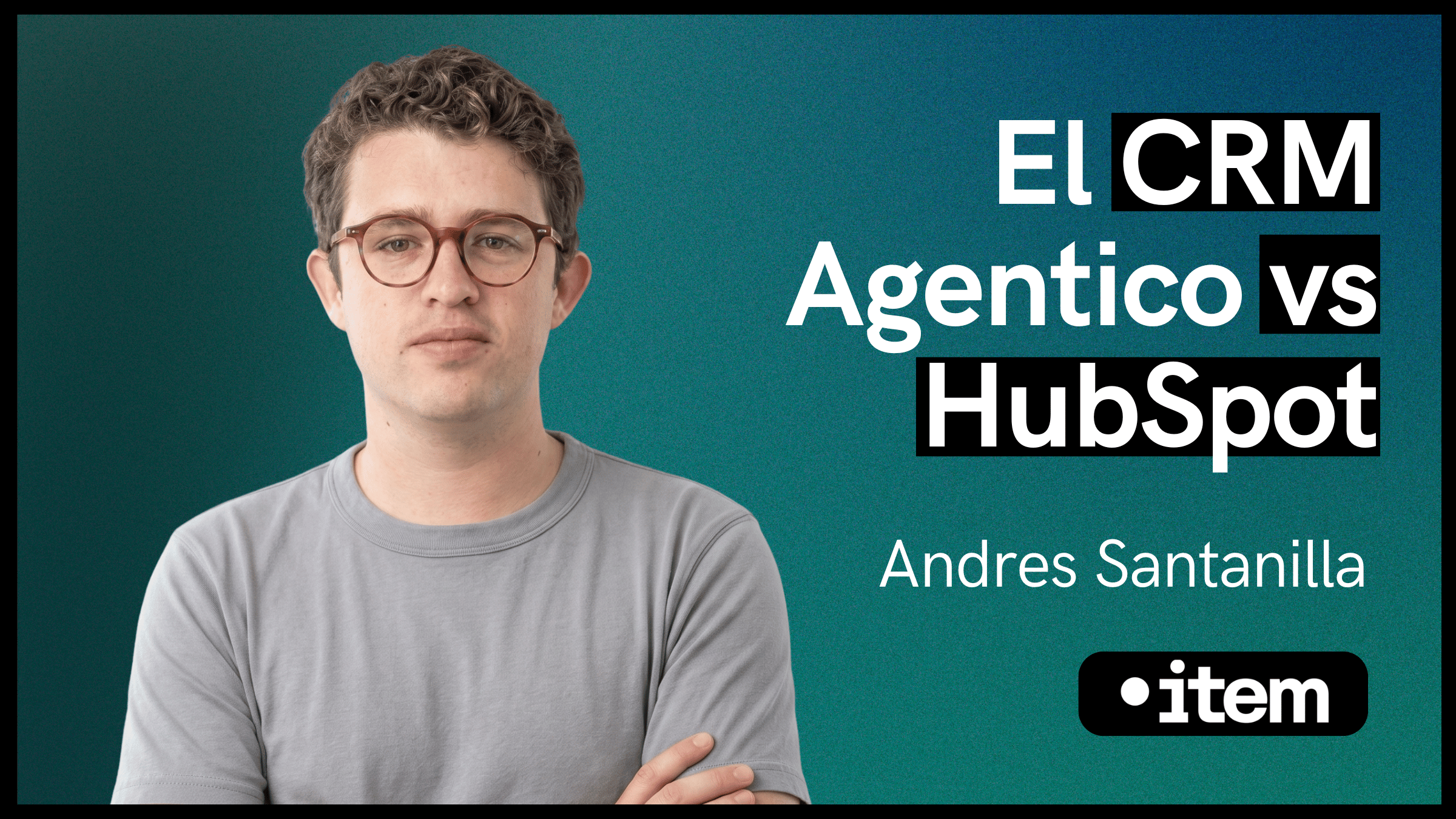
Today I interviewed Andrés Santanilla, founder of item, a CRM where humans and agents work together and autonomously. They have raised capital from Y Combinator, True Ventures, and Matrix, and several Silicon Valley startups are replacing HubSpot with item.
Andrés is a designer, not an engineer. He studied at an art school in Savannah and ended up at SAP designing financial reconciliation, which turned out to be exactly the kind of complexity that fascinates him.
He applied to Y Combinator six times with the same idea, with four interviews along the way, until he got in. YC had never accepted a CRM.
The idea that organizes the whole episode: at item they do not build the product, they build the factory that makes the product. Like Tesla, where the product is not the car.
Structure and Key Highlights
From Selling Candy to Studying Design
- As a kid he sold a bit of everything at school, and set up a candy stand in front of his house on vacation
- His grandfather, his father, and his brother were entrepreneurs, including a famous bar where he helped out
- He was going to stay in Colombia studying business, until he got a scholarship at SCAD, a university only for art and design
- His mother told him to go for six months and come back if he did not like it. He has been there since 2011
- What opened the world for him: in the United States you can study industrial design, fashion design, or even theme park design
- His contrast: in Latin America they say “oh, he is a designer,” and in the United States the designer is the creative inside a large team
Learning to Code Out of Boredom
- Halfway through the degree he realized he did not like industrial design, but he was already deep into it
- He confirmed it during an internship at Fisher-Price, where his boss did not believe an intern could design
- He was in a town in northern New York State, snowing, without much to do, and he learned to code with code.org
- A professor told him about UX, a term he did not know, and he understood it was the intersection between design and programming
- Then he spent three months at IBM that turned into a year, doing UX research
Oto, the 2016 Assistant
- A university project in the era of the Internet of Things and the first smart speakers
- You connected your accounts, Spotify, Fitbit, even your Tesla, and the assistant built knowledge about you
- It would alert you if your favorite artist was coming to the city or if something in your cart dropped in price
- He launched it with a website, a waitlist, and all the production around it, even though the product never worked and the prototype was an empty shell
- It won several design awards and he exhibited it around the world
What He Took from SAP
- What hooked him was not the product but the complexity: how you design a UX so a finance person can reconcile accounts across countries and currencies
- Why he likes B2B: most designers stay in consumer, and he tried it and discovered it was not his thing
- His organizational observation: companies need good designers and good design enablers, and SAP had a Chief Design Officer who was not a designer but defended them
- The time context: it was when machine learning was starting to work and the first decision-tree chatbots were appearing
- What he discovered when he put intelligence on top of SAP: the system knows absolutely everything your company did, even who bought something 20 years ago
- The real design problem: how you get the user to believe the machine, when they have spent 25 years operating with their own little playbook
Why CRMs Do Not Change
- At SAP, seven to ten enormous customers concentrate most of the balance sheet, and what they think carries weight
- The other brake is internal bureaucracy, sustained by the customer’s fear of retraining their people
- The anecdote that illustrates it: they repositioned a button for a customer and there were purchasing delays for days because nobody could find it
- Many companies stay on legacy systems out of that same fear of relearning what already works for them
The Two Years of Exploration
- He started in 2023, consulting for an AI company that was sold to Zendesk and that read papers every Thursday
- The paper that changed him: giving GPT-3 a web search tool
- His reasoning: if you can give it search, you can give it email and access to products, and if it also reasons, everything changes
- He spent all of late 2023 building prototypes with context windows of 8,000 tokens
- The thesis with his cofounder from the start: the system of record is going to change, and what is going to change the most is its experience
- Why they entered through sales: there is budget, there is interest in trying, and they give you the benefit of the doubt when the agents are bad
- They built the whole harness themselves, because today’s SDKs did not exist
Why They Killed Their Own Business
- They were doing well with their agents, not incredible but good, and they could have kept growing there
- What made them unhappy: the very high churn of that kind of tool, which he already knew from working on hiring products
- His conclusion: what makes it sticky is the CRM, not the tool that finds you five people
- The decision: offer the CRM to all their customers, but only if they left theirs
- The result: three said yes, two said maybe. They dropped the rest and kept five
- What unlocked everything: a customer wrote that they were not renewing HubSpot and would stay with them if they met a list of 25 things
Against the Vertical Advice
- The two dominant theories were to do vertical SaaS, or bring in an industry expert and add a technologist
- His problem: neither fit what he and his cofounder wanted to build
- His references: Larry Ellison and Hasso Plattner, who never started by making the scheduling tool for a car dealership
- How he describes the vertical curve: you grow extremely fast because you know your ICP, and then it flattens
- How he describes the horizontal curve: extremely slow for a long time, and then it grows with no ceiling
- His cultural critique: in Silicon Valley there is very little long-term mentality, with founders who want an exit in three or four years
- What he brings from Colombia: building a healthy business, one that makes money and supports its customers
The Six Applications to YC
- They applied six times with exactly the same idea, without redoing the application, counting the accumulated progress
- Four interviews, always with different partners
- What they discovered along the way: YC had never accepted a CRM
- What happened in the last one: the partner did not believe what they had built as two people, with customers of 8 and 10 million using it
- He invited them back, they reviewed the product for an hour and opened the code
- The reason he gave them when he accepted them: he had seen the progress across all their applications, and the resilience to build something slow is normally something nobody can prove
- His advice: apply, and keep applying
What item Is
- The pitch: it replaces your HubSpot or your Attio with a system that builds itself
- When an email or a meeting comes in, it adds the person, enriches them, and places the opportunity where it belongs according to the context of your business
- What makes it different from putting AI on top of a CRM: the whole system runs on agents
- How those agents get created: by writing documents, like in Notion, instead of configuring automations
- Its home is not a metrics dashboard: it is the agents bringing you the things where they need help
How They Sell a Migration
- What he discovered: the idea that pulling out a CRM is impossible only applies to a very specific segment
- That segment is companies with an internal Salesforce administrator or an implementation firm
- The rest almost never implemented it well, and that is the market they need now
- The technical migration: one agent dumps your whole HubSpot into files, another uploads them to item, and you can run both systems in parallel
- Why LLMs make it possible: they are extremely good at reading and writing code, so they read how your instance was built and replicate it
- The obstacle he admits he does not know how to solve: the person whose job is precisely to be a Salesforce specialist
- The generational shift that plays in their favor: the old guard that built a career implementing the cloud is retiring, and whoever comes next will not grow up being extremely good at Salesforce
Designing for Agents
- His premise: the next programming language is English
- The design principle: give the user the confidence that the agent is going to work the way they expect
- The memo they wrote in 2024 and did not execute until a year later: humans go from being producers to being the ones who review the production
- The parallel they use: what happened in the industrial era when the machines arrived
- What they have stuck on the office wall: teach the machine
The Software Factory
- They do not build the product, they build the factory that makes it, and they call the agent that cooks the chef
- The internal rule: the engineers can write code, but less and less of the code that makes the product
- Their stated coherence: it would be hypocritical to ask the customer to teach item and not do it themselves internally
- How they work now: they hand a PRD to the chef and 80% of the feature comes out, sometimes 100%
- What happened last quarter: engineering ate all of the product and design planning
- The change in the method: many more prototypes running under feature flags, tested by them before they reach users
- The speed example: nine end to end integrations in a day and a half
- How they kicked it off: they brought the whole team to San Francisco for an entire week, with spikes of energy and also questions about what happens to my job
- Their discipline: someone pushes improvements to the factory every day, and it will never be finished
Why the Factory Is the Defense
- His analogy: in the industrial era everyone made the same chair because they had the same machines, until someone invented bending wood with steam
- His reference: Herman Miller, and the best makers, who always make their own tools
- The contemporary example: at Tesla the product is not the car, it is the factory
- His thesis: anyone can vibe code a CRM, but not with item’s factory
- What keeps it from being replicated: the speed plus the taste, its own flavor
- His prediction: in a few years, the best software companies will be the ones with the best factories
- His critique of a good part of the market: many AI tools are going to disappear because they only make you faster
- The shift in perspective that made it click: it is not that it makes me better, it is that it gives me a million hands and I am the boss
On SaaS and the Models
- How he sees Anthropic and OpenAI: as an operating system, not as the direct competitor
- His nuance: you will be able to ask it for anything, but for specialized work you will turn to your specialized tool
- The current friction: all the tools were very closed, and a lot of people find it hard to open them
- His answer to the fear that a lab will copy you: if you start from that premise, better not to build the company
- On the SaaS apocalypse: he does not believe it exists as such, but he does believe many tools are going to disappear
- What they are going to group inside: things that were historically point solutions, starting with the data
- His critique of the current enrichment model: you are telling the system to be dumb until you pay it more
- What they want instead: to be a platform where you connect specialized third-party agents, and item gives them the customer context
The Memory Problem
- The conversation Enzo brings in, with Daniel Rabinovich of Mercado Libre: it is not a context-window problem, because more information makes it easier to lose what matters
- What they call it at item: core memories, and they admit they still do not have a good answer
- His human example: you remember a few very specific birthdays and you would not know how to explain why
- The asymmetric risk: with incorrect memories the product is very bad, and with the right ones it is excellent
- The behavior both recognize: opening an incognito window so the model does not remember something
- Why he believes a lab does not solve it with resources alone: what matters to the CEO is not the same as what matters to someone in sales, and that requires understanding the organization
What a Designer Brings
- His obsession is not making the existing CRM better, but that the system works with you and speaks your language
- The example of how he questions what was inherited: lists were central in a CRM, and they stop having value when you can ask an agent for any list
- His argument: all the tools we build software with are changing, and having a designer in charge makes it possible to rethink those experiences
Who He Thanks
- Parker Conrad, of Rippling, whom he spoke with for two minutes at a YC dinner he did not even belong to, and whose compound startup idea reached them at exactly the right moment
- A design futures professor who taught him to question whether the things that are there have to keep being there
Silicon Valley Glossary
| Term | Meaning | Context in the episode |
|---|---|---|
| System of record | The software that stores the truth of a business process | What they want to build, beyond the CRM |
| Compound startup | Building several integrated products instead of one vertical | Parker Conrad’s idea, which they adopted |
| Vertical SaaS | Software specialized for one industry | The dominant advice they decided to ignore |
| ICP | Ideal customer profile | Why the vertical curve grows fast at the start |
| Churn | Customers who leave | What made the sales-agent business unsustainable |
| Harness | The layer that wraps the model | What they had to build in full in 2024 |
| PRD | A document that describes how a product should work | What they hand to the chef |
| Feature flag | A switch to turn a feature on partially | How they run many prototypes at once |
| Point solution | A tool that solves a single thing | What now makes sense to group inside the system |
| Taste | Aesthetic and product judgment | What he says his factory has and cannot be copied |
| Core memories | The few things you really have to remember | The open problem they are exploring |
| Teach the machine | Teach the system instead of operating it yourself | Their principle, literally stuck on the wall |
People, Companies and References
People Mentioned
- Andrés Santanilla: founder of item, a designer by training
- His cofounder: with whom he built everything from 2024
- Parker Conrad: founder of Rippling, for the compound startup idea
- Larry Ellison and Hasso Plattner: the founders of Oracle and SAP whom he admires
- Daniel Rabinovich: CEO of Mercado Libre, for the conversation about context
- His design futures professor: who taught him to question what is established
- Enzo Cavalie: host of the podcast
Companies and Organizations
- item: agentic CRM, backed by Y Combinator, True Ventures, and Matrix
- SAP and IBM: where he worked before
- AngelList: where he built product with his cofounder
- SCAD: the art and design school in Savannah
- HubSpot, Salesforce, and Attio: the systems they replace
- Herman Miller and Tesla: his two references for building your own tools
- Rippling, Linear, and Figma: the examples of slow growth and then explosive growth
- Zendesk: which bought the company where he was consulting
- Harvey: the kind of specialized agent they want to be able to connect