The audio and video are in Spanish. These notes are a translation.
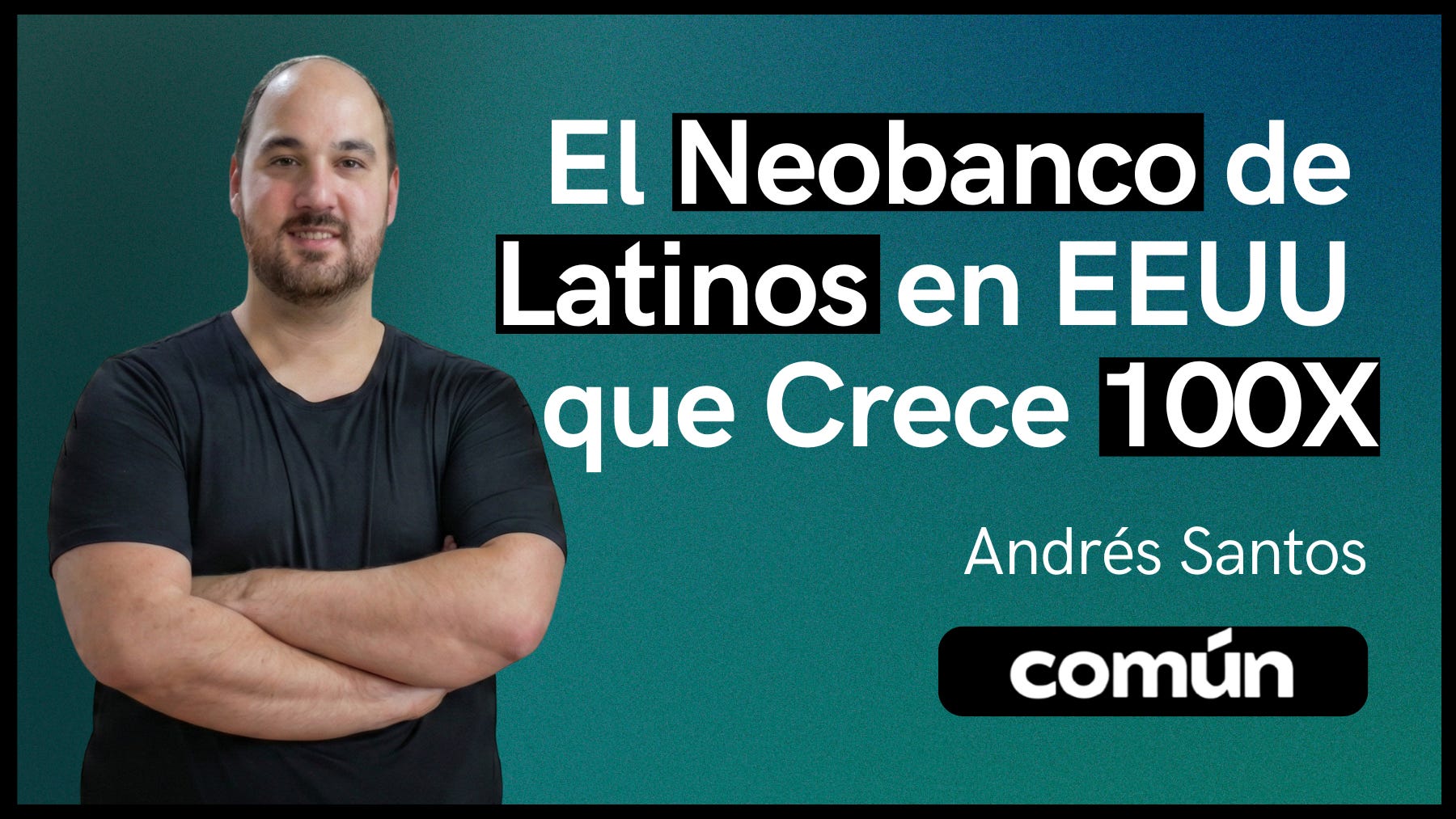
Today I interviewed Andrés Santos, cofounder and CEO of Común, the neobank for Latino immigrants in the United States. In 2025 their revenue grew 100 times, and today they process more than 1,000 million dollars a year in payments.
That attracted funds such as Redpoint, Costanoa, and FJ Labs. Harvard wrote a case about one of their decisions.
His story starts much earlier: a restaurant in Monterrey at 17, a job at Grupo Alfa at 15 because his grandfather told him that before being his own boss he should learn from someone who does it well, and leaving university, which he postponed for three years.
We talked about the time a millionaire investor told them that if they did not join him he was going to crush them, about why they rebuilt their infrastructure from scratch while growing 20% a week, and about why he froze the marketing budget right after raising their Series A.
Structure and Key Highlights
Monterrey, Age 17, a Restaurant, and a Warning
- His first business was a restaurant franchise. In that Monterrey the startup world did not exist, so starting a company meant opening a restaurant or a service
- A beverage supplier very casually warned him that they were going to come and demand protection money. They never came, so it stayed a scare
- He ran the operational side practically on his own, dealing with theft and with employees close to difficult environments
- Looking back, he would not open a restaurant again, but he is grateful
- His diagnosis of the underlying mistake: he started it thinking about what came next, as a springboard toward a holding company. That is the wrong framework, because when the difficulties arrive and you do not love what you do, the motivation is not there
The Decision He Postponed for Three Years
- He ran the business in parallel with his degree at Tec de Monterrey, and neither of the two was going well
- The Bezos line he uses: stress does not come from being busy. It comes from decisions that are in your control and that you are not taking
- He knew he had to decide, and he put it off for three years
- What he felt he was giving up: not working at a large company in Mexico, not doing a master’s. Practically saying that from then on he would control his own opportunities
- He was the only person he knew in his city who did it at that moment
- A former professor recommended a hybrid program at Northeastern, in Boston, and that is where he finished his undergraduate degree. After that, he was able to do a master’s
Grupo Alfa at 15
- His first entrepreneurial attempt was selling artisanal cheese from house to house
- He told his grandfather that he was ready to start his company. His grandfather answered that if he wanted to be his own boss, he should first learn to work for someone else, and not for just anyone, but for someone who does it at the highest caliber
- They adapted an internship program designed for university students so that he could join it. He left high school at 3 and worked until 7:30, every day
- He joined the finance area right after the crisis, with the whole derivatives issue shaking the large companies in Mexico
- The restaurant idea came out of that: he saw, on the Bloomberg terminal, an article about a Spanish company that was expanding, he called them to offer himself, and it took a year to convince them
From Sigma to the Idea of Común
- He went back to Alfa, to Sigma, first into a role that he invented himself and then into strategic planning, where the IPO with Goldman fell to him, along with M&A topics
- While growing a category in the United States and in Mexico, they realized that the demand came from the Hispanic customer who grew up with those brands and now lives there
- That pulled him into studying Hispanic stores, almost all of them owned by immigrants, with the whole family involved
- His observation: it is a very underserved population that grows faster than the rest, and one of the few that can still reach the American dream of arriving with nothing and building wealth
- The problem he saw: that path takes generations. With technology it could take two or three years
- His read of the population: migrants are the entrepreneurs who took the extra risk of stepping out of their comfort zone
- And the psychology is about family. They do not want a better car. They want their parents to have a dignified retirement, and they want their children born there to have equal opportunity
MIT and Chasing Fabrice Grinda
- He heard him give a class and decided that he had to talk to him
- He got the January winter internship, went to New York, and from there he strung together the semester, the summer, and the whole second year
- What he admires most about him: he lives his own way, he does not follow any status quo, and he decides from first principles
- What he learned at FJ Labs: they did the first filter of who to call, the first call, the investment committee, and the follow-up all the way to close
- Talking with founders in healthcare, fintech, and marketplaces, he saw which models work and which metrics matter. He calls it his real MBA
- He also helped incubate ideas in the fund’s venture studio
Why Now, if Nobody Had Pulled It Off Before
- There were attempts for decades, but they were focused on the corner store. Companies like Oportun put kiosks inside large Hispanic stores, and that was the model until around 2015
- Two things were still not working: Latinos were still deep in the cash economy, and the infrastructure between regional banks and fintechs did not exist the way it does today
- COVID changed the first one. With nobody leaving the house, cash stopped working, and there was a strong shift in consumer preferences
- Banking as a service APIs changed the second: the cost of building an MVP dropped radically
- The result was that in 2021 and 2022 they had eight competitors doing exactly the same thing
- His comment on that: things that come easy also go easy
The Investor Who Wanted to Crush Them
- When he found out that Andrés and Abiel were going to compete with him, he wrote to them saying that if they did not join them, they were going to invest heavily in the idea and they were going to crush them
- Days later, investors who were already very close started to pull back. The round fell apart
- At the same time, a friend was raising from Andreessen with a similar idea
- What worried him the most: it was the first hard challenge they were facing together with his cofounder
- They ended up raising 4.5 million, oversubscribed, led by Costanoa
- His read of Silicon Valley: it is a small place where everyone talks to one another and follows one another. In that moment it became clear who was following and who was thinking for themselves
What to Look for in the First Round
- His thesis: the first round is not for landing the brand names you want. It is for having the people you want beside you for the next 10 years
- The useful question is who is going to make a difference when things are not perfect, not who has the biggest fund in which you are a small check
- They ran a process of two and a half weeks. They had a term sheet on the second day and another on the last day. They chose the one from the last day
- The offer they accepted was not the one with the highest valuation
- What convinced them was the process: the investor told them he needed to do research, and in two weeks he spoke with remittance CEOs, with marketing companies focused on the Latino market, and with executives at Western Union
- When he reached his conclusion, he flew to New York, took them out to dinner, and gave them the offer
- On competition: at the beginning it only matters in two places, raising capital and hiring. Outside of that, it does not matter
- And chasing what everyone else does leads you to make the wrong decisions, because you lose sight of how to give more value to your customer
Rebuilding the Infrastructure from Scratch
- They had used a banking as a service provider to test product market fit, and they were growing close to 20% a week
- They decided to start over from zero with their own technology, connected directly to a bank. Nine months of building with no results, while everyone else was growing
- The common wisdom at dinners of fintech founders was that a company at seed should never do that, that it is a Series C or Series D thing
- His nuance on that: common wisdom is often a narrative that someone else is pushing, and in fintech there are vendors who sell their version of the world to the VCs, who believe it and repeat it
- The margin reason: in fintech the margin is small and it is already set, often by law, and who is in your stack defines it
- The deeper reason, which is the critical one: with a vendor in the middle, any feature you ask for and that they prioritize becomes available to all of their customers. Differentiating yourself over the long term becomes impossible
- How they held the conviction: they already had thousands of users, they knew what those users were missing, and they knew there would be demand
- They relaunched in November 2023 with zero revenue. They broke a million around February and two million in March
How to Decide When to Go Against the Advice
- The compounding frame: people predict one year well and ten years very badly, because we are not built to estimate the compound effect
- His guiding question: how do I get into decisions that build something of my own that grows with my input. A company is exactly that, a compounding vehicle
- The other frame is expected value multiplied by probability. For some decisions the appetite for risk can be high, and for others it can be very low
- The question that closed this decision: if I want to be doing this for 20 more years, does it make sense to change the infrastructure while generating 100 million, or while generating 100,000?
Freezing Marketing After the Series A
- After raising from Redpoint, he told the team they were not going to increase marketing spend. The growth had to come from the product
- The constraint had two goals: force creativity in the product, and push the marketing team to look for channels that are not correlated with the algorithms of Meta and TikTok
- The risk he was protecting against: there are companies that depend 100% on that, and a change in the algorithm or a change in iOS breaks your go to market
- The result in the revenue mix: they started 2024 with interchange at 80% of their revenue, the way Chime was for almost its entire life. Today it is around 35 or 40%
- They grew revenue per user 4x in 2024, well above what is normal in fintech, going after a market that is considered low income
- Why it is possible: it is a family with complex needs that lives cross border, so remittances and the holistic picture of the family enable products that do not exist in the market
- The underlying logic: you raise acquisition spend as revenue per user goes up, not before
A Fintech Led by Engineers
- His investor describes it this way: most fintechs are led by marketing people, and Común is led by engineers
- Why it matters: their users often cannot open an account because of documentation issues or supporting documents. Solving those edge cases requires their own technology
- How they structure it: the largest team is the technical team, and they look for technical profiles even in operations
- His argument about service: if you hand every point of contact to a human without capturing the learning, that learning gets lost
- They see the company as a system that has to be optimized in order to scale
- Their engineers work in the New York office, not spread out across Latin America, and they are horizontal profiles with good product intuition
- His read on why that has aged well: with AI you raise the output, but you still need the strategist who understands the whole system
What AI Enables in Fintech
- He is in Claude Code every day. He calls it his current obsession
- The concrete part: product people deploying to their systems while keeping the standards, something that was not possible three months ago
- The limiting factor was always how many engineers you have, and that is expanding
- His working question: in a world where the cost of code is zero, what future can exist in fintech
- The structural problem of the sector: margins are low, and the public companies that report a 90% margin have all of the expenses below that and are close to break even
- The only way to reach SaaS-like margins is not to depend on third parties for every piece of the stack
- His reference: Robinhood was a business model innovation, not an interface innovation. Before, a human charged a commission on every transaction, and they made it free
The Analogy that Explains the Ambition
- One of his criteria when he evaluated the idea was that a path existed to 100,000 million in market capitalization. Not that they were going to get there, but that the path existed
- The historical context: the United States had thousands of local banks designed to know their community well, and consolidation through M&A left enormous banks with the local need still intact
- His question: in a world where nobody goes to the branch, is the local bank still defined by geography, or by something else?
- The case they study is USAA, which only serves military members and veterans. With around 16 million members, it is one of the ten largest banks in the country, and it has the highest revenue per user in consumer
- They pulled it off by speaking to a population that the other banks saw as high risk, a risk that did not exist in the numbers
- There are many more Latinos than there are military members, they are growing faster, and they are more underserved
- His vision: a product centric bank that brings the two families together, the one here and the one there, inside the same system
- His difference from the people who attack this from remittances: they want the person who generates the money to have control of that money
- Who he thanks: his grandfather, who pushed him to work at 15 and set standards of excellence for him, and his parents, who have said yes to everything he has wanted to do
Silicon Valley Glossary
| Term | Meaning | Context in the episode |
|---|---|---|
| Banking as a service | An API that connects you to a bank without you holding the license | What they used to test product market fit, and what they later left |
| Interchange | The fee that gets split every time you swipe a card | It went from 80% of their revenue to around 35% |
| Revenue per user | How much each customer generates on average | They grew it 4x in 2024 with product, not with marketing |
| CAC and payback | The cost of acquiring a customer, and how long it takes you to recover it | The equation that many consumer fintechs never solved |
| Diminishing returns | When spending more stops bringing results in proportion | What happens with Meta and TikTok when you raise the budget |
| Expected value | The size of the opportunity multiplied by the probability of success | His frame for deciding when to take high risk |
| Compounding | The accumulated effect of decisions that reinforce one another over time | His criterion for choosing what to get into |
| Term sheet | The offer that formalizes an investment | They had one on the second day of the process, and they chose the one from the last day |
| Common wisdom | What everyone repeats as established truth | In fintech, sometimes the narrative of a vendor selling to the VCs |
| Product centric bank | A bank defined by who it serves, not by where it is located | Their model, taken from the USAA case with the military |
People, Companies and References
People Mentioned
- Andrés Santos: cofounder and CEO of Común, from Monterrey
- Abiel: his cofounder, the person with whom he started the idea in New York
- His grandfather: told him that before being his own boss he should learn from someone who does it at the highest caliber
- His parents: supported him even when he left university
- Fabrice Grinda: the angel investor he chased until that investor hired him, a previous guest on the podcast
- Mark Selcow: from Costanoa, the person who led their seed round after doing the research on his own
- Enzo Cavalie: host of the podcast
Companies and References
- Común: neobank for Latino immigrants in the United States, more than 1,000 million a year in payments
- Redpoint, Costanoa, and FJ Labs: their investors
- Grupo Alfa and Sigma: where he worked starting at 15, and where he saw the Hispanic market in the United States
- MIT: where he did his master’s and where he met Fabrice Grinda
- Northeastern: where he finished his undergraduate degree after leaving Tec de Monterrey
- Oportun: the earlier model for serving the Latino market, with kiosks inside stores
- Chime: the reference for a consumer fintech sustained by interchange
- USAA: the bank only for the military, which he uses as proof that community can replace geography
- Robinhood: his example of a business model innovation, and not an interface innovation
- Claude Code: the tool he is in every day