The audio and video are in Spanish. These notes are a translation.
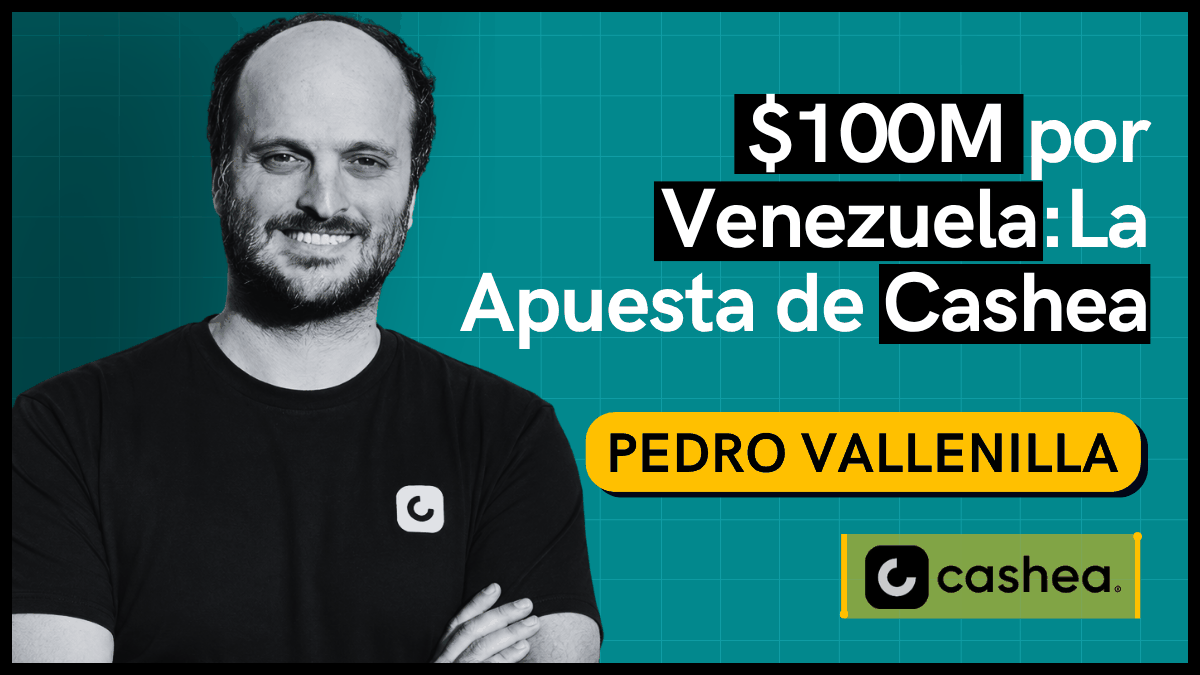
Today Pedro Vallenilla returned to the podcast, founder and CEO of Cashea, the most used credit and commerce app in Venezuela, with more than 11 million users and a network of 40,000 merchants.
Cashea generates $300 million a year in revenue and just announced a $100 million round, the largest venture capital round in the country’s history.
The round closed in June. Weeks later, while they were planning the announcement, the two earthquakes happened. Pedro tells how that completely changed the meaning of the celebration, and how having the capital already closed let them waive reactivation fees and advance money to the affected merchants instead of protecting cash.
We also talked about why he stopped telling Venezuela’s story in San Francisco in order to tell it by walking Caracas, and why he believes the greatest economic miracle of the century is going to happen in his country.
Structure and Key Highlights
The Earthquake and the Moment of the Announcement
- The round closed in June, before the earthquakes, and the announcement was in planning when they happened
- Having the capital available let them waive reactivation fees and advance capital to affected merchants
- They launched “Venezuela, I believe in you” to expand benefits during the reconstruction
- The response from the board and the new investors: that is what the capital was for
- Most companies in that situation protect cash, and they did the opposite
The Structure of the Round
- They were coming off having raised only $2 million in total
- They closed a Series A and went straight into a Series B
- The amount is made up of two tranches: 40 million first and 60 after
- Profitability since Q1 2024 gave them the luxury of taking their time and owning their own process
Why the Conversations with Investors Changed
- For years the reason for the rejection was the country, not the company
- His nuance: it was not January 3 that changed everything. Already, once they passed $120 million in run rate, the conversations opened on their own
- What did change was stopping telling Venezuela’s story in San Francisco, New York, London, Miami, São Paulo, or Buenos Aires
- They took dozens of investors to walk Caracas and interact with Venezuelans
- The trip also worked as a filter: it separated curiosity about a $300 million company from those who really wanted to invest
- The team already had the habit: 15 nationalities in 12 countries, and they always brought the foreign team to the country
The Country Thesis
- Access to credit in Venezuela is 3% of GDP, against a 30% Latin American average
- If they only reached that average, the size of the business changes scale
- His calculation: a $10 billion revenue business, the one Nubank had until recently, is possible in Venezuela
- The country has the largest oil reserves in the world and was once a half-trillion-dollar economy
- Current oil production of 900,000 barrels a day, with a target of 1,200,000 and a theoretical ceiling of 4 or 5 million
- His first OKR: build the highest-impact company in Venezuela in the 21st century
- He talks about a mission of decades, not of years
Moving Back
- When they were going to record in San Francisco he canceled the trip: he was moving to Venezuela
- In the previous conversation the plan was to expand to Central America, and it ended up being the opposite
- What moved him: you feel the purpose by being in Caracas
- On his wife Jessica, who had already told him Cashea was the last attempt: he thanks her for not getting carried away with the news and for keeping him grounded
Advice to Venezuelan Founders
- Today there are flights, fund visits, and private equity looking at the country, something unprecedented
- His warning: nobody should assume the tap opened and trillions are going to come in
- “Let’s build coherent businesses”, profitable, that stand on their own with or without capital available
- Obsess over living off customers and not off investors
- Today there is interest in Venezuela. Tomorrow there might not be
What Is Next for the Product
- He does not want to put a label on it: Cashea is not Mercado Libre, it is not Kaspi, it is not Nubank
- The clear vision is to keep enabling local commerce and give financial tools to users
- The challenge is not the optionality of what to build, but in what order and at what cadence
- The Venezuelan regulatory framework still has a long way to go compared with the Brazilian, Mexican, or Argentine one
- They are having the country’s first conversations about warehouse credit facilities and Brazilian FIDC-style structures
- He wants other big technology companies to enter the country, including what it means for Uber to buy Delivery Hero and, with that, land in Venezuela
What to Keep When the Country Normalizes
- When bank credit and competition come back, the market Cashea was born for stops existing
- “What got us here is not what is going to get us there”
- What is not negotiable: the day profitability becomes optional, Cashea stops being Cashea
- His three metrics: revenue as a signal of ambition, profitability as responsibility, NPS as proof that they build something people value
- They went from 0 to $300 million in run rate in less than three years, and they expect to be even more aggressive
- Luis Echevarría, of Goodwater, told him their metrics were world class when evaluating the investment
On the Symbol
- He does not experience it as responsibility but as the luck of being able to build for a country off the map
- He left in 2017 and describes the shame many Venezuelans felt for what the country stopped being
- What he hopes is that others found companies bigger than Cashea
- To the skeptics he says that skepticism is good, because it forces you to go in with your eyes open
Silicon Valley Glossary
| Term | Meaning | Context in the episode |
|---|---|---|
| Revenue run rate | Annualized revenue by projecting the current period | The metric he uses to describe Cashea’s jump: from 120 to more than 300 million |
| Series A / Series B | Successive investment rounds as the company scales | They closed the A and went straight into the B, for a total of 100 million |
| Super app | An application that concentrates several services on the same user base | The category he is aiming at, even though he avoids the label |
| NPS (Net Promoter Score) | A measure of how much users recommend a product | One of his three success metrics, along with revenue and profitability |
| Flywheel | A cycle in which each new product accelerates the ones that follow | How he describes the chaining of his roadmap |
| Optionality | The range of businesses that distribution and brand open up for you | His advantage: the problem is not what they could build, but in what order |
| Warehouse credit facility | A wholesale credit line to finance a loan portfolio | The first conversations of this kind in Venezuela |
| FIDC | A Brazilian vehicle for securitizing credit rights | The model they study to structure local financing |
| Leapfrogging | Skipping stages of development and adopting the most advanced thing directly | His read on why markets like this allow quantum leaps |
| Capital efficiency | How much revenue you generate per dollar raised | His differentiator: 300 million in revenue after raising only 2 |
| Cash collateral | Cash posted as a guarantee that backs a transaction | The kind of arbitrage Venezuela allowed and other markets did not |
People, Companies and References
People Mentioned
- Pedro Vallenilla: founder and CEO of Cashea
- Jessica: his wife, who had told him this was the last attempt
- Luis Echevarría: of Goodwater, evaluated the investment and called their metrics world class
- Enzo Cavalie: host of the podcast
Companies and Organizations
- Cashea: credit and commerce app, 11 million users and 40,000 merchants
- Goodwater Capital: a fund with comparative fintech data globally
- Nubank: the scale reference, with the $10 billion in revenue Pedro uses as a possible ceiling
- Mercado Libre / Mercado Pago: the Argentine playbook of commerce plus fintech
- Kaspi: the Kazakh super app, another reference he mentions in order to set it aside as a label
- Uber and Delivery Hero: the acquisition that would bring Uber to Venezuela via Pedidos Ya
- Local stock exchange: an ally in their credit solutions
- Notion: sponsor of the episode
Data and References
- 11 million users and 40,000 merchants: the scale of the network
- $300 million: current annual revenue
- $100 million: the round, in tranches of 40 and 60
- $2 million: everything they had raised before
- 3% versus 30%: credit penetration as a share of GDP in Venezuela versus the regional average
- Q1 2024: since when they have been profitable
- 900,000 barrels a day: current oil production, with a target of 1,200,000