The audio and video are in Spanish. These notes are a translation.
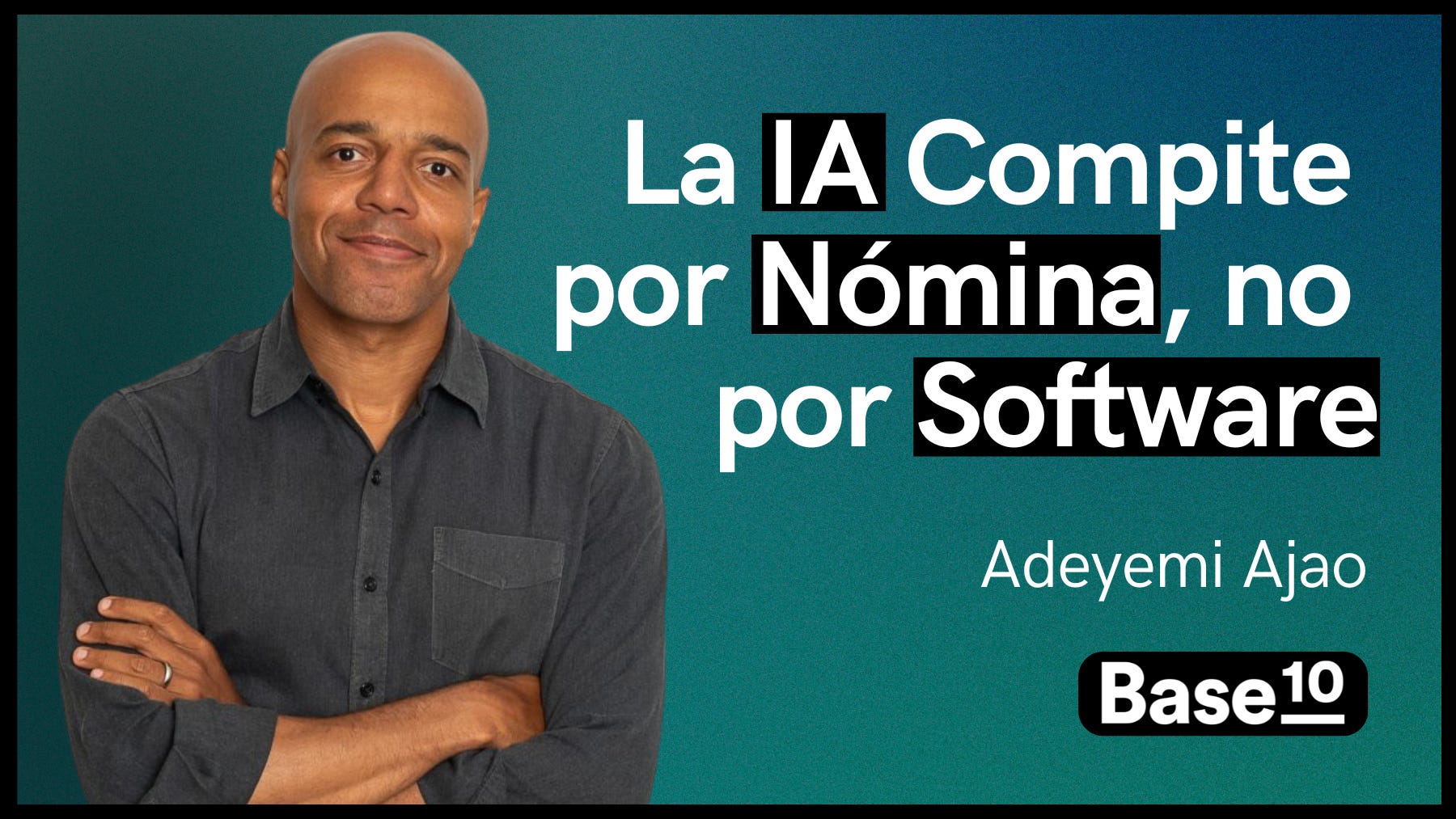
Today I interviewed Ade Ajao, founding partner of Base10, a Silicon Valley fund that manages close to $2 billion and invests in companies that automate the real economy. Its portfolio includes Nubank, Figma, Brex, Rappi, and Notion.
Before Base10, Ade founded Tuenti, the Spanish Facebook, and sold it to Telefónica for 100 million when he was 26. He later cofounded Cabify and sold his next company to Workday.
He was born in Nigeria to a Nigerian father and a Spanish mother, grew up in Spain, and has spent 16 years in Silicon Valley. His mother told him as a child that with that mix he was not going to fit in anywhere, and that this was fine.
We talked about why he had to learn to pitch like an American, about the only signal he gives more weight today when he evaluates a founder, and about his current thesis: that AI does not compete for the software budget but for the payroll budget.
Structure and Key Highlights
The Ones Who Do Not Fit
- His parents met on a plane and were not even sitting together. His father saw his mother walk past, she was traveling with her grandmother, and he took the chance
- He has lived in Africa and Europe, and he has done business in Latin America and the United States. There were periods of feeling neither from here nor from there
- His mother’s line when they came back from school saying they did not fit in: you are such a mix that you are not going to fit in anywhere, so forget about that and be yourselves
- His reading of that line today: when people tell him to invest in Europeans, in Latinos, or in minorities, his answer is that everything is the mix
- He has spent 16 years in Silicon Valley and he still understands it, among other things because it changes all the time
- His broader observation: with AI, the whole world is going through the question he lived as a child, where do I fit
Selling Tuenti at 26
- What changed him most was not the money but the evidence that it could be done. That a group of 22-year-olds could start a startup, grow it, and sell it did not fit the Spain of that time
- His university professors told him not to throw his career away over putting photos online
- He offered jobs at Tuenti to several of his best classmates, and they told him that was not something you did
- What makes him proudest: close friends around that story who decided that they could too, and today they have companies bigger than Tuenti
- His half joke, half serious line: if I look at him and he can do it, it cannot be that hard
- The week before he was with Spanish engineers between 20 and 30, and he left with two conclusions: they all take it for granted that it can be done, and he is glad he does not have to compete with them
Learning to Pitch Like an American
- What cost him most to adapt was confidence. In Spain the educational and social system teaches you to ask permission and to be grateful, and meeting a deputy director is like an audience with the Pope
- In Silicon Valley someone offers to introduce you to the CEO by email and grab a coffee, and your internal reaction is to ask yourself why that person would talk to you
- The feedback that marked him: a friend in venture capital told him he was missing arrogance, because an 18-year-old who had done an internship at Microsoft had just pitched them introducing himself as an advisor to Bill Gates, and Ade was not even mentioning that he had founded and sold a company
- What changed him: 50 funds telling him no. Either he went back to Spain, or he learned to do the pitch like an American
- It still does not come naturally to him, but he changed out of necessity
- The good thing about an environment like that, in his view, is that it forces you to give your best and it gives you feedback very fast, and that people are also open when things are going badly for them
What It Means to Sell Like an American
- Above all, being direct. In Hispanic culture the message comes wrapped in description and feeling, and that is why we have such rich literature
- The advice he received before speaking with a legendary founder: billionaires do not have time for you to get to know them, they want you to sell them something
- They got there because they like business opportunities, so when they talk to you they are looking for where the opportunity is
- The practical translation: instead of “I would love to grab a coffee and chat”, something like “I know X interests you, here are two, tell me what you think and I will get you three more”
- His nuance on the transactional side: what is inauthentic is wanting something and not saying it when it is obvious
- His example of authenticity: people at the top of their profession are consistent. Dinner with someone like that is uncomfortable unless you want to talk about their subject, and then there is nobody better
The Real Economy Thesis
- Base10 started in 2017 with the tagline “Applied AI for the real economy”. The feedback he got from LPs was that applied AI was not a category, so he changed it to automation
- He showed that old deck at this year’s annual meeting to remind them of it
- Where the thesis came from for him: launching a car service in Peru with Cabify, and later Rappi, Nubank, Instacart, and ShipBob
- His experience at Workday points there too. It fell to him to serve clients such as Life Time Fitness and Chuck E. Cheese, where the question was genuinely what can be done with this data
- He was working with neural networks in 2011 and 2012, and in 2014 he presented the Workday board with a benchmark of when AI was going to solve each game. He put Go at about 20 years, and AlphaGo won about nine months later
Why Slow Industries Now Buy Fast
- His surprise is genuine: he never thought it was going to go this fast
- The cultural factor seems as important to him as the technological one. Now people believe it
- His comparison: the transition to the cloud started around 2002, and in the United States we are still close to fifty percent on premise. Twenty years for half the country
- The transition to mobile was faster because people bought iPhones and played with them. It was much less abstract than the cloud
- The same thing is happening today with chat. People use it all day, they arrive at their company, they cannot use it, and they conclude that it is needed
- So ChatGPT and Claude did the work of evangelization, and startups arrive at a customer who is already prepared
- He sees adoption everywhere: logistics, financial services, legal, food, agriculture. What surprises him most is legal
- On small and medium businesses: in Latin America WhatsApp Business is used much more than in the US corporate world, and the same thing is happening with AI. For a five-person company the change is immediate, and that is why they want it now
Defensibility, Without a Framework
- His answer when they ask him where the defensibility is: he has no idea, and he does not believe anyone has it
- His argument: Karpathy, Amodei, and Altman could sit down and build a framework that would be obsolete the day after tomorrow
- What they do at Base10 instead is go to the people more than ever. If we are heading toward a world where anyone can build a Salesforce, he is not smart enough to solve it, but that founder is
- The case that illustrates it: a full month of research in a healthcare subsector, more than 30 companies, 50 customers, a team of four people
- The work was useful for learning the market and for seeing which teams were more interesting, not for arriving at an answer about where the market is going
- The final decision was entirely about people. They did not pick the biggest company, and they did not pick the one that was growing fastest
The Only Thing that Has Never Failed Him
- What carries the most weight today in his evaluation of a founder is his own desire to work with that person
- He has been wrong more often than he has been right, which is part of the business, but he prefers to be wrong with people he wants to work with
- His central observation: it has never happened that he was right about people he was not eager to work with
- He does not confuse that with agreeing. He is in continuous disagreement with his team, his family, and his friends, and he loves working with them
- He does not try to compete with Marc Andreessen, Doug Leone, Mike Moritz, or Peter Thiel. His conclusion is that he is who he is
- The practical consequence: when he finds the person, the stage matters less. They have done terms they normally would not do, always within limits
- The lesson still pending: he puts his personal capital into the fund, but the math of returning a fund is different from the math of investing as an angel
Selling Against the Payroll Budget
- The thesis in one line: invest in companies that do not compete for the software budget but for the payroll budget
- They discovered it by talking to customers, not on a whiteboard
- The consequence is hard: if the money comes out of the customer service budget, the product has to solve customer service, not leave a note for a human
- Higher demands on the product, but also a much larger budget
- When they ask him whether that makes an AI startup operate more like a consultancy than like a technology company, he answers with his own mistake: 14 years ago he did not invest in Palantir because he saw it as a consultancy
- The lesson he drew: do not put labels on it when you are in front of a new model. If they ask you whether it is consumer, SaaS, or services, the useful answer is what the expectation is, what the price is, and what the service is
The New Growth Bar
- Of the hundreds of companies they evaluated internally in the first eight weeks of the year, at least a third grew more than 5x last year
- A year and a half ago, it was enough for someone to write him saying a company had grown 5x for him to ask for the introduction right away
- Now most of the time goes into deciding whom to meet, because there are always two competitors growing faster
- His close example: Happy Robot grew 10 times in a year
Science Fiction as a Method
- Every science fiction story starts with the same question: what if
- The best science fiction is not about technology but about human nature. The first one, Frankenstein, is exactly that
- His recent examples are deeply human stories: Arrival, Ex Machina, Her, Dune
- How he applies it to the work: in the end what matters is the human, the founder
- And the mental habit he carries with him: ask what could go right, not what could go wrong
- Whom he thanks for having thought big: his mother, for making it clear that he should forget about fitting in, and his wife Emily, the person who believes in him the most and the one he consults on the important decisions
Silicon Valley Glossary
| Term | Meaning | Context in the episode |
|---|---|---|
| Payroll budget | The line item used to pay salaries, not tools | The one agents compete for, according to his current thesis |
| Real economy | Physical and traditional industries, not pure software | Logistics, banking, insurance: Base10’s original thesis in 2017 |
| Applied AI | AI applied to a concrete business problem | The tagline the LPs asked him to change because it was not a category |
| On premise | Software that runs on the company’s own servers | Half the US market is still there, 20 years later |
| Defensibility | What keeps a competitor from copying you | The question he says he does not know how to answer, and that he believes nobody knows |
| LP | The investors who put the money into a fund | The ones who told him in 2017 that applied AI was not a category |
| Pre-seed, seed, Series A | The financing stages of a startup | It stops mattering to him when he finds the right person |
| Wrapper | A product built as a thin layer on top of a model | The discussion about where the value is, whether in the model or in the application |
| Pipeline | The flow of opportunities a fund evaluates | Hundreds of companies in eight weeks, a third growing more than 5x |
| Self selection | The environment on its own filters for whoever is willing to compete | His description of why the people who are in Silicon Valley are there |
People, Companies and References
People Mentioned
- Ade Ajao: founding partner of Base10, previously Tuenti, Cabify, and Workday
- His mother: Spanish, the line about not fitting in that organized his life
- His father: Nigerian, the one who dared to speak to his mother on the plane
- Emily: his wife, the person he consults on the most important decisions
- Simón Borrero: founder of Rappi, his example of the effect of having close role models
- Marc Andreessen, Doug Leone, Mike Moritz, and Peter Thiel: the legends of the industry he does not try to compete with
- Andrej Karpathy, Dario Amodei, and Sam Altman: the ones who could build a framework that would still end up obsolete
- Enzo Cavalie: host of the podcast
Companies and References
- Base10 Partners: his fund, close to $2 billion under management
- Tuenti: the Spanish Facebook, sold to Telefónica for 100 million
- Cabify: cofounded in 2012, his first experience with automation of the real economy
- Workday: acquired his company in 2014, where he worked with machine learning applied to human resources
- Nubank, Rappi, Figma, Brex, Notion, Instacart, ShipBob: portfolio investments
- Happy Robot: the company close to him that grew 10 times in a year
- Palantir: the investment he did not make because he put the consultancy label on it
- Harvey: the adoption in the legal sector that surprised him
- AlphaGo versus Lee Sedol: the milestone that arrived a decade earlier than he had projected
- Frankenstein, Arrival, Ex Machina, Her, and Dune: the science fiction he reads as stories about human nature