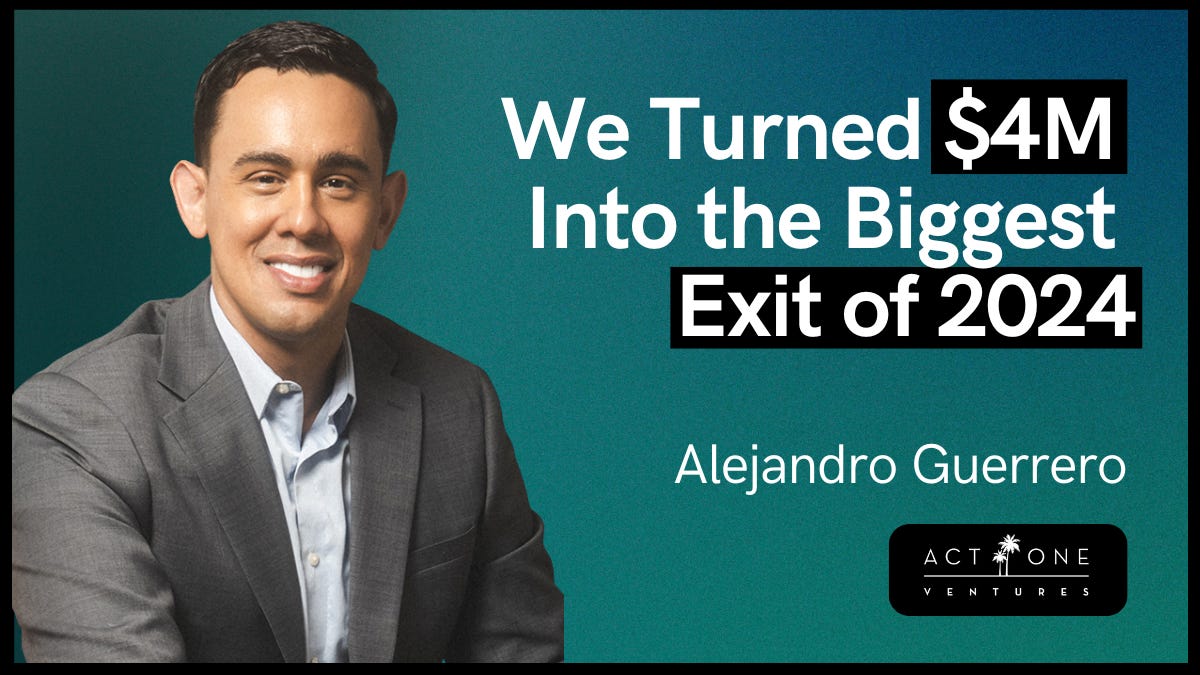
Today I interviewed Alejandro Guerrero, co-founder of Act One Ventures, one of LA’s top seed funds with over $150 million under management.
He grew up in Chula Vista, fifteen minutes from Tijuana, the son of a mechanic. He wanted to work in music, not venture. Act One’s second investment ever, out of a $4 million first fund, was on two accountants nobody else wanted to back. That company became AuditBoard, a $3.1 billion exit in 2024.
The hardest part of this conversation is what he did in 2025: sitting down in person with five or six of his own portfolio founders to tell them they would never raise another venture dollar, and that their product was out of flavor.
Structure and Key Highlights
Growing Up on the Border
- Fifteen minutes by car from Tijuana, with family on both sides
- His read on the line: it truly makes the difference in opportunity, because his public schools were not great but were better than Tijuana’s
- The word he heard from people born there, sometimes from his own family, telling him he was not really Mexican
- His father was a mechanic and his mother volunteered at their schools to keep them away from the wrong crowds
- School and music were his outlets, and he describes dissociating from the hardship around him through both
- What he did with CD liner notes: reading who produced and who wrote, imagining a life he could not picture
Music First, Venture by Accident
- The dream was A&R, artist and repertoire, the people who find talent and see what others do not
- His own observation on the irony: he was directionally correct, he just did not know it would become venture
- Played trumpet seriously, stopped in high school because the AP workload was too intense
- How he learned UCLA existed: a history teacher took the class on a charter bus, and he decided that day
- The critique he got for it: why do you only wear UCLA stuff, what if you do not get in
- What he learned once there: in the music business it is not what you know, and the door in was an internship course whose alumni had become agents and directors
- Worked for the A&R executive who had discovered Linkin Park, and learned the story intimately: Chester was not the original singer, and nobody wanted to sign the band until it came together
- Then the job lined up after graduation was pulled away, and a year later the financial crisis took the next one
Getting into Venture
- He never wanted to be a venture capitalist
- Between his first and second startup he realized raising money does not solve problems, it compounds them, and he needed a network
- He went back to UCLA and cold reached out to the executive director of its venture fund, Michael Silton, a fourth-generation entrepreneur who had taken a company public in 1999
- What he asked for: to volunteer as an associate, not because he cared about venture, but to learn how Michael thought
- The reversal: Michael asked him to help raise money for a new fund, using Alejandro’s entertainment network, and everyone in the meetings assumed they were already partners
- Ten years later, from an activation date of March 11, 2016
The AuditBoard Bet
- Week one of fund one, second investment ever, out of $4 million converted from $10-12 million soft circled
- The introduction came through the UCLA venture network, from a lawyer who knew two internal auditors from high school and church
- Jay and Daniel had spent ten years on Sarbanes-Oxley compliance, drowning in spreadsheets with no centralized data
- What made it contrarian: not engineers, not Stanford, not Harvard, not Meta. Accountants
- The other objection: roughly 2,000 public companies as a market, which everyone called too small a TAM
- What other investors told them: nice exit, but you cannot return multiples of a fund on that
- Michael’s edge: he was a sitting public company CEO when Sarbanes-Oxley rolled out, figuring it out himself
- The company was originally called SOXHub, and rebranded to AuditBoard three or four years later as it moved up to board-level internal controls
- The postscript he enjoys: today everyone building SOX automation is building on top of AuditBoard
What He Actually Learned from It
- What they saw early: a product visionary and a consummate sales person who knew their strengths and did not step on each other
- The depth of industry knowledge, paired with wanting help to understand the venture game rather than having their hand held
- The honest caveat: in sixty-some investments over ten years, AuditBoard is the only company that did what it said it would do from the start
- Everything else pivoted, and most successful companies have one or two near-death experiences
- What made the timing work: the space was undeveloped, with no hundred startups chasing the same thing
- Why that lesson may not transfer: today you lift a rock and see a hundred teams in any category
How He Assesses Founders
- His guiding principle: keep it real, wear his heart on his sleeve
- What he does in first conversations: get them to open up about themselves, which he considers basic and says most investors skip
- The move that levels the field: telling his own story first, that he was poor, that his parents were not rich, that he did not learn to code at five
- Why it works: the founder stops seeing a power dynamic and sees a human
- What he is really trying to read: how someone responds when things do not go their way
- The two failure modes he watches for: founders who have never dealt with pain, and founders so ashamed of their pain that they hide it
- On venture as a craft: it is an apprenticeship business, and he had a partner twenty years older for exactly that reason
The Part of Venture Nobody Sees
- His iceberg framing: everyone thinks venture is the tip, the investing. The other 90% is administration and getting the money out
- Anyone will take a million dollars from you. The hard part is getting it out, tax-advantaged, timed to a cycle
- The story that shaped him: Michael’s company went public in 1999, he was worth a quarter billion on paper, and a year later it fell 99% because he could not sell in time
- What that taught: paper means nothing, it is a flash point in time
- What they did with AuditBoard: sold a third of their shares in a secondary at $3 billion in September 2021, at the top of the market
- Then the market crashed, and in 2022 they ran a process and sold another third at $2.5 billion
- How they did it: working with the founders and the CEO, not marketing it as an open process, to avoid disrupting a valuation the company was using to recruit
- The context that made it matter: AuditBoard raised only $43.5 million in primary equity for a $3.1 billion outcome
- His term for it: the scalpel approach instead of the bludgeon
What AI Is Doing to B2B Software
- His starting position: the rules are being rewritten and he does not know how it shakes out
- What he is sure of: enterprise AI, vertical or horizontal, is about speed, and the moats that used to exist are not really there
- The inversion he describes: hard skills are being commoditized, and the barrier that kept people out for a long time is coming down
- The advantage that is disappearing: private-school preparation that made technical skills a compounding head start
- The counterpart: the value of human skills, network building and connection, is going up
- What Act One built for itself: their own agent trained on ten years of memos and deals, guided by principles they developed, which he calls a super analyst
- Their structural advantage entering this: a ten-year track record with a power law already in the portfolio, not conclusions drawn from someone else’s data
Their Own CRM Switch
- Every fund complains about their CRM, because the data entry never happens and you forget the follow-ups that would have converted
- They tested a native AI CRM that came out about a month before, worked with their security partner, and went all in
- How he uses it now: everything through chat, with a voice connector so he talks instead of typing, connected to his email
- His read on the incumbents: the walls of the Salesforces are still there and there is real value, but nimble players will keep chipping
The Three Buckets of the Portfolio
- Fund one, eight to ten years in: either you created enterprise value or you did not, so the question is how to bolt on AI and get a premium at exit
- Fund three, a 2022 vintage of $73 million: they deliberately did not deploy fast, doing a third of the deals of their first two years
- The result of that discipline: 2x DPI, and a fund that effectively became AI native because they still had money when the game changed
- What people said at the time: nobody cared about secondary strategy in 2022, and now everyone asks about it
- Fund two, a 2019 vintage, is what he calls no man’s land: not old enough to have created enterprise value, not AI native
- The pandemic forced them from leading seed rounds into pre-seed with a $23 million fund, which is risk on risk
The Conversation He Chose to Have
- Five or six companies with product, customers and a few million in revenue, facing the headwind of AI
- The verdict he delivered: you are never going to get another venture dollar, you are not going fast enough, and your product is out of flavor
- Why he did it: as a founder, he would want his investor to tell him the truth, because founders deserve that respect
- How he did it: in person, in each of their cities, not over Zoom
- The hardest part to say out loud: in my books I need to write you down to zero
- Most took it well and one or two did not, which he accepted
- What surprised him: some thanked him, because it freed them from feeling beholden and let them go all in on something new
- What they did next: created a Slack group for all their founders, where people started sharing what was working
- The reframe he offers: your old excuses were needing more money and the right people. What is the excuse now
On Growth as a Signal
- Three years ago 3x year over year was extraordinary. Today he sat with a tier one growth team who said anything under 3x or 4x is uninteresting
- The problem: growing fast is not a long-term predictor, and companies blow up as fast as they grew
- What he looks at instead: unit economics, time to value, and whether the price is right
- The comparison he draws: these companies look more like restaurants, where mispricing puts you negative on margin
- What made AuditBoard different: quality of revenue, enterprise contracts, integration in weeks, and growth partly financed by customers
Who He Thanks
- Michael, for pushing him through the discomfort of the job and insisting they innovate rather than run a cookie-cutter fund
- The conversation he remembers: a dinner in Vegas while closing a hard second fund, agreeing they did not know exactly where they were going but would keep adapting
- His parents, whose version of thinking bigger was telling him they could never do what he was doing, so they would not tell him what to do
- Where he is now: forty years old, moving to San Francisco with his girlfriend and her animals, because there are not many VCs in their forties who move
Silicon Valley Glossary
| Term | Meaning | Context in the episode |
|---|---|---|
| A&R | Artist and repertoire, the role that finds and develops talent | The music career he wanted, and the closest analogy to seed investing |
| TAM | Total addressable market | The objection everyone raised against AuditBoard |
| DPI | Distributions to paid-in, the cash actually returned to LPs | Their 2x on fund three, and the 1x milestone he refuses to celebrate |
| Secondary | Selling shares before an exit | How they de-risked AuditBoard twice before the acquisition |
| Power law | A few investments generating nearly all returns | What he says guides them, because they have already lived one |
| Founder market fit | Whether this founder is right for this problem | Their actual filter, over TAM size |
| Sarbanes-Oxley (SOX) | US compliance regime for public company reporting | The problem AuditBoard was built on |
| System of record | Software that holds the authoritative data for a process | The category he expects agents to reshape |
| Vintage | The year a fund started deploying | Why fund two, a 2019 vintage, ended up in no man’s land |
| Recycling | Reinvesting early returns instead of deploying fast | Their discipline in 2022 and 2023 |
| Soft circle | Commitments not yet converted into capital | The $10-12M that became a $4M first fund |
People, Companies and References
People Mentioned
- Alejandro Guerrero: co-founder of Act One Ventures
- Michael Silton: his partner, twenty years older, who ran UCLA’s venture fund and took a company public in 1999
- Jay and Daniel: the two internal auditors who founded AuditBoard
- Chester Bennington: whose story he learned working for the executive who signed Linkin Park
- His parents: a mechanic and a school volunteer
Companies and Organizations
- Act One Ventures: over $150M under management across three funds
- AuditBoard: originally SOXHub, a $3.1B exit in 2024
- UCLA and its venture capital fund: where he met Michael and got the AuditBoard introduction
- Linkin Park: the band whose formation he watched from the inside
- Salesforce: the CRM incumbent he expects to be chipped at
- Hybridge: their security partner for the CRM migration