The audio and video are in Spanish. These notes are a translation.
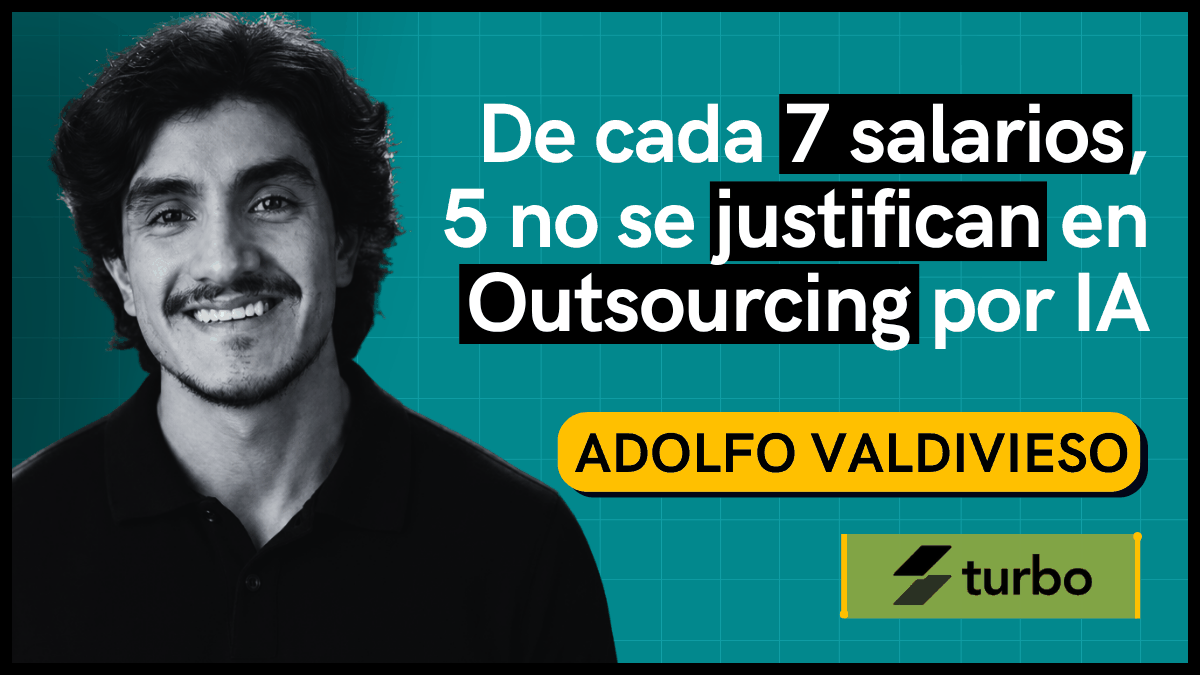
Today I interviewed Adolfo Valdivieso, co-founder and CTO of Turbo AI, an AI native software factory that works with startups and small and midsize businesses in the United States.
Adolfo is a physicist, has been doing machine learning since 2008, and during his master’s at Stanford ended up as the CTO as a service for his classmates. That is where Turbo was born.
His read of the market runs against what you hear in Silicon Valley. Globant and Accenture shares fell more than 50%, and for him that does not mean outsourcing dies. It means a business model expired: the client paid seven salaries and five are no longer justified.
His bet rests on a paradox he says he lives empirically: as agents get better, you need more sophisticated humans, not fewer.
Structure and Key Highlights
The Inventor
- They gave him a Nintendo and he took it apart instead of playing it. They did not buy him another one
- Worse still: at four or five, a Christmas microscope ended with his fingers cut because he wanted to see his own blood, and with his grandmother’s plants cut up
- What hooked him when he opened the Super Nintendo looking for where Mario was: inside, it was the same as a computer
Why Stanford
- He studied physics at UNI and, even before graduating, he was clear that he wanted to get to Silicon Valley
- What he was looking for: a density of capable people and, above all, people motivated to build
- In Lima around 2010 and 2011 the dominant goal was to get into a bank or a mining company, and building something of your own was not an option
- He went to Singularity University first, as a first door in
- He chose the MBA and not a technical program, because he wanted to meet people unlike him with complementary skills
- He had already taken technical classes on his own, including Andrew Ng’s original machine learning course on Coursera in 2011
How Turbo Was Born
- They arrived at Stanford in September 2022 and ChatGPT came out in November. He calls himself part of the luckiest class
- His classmates knew industries and problems he did not, but they got stuck on technical decisions
- What he found astonishing: in the heart of Silicon Valley, with intelligence, a network, and skills, ideas died before they ever saw the market
- In the Startup Garage class they were building coding agents, when the concept did not yet exist as a category
- The discovery that opened the space: generating code had become cheap for the non-technical person, but the barrier to entry was still enormous
The 2014 Intuition
- A mutual friend, Andrés Benavides, remembers that as early as 2014 he was talking about programmers who would not program
- It came from using machine learning since 2008 as a toolkit for problems he did not know how to program
- What impressed him: having no idea why it worked, and that it worked
- He did poetry generation with next-character prediction, learning punctuation letter by letter
- His conclusion then: the idea matters more than the code, and the model will take you to it
Where Turbo Sits on the Map
- He distinguishes the tools that amplify an individual, like Cursor or Claude Code, from what he builds
- His thesis: the intrinsic change is how people collaborate when agents execute part of the work
- Three things he says he is building: something that takes responsibility for decisions and their consequences, something that truly understands human intent, and the system that lets you operate that kind of organization
- On intent: we humans communicate poorly what we want, and if the agent cannot interpret it, it fills the gaps with noise
- Why a client pays: not for the tool but for the work done, with the confidence of steady progress
The Paradox and the Two Studies that Support It
- As agents get better, you need better humans to catch and fix what they generate
- If everyone has the same tools, the field flattens and the scarce resource becomes the top 1% of people
- The METR study measures the length of tasks an agent completes with 50% success: 12 to 16 hours
- The key data point: when you require 80% success, that duration falls to 2 or 3 hours
- The Princeton study on agent reliability shows a flat curve over two years, from 0.7 to 0.8, while the rest of the benchmarks saturate
- His conclusion: a 20% margin remains where the agent can do something dangerous, and finishing a feature is useless if it deleted the database
- His explanation of the stall: post-training rewards the final result and not the process, and the market competes for the highest number on artificial benchmarks
- His version of good, nice, and cheap: with agents you pick two out of general purpose, autonomy, and mission critical
What the Client Is Buying
- On the invoice: he says 100% is for the responsibility, not for the code
- The parallel: you do not hire an engineer to make 100 commits a day
- On objections like “I can do this with Claude Code”: what changes all the time is expectations
- Six months ago a prototype was incredible, and today finishing a feature in a day seems normal
- His personal job is to anticipate what the next barrier is before the expectation moves
Why the Market Is Punishing Globant and Accenture
- The old model assigned a team of seven: one or two seniors plus frontend, backend, QA, mobile, and devops
- The client paid seven salaries, and today five are not justified
- The problem for those companies: going from charging 7x to delivering 10x for 20 or 30% of the revenue, as large, slow organizations whose processes sustain jobs
- But the market is growing: $650 billion today, with a projection of passing $1 trillion by 2030
- The reason: many more things are becoming software
The New Client: The Graduated Vibe Coder
- Small and midsize businesses that used to buy specialized SaaS and pay hundreds of thousands in licenses
- The client’s reasoning: I pay for something where I use 5% of the features and it forces me to adjust to its process
- What changed: they go into Claude Code or Lovable, make a prototype, and convince themselves they can build it
- The strategic shift: SaaS standardized them with their market, and they see their own software as a way to beat their competition
- These small and midsize businesses would never before have hired a consultancy or a software factory
Latin America and Outsourcing
- His thesis on the regional advantage: when execution drops in cost, what becomes critical is coordination and alignment
- That is where time zone and working style become fundamental
- The day is spent coordinating and during the night the work gets executed, versus having one or two hours of overlap
- He does not believe in a wave of unemployment but in a transformation toward a more competitive market
- It is already happening with the training data providers that are moving to those countries
How a Project Works
- Clients arrive looking to hire an engineer or a PM, usually with a project that is a month or two behind
- They start by taking maximum context from the codebase and detecting the gaps
- The team is three: a senior engineer, a senior PM, and GIO, an agent available in the shared Slack channel for status, brainstorming, and prototypes
- There is no designer: they have an internal tool that generates the prototypes
- The agents do implementation, testing, and QA, and the team decides where to place the human decision gates
- The seven roles of the old model collapsed into two: the engineer decides technical quality and verifies, the PM translates business into specifications
How Judgment Gets Industrialized
- His sequence: first improvisation, then standardization, then automation
- The agent layer becomes the way to share knowledge across projects
- The agents learn from past decisions, including proposals that failed
- The difference versus implementing Claude Code inside a company: their agents are public by default and share context with each other
Models and Costs
- They went through searching for the perfect model per process, and through fine-tuning, which they abandoned because it takes months and becomes obsolete
- Then they optimized for pure quality, and Opus was the peak of that decision
- Now, with agents running all day and personal agents for every employee, they are reevaluating on cost
- They are exploring orchestration with subagents on different tiers and models
- There are models comparable to Opus at 15 or 20% of the cost
- He calls it a Jevons paradox: as it gets cheaper you do more, and it gets expensive again
Hiring the Top 1%
- What he looks for has not changed: genuine curiosity, passion, and understanding things in depth
- His interview question: what have you learned in the last 6 months that I should learn. If he walks out knowing two or three new things, he hires
- The signal of a team that really uses AI: they set ridiculously ambitious goals and they hit them
- The contrast: before, hiring the right person took two or three months plus onboarding, a six-month timeline. Now a weekend can generate value
- Many of his engineers worked with him ten years ago and today they do not write a line of code, but their behavior is the same
What He Would Do Differently at 22
- Come to Silicon Valley sooner, without the mental barrier of having to get in through Stanford or Singularity
- His father told him they would buy the ticket and that was it
- Why it seems like a special place to him: it resets your standards
- It took him time to convince himself that he was good on a global scale and not only compared with Peru or the region
- The Paul Graham talk he cites: you are the big fish in the small pond and you will never know how big you are if you do not go
Silicon Valley Glossary
| Term | Meaning | Context in the episode |
|---|---|---|
| AI native | A company built from scratch assuming agents in the workflow | How he defines Turbo versus a traditional software factory |
| Coding agent | An agent that plans and writes code autonomously | They were building them at Stanford in 2023, before the term existed |
| Software 2.0 | Andrej Karpathy’s term: create data so the model produces what we do not know how to program | The vision he already had since 2014, and that today he considers the past |
| Mission critical | Processes where an error has serious consequences | Why 50% success is not an option for a company |
| Human decision gate | A point in the process where a human decides before continuing | What Turbo keeps moving depending on the project |
| Alignment | Clear consensus on what has to be achieved | What he considers the most expensive and hardest part of the work |
| SOP | A standardized operating procedure | The intermediate step between improvising and automating |
| Post-training | Later training that adjusts the model’s behavior | His explanation of why reliability does not improve |
| Forward deployed engineer | An engineer embedded with the client to capture their context | The signal that Silicon Valley changed its view of the human role |
| Jevons paradox | Making a resource cheaper increases its total consumption | How he describes his cost cycle with the models |
| Innovator’s dilemma | When the model that made you big keeps you from adapting | His read on why the big consultancies will move slowly |
| Output elasticity | Being able to multiply the work delivered without renegotiating the team | The differentiator of his pricing model |
People, Companies and References
People Mentioned
- Adolfo Valdivieso: co-founder and CTO of Turbo AI, a physicist from UNI
- His wife: CEO and technology entrepreneur, whom he refers to as the person he admires most
- His uncle from Cajamarca: the engineer in the family, who taught him to program and gave him the microscope
- Andrés Benavides: a mutual friend who remembers his ideas about AI since 2014
- Andrew Ng: his 2011 Coursera course
- Andrej Karpathy: for the Software 2.0 concept
- Paul Graham: for the talk about the big fish and the small pond
- Dario Amodei: cited as the biggest doomer two years ago
- Enzo Cavalie: host of the podcast
Companies and Organizations
- Turbo AI: AI native software factory for startups and small and midsize businesses in the United States
- Stanford: where he did the MBA and where the idea was born
- Singularity University: his first door into Silicon Valley
- UNI: where he studied physics in Lima
- Globant and Accenture: the stocks that fell more than 50%
- Cursor, Claude Code, Codex: tools that amplify the individual
- Devin, Factory: the ones that position themselves as the developer itself
- Lovable: where the clients come in who later need real software
- Scale AI: mentioned when talking about specialization
- GIO: Turbo’s agent that lives in the Slack shared with the client
Studies and Data
- METR: the chart of task duration completed by agents, and the jump when you require 80% success
- Princeton: the agent reliability framework, flat from 0.7 to 0.8 over two years
- $650 billion: the size of the software outsourcing market, with a projection of passing $1 trillion by 2030
- 7 salaries: the team that used to get hired, of which 5 are no longer justified