The audio and video are in Spanish. These notes are a translation.
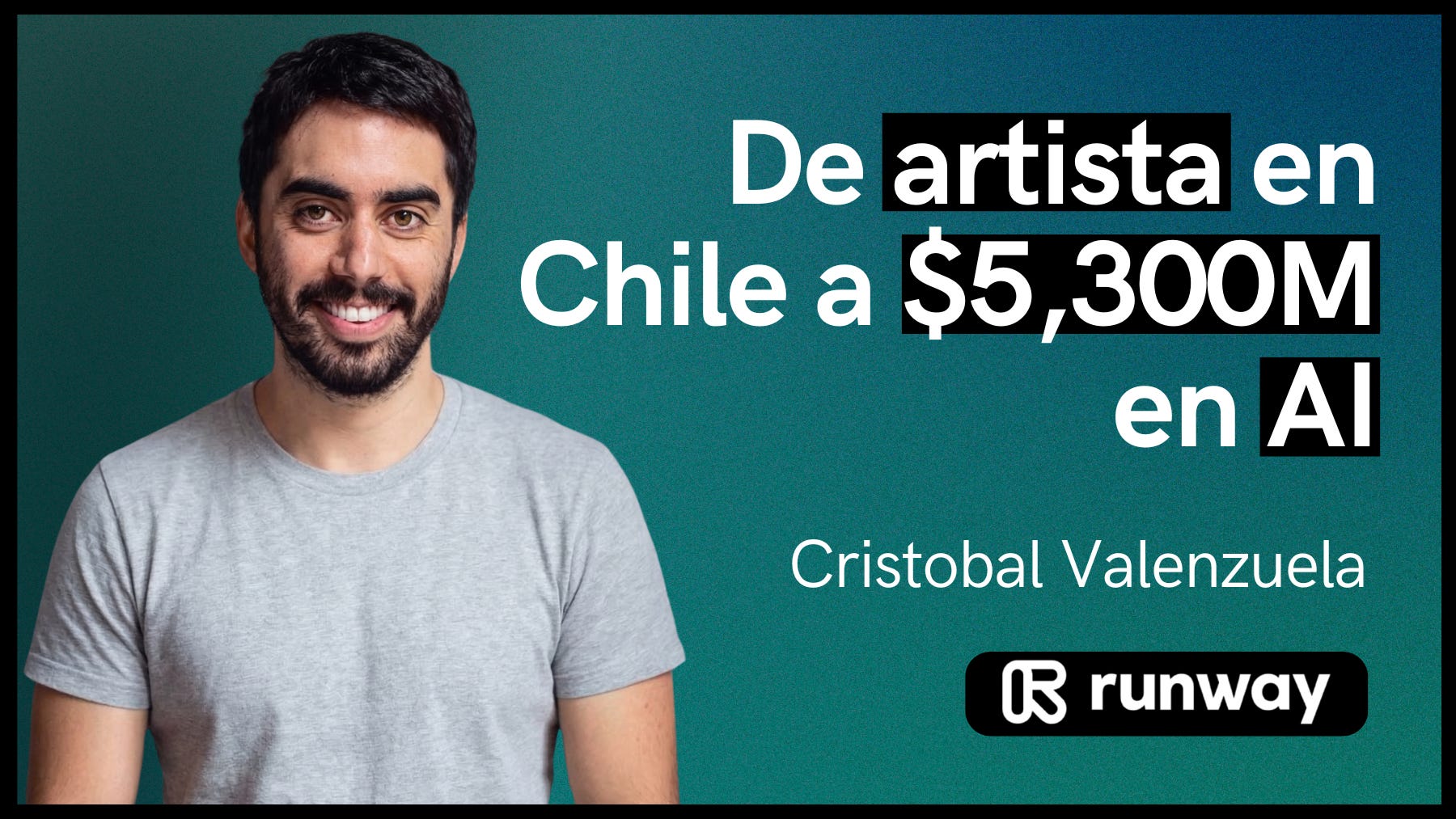
Today I interviewed Cristóbal Valenzuela, CEO and cofounder of Runway, the artificial intelligence platform for video most used by Hollywood, valued at more than $5 billion.
Runway has raised capital from Google, Salesforce, and Nvidia, and its Gen 4.5 model beat Google Veo and OpenAI Sora on independent benchmarks.
If you look at his LinkedIn through 2015, what shows up is a Chilean commercial engineer who taught at a university, made short films with borrowed cameras, and had a small video consultancy. Nothing there anticipates this.
We talked about why he left for New York with no plan, about why the labels technical and non-technical seem arbitrary to him, and about how you compete in AI against Google and OpenAI.
Structure and Key Highlights
A Career Guided by Curiosity, Not by a Plan
- His definition of curiosity: interest in something without filtering yourself
- His underlying conviction: the only laws are the laws of physics, the rest we humans invent, and the moment you think that way you start asking yourself why you cannot do something
- Before Runway he was a university professor, he did art projects, he had a small video and marketing consultancy, and he programmed on his own
- He was hard to classify, and that was the point. His thesis is that from there you discover things more interesting than the ones that already exist
Deep Dream and the Hole He Has Not Come Out of
- In 2015 he came across the Deep Dream papers, one of the first generative models, which produced surreal images
- Two things caught his attention: aesthetically he had never seen anything like it, and the idea that you can train systems that generate images
- He describes it as hunger. Intellectual curiosity to know why that was possible
- He is closer to understanding the why, but he says there is still a lot left for him
Why the Technical Label Seems Arbitrary to Him
- He studied economics in Chile, with calculus, statistics, and econometrics
- He realized that a good part of machine learning was sophisticated versions of linear regressions and prediction models
- His argument today: anyone can program and learn whatever they want with the tools available
- The Runway fact that backs it: they have one of the strongest research teams in video and image, and many of those people do not have a PhD or a master’s
- What does matter: intuition, the ability to solve a problem, and the determination to learn how to do it
- His conclusion from university: if you learn how to learn, you can go very far
Art and Science as the Same Work
- He showed work in galleries in Chile, made shorts, and won small festivals, getting cameras borrowed from friends
- The most interesting projects come out of the union of those two worlds, when the scientific method and aesthetic sensibility speak the same language
- His reading: many of the best artists were scientists, because they experimented and they showed the world what was possible
- And many scientists are artists, because they are able to tell a story and make you see the world another way
- At the time he could not articulate that. He was simply interested in both things, and putting a label on them seemed less relevant
New York Without Expectations
- He left with the idea of studying for two years and going back to Chile. He never thought staying was possible
- He worked 18 or 20 hours a day for two years, taking classes in everything
- His argument against the long plan: if you know exactly what you want at 6, 12, and 24 months, you close yourself off to the unpredictable
- It was not a master’s in artificial intelligence. It was a multidisciplinary program at NYU’s art school, with people between 25 and 35, engineers who want to learn art and artists who want to learn engineering
- His obsession when he applied in 2016: apply deep learning to art and creativity. A program for that did not exist, so he built his own
- His comparison: talking about this in 2016 was like talking about making films in 1850
The Tweet that Went Viral with 10 Followers
- He did not have social media. He opened a Twitter account and posted a two-minute demo of what he was building
- A NASA engineer wrote to him, artists in South America, designers in California
- That is where he understood it was not only his personal interest
- He talked it over with his classmates in the program, and the three of them had very similar interests. Founding the company became the obvious decision
Why Runway Is Not a Better Editing Tool
- His original insight: the way we create content, media, and stories is going to change at the root. And we are still in the 1900 of that story
- The analogies he uses: the difference between a horse and a car, between a camera and a paintbrush, between a camera and a stage play
- Telling a story with artificial intelligence is a different medium, and it requires another process and other people
- The fundamental thing to understand: it is not a linear transformation, and it is not doing better what we were already doing
- Today Hollywood studios, brands, marketing teams, designers, musicians, and creators use them
What Happens When You Take Away the Cost of Improvising
- In film, a good part of the budget and of the time goes into planning every scene and every shot, because improvising on set is extremely expensive
- So the barriers of planning and coordination are really barriers of cost
- If you take the cost away, you get to the set and you try things. Two different scenes, the camera over here, crazy things, and you see what you like
- That is what exists today: a creative studio available 24/7 that compresses the distance between coming up with an idea and executing it
- The consequence: you can create 10,000 versions of an idea and choose the most interesting one
- His conclusion: the best directors and cinematographers today are limited by budget and time. If you take those two things away, the world becomes more creative
Raising Capital When the Idea Was Crazy
- In 2018 there was no boom. The idea was not very obvious, not very clear, and it carried a lot of risk
- His reading of that: if there is consensus about something, it is no longer worth it and it is boring
- He has emails from the best investors in the world telling him it was crazy, and telling him to look at the quality of the images he was generating in 2017 and 2018
- They talked with many dozens of people. The first pitch went badly, the second went better, and by number 2,500 you already know how it is done
- His rule: there is no book that teaches you, quantity leads to quality
- On the collective amnesia, he cites the curse of knowledge: when you learn something, you forget what it was like not to know it. Four years ago, generating a hyperrealistic scene in 4K from text seemed 20 or 30 years away
Conviction During the Slow Years
- Before ChatGPT there were many internal milestones that were important at the research level even if they had no public impact
- His analogy: being inside the community of people who wanted to fly in the early 1900s. You see every experiment, every type of wing, and you know someone is close
- What they do well, he says, is prepare for what is coming and be pragmatic about the progress
- The example he uses to explain why it is so hard: extrapolating exponential growth. Nobody was paying attention to COVID, and in three weeks the most important city in the world shut down
- The consequence: the people who see the progress coming have to communicate it, because socially, culturally, and economically you have to prepare
Where the Value Is
- Two parts. One: research and create new frontiers. The people who build the models have an important competitive advantage
- Two: build useful products, and build them very fast, on top of those models. And do it every day, every month, every year
- The concept they repeat to the team, taken from reinforcement learning: exploration and exploitation
- One part of the organization has to be exploring and questioning, and another part has to be optimizing every detail of the product
- Historically those two functions get along badly, because they are different cultures. Today you need both
- For a founder that means speaking two languages: the language of science and discovery, and the language of market, product, and distribution
- His metaphor: the language of Amazon, which optimizes every margin of a transaction that already exists, and the language of SpaceX, which creates the category
The 2024 Post About the End of AI Companies
- The idea he wanted to provoke: the models are the fundamental base of the economy, and in 2023 or 2024 that was not obvious
- Today it is, and the interesting part becomes what you build on top
- His bet: if all of Hollywood, advertising, marketing, and everything that is video on a screen is going to be generated with models, the interesting question is what comes after
The Roller Coaster You Do Not See in the Chart
- No story of progress is linear, even if on paper it looks that way
- There are Tuesdays with 1,000 experiments where 900 fail, 10 work, and 3 succeed. The story gets written about those 3
- His example is Picasso: the world knows a couple of paintings, not the number of sketches that were behind them
- His rule: if you are not failing, you are not trying hard enough
The Future of Media
- Enzo tells him that he deprioritized his blog when ChatGPT came out, and asks him whether he should do the same with the podcast
- His answer: probably yes, it is going to change a lot
- What he imagines is content in real time. An AI version of the host and of the guest, with the audience asking questions
- They would not be exactly the answers he would give, but they would be quite close and perhaps they would be more interesting
- He does not know whether that is a podcast, a video, or a game, but he believes there is something there
Talking with the Creative Community
- His estimate: 70% of the people he talks with are already convinced, and a smaller percentage is still reluctant
- His historical context: the cultural world rebelled against photography, and cinema was seen as the worst thing that happened to art. Inside cinema, adding audio was also fought over
- His underlying point: art is technology. If you take photos, make films, paint, or compose, you are using some instrument
- We antagonize technology as something alien to the human, when in reality it is the most human creation we have made
What It Takes to Compete from Latin America
- His answer is a single thing, and it is attitude
- With an internet connection, any person today has a capacity to create that a year ago was unthinkable, and you have to recognize it internally as a superpower
- Nothing prevents anyone, in South America or anywhere, from building companies worth billions
- His warning about the excuses: I am very young, I am very old, I just graduated, I need a better financial situation, I just had a child. There is always one, until you decide that enough is enough
- Whom he thanks: his wife, with whom he thought through many of these ideas, and his mother, who taught him that if he is going to do something he should be the best at what he does
Silicon Valley Glossary
| Term | Meaning | Context in the episode |
|---|---|---|
| Deep Dream | One of the first generative image models, from 2014 and 2015 | The paper that put him in the hole he has not come out of |
| Deep learning | Deep neural networks, the name people used before saying AI | What he wanted to apply to art when he applied to NYU in 2016 |
| Benchmark | A standardized test for comparing models | Where Gen 4.5 beat Google Veo and OpenAI Sora |
| Exploration and exploitation | Balancing the exploration of what is new with the optimization of what already works | The reinforcement learning concept they repeat to the team |
| Commodity | An undifferentiated product that competes only on price | His 2024 argument about models as the base of the economy |
| The curse of knowledge | When you know something, you forget what it was like not to know it | Why everything today seems obvious, and four years ago it was unthinkable |
| Exponential growth | Progress that accelerates instead of moving in a straight line | What almost nobody manages to extrapolate, as happened with COVID |
| Frontier | The limit of what the technology can do today | Where the competitive advantage of the people who build the models lives |
| Generative model | A system that creates new content instead of classifying it | The category Runway has been building since 2018 |
People, Companies and References
People Mentioned
- Cristóbal Valenzuela: CEO and cofounder of Runway, Chilean, an economist by training
- His cofounders: the classmates from the NYU program with whom he started the company
- His wife: his right hand, the person with whom he thought through many of these ideas
- His mother: she taught him that if he is going to do something he should be the best at what he does
- Picasso: his example that the amount of work behind it is what nobody sees
- Enzo Cavalie: host of the podcast
Companies and References
- Runway: valued at more than $5 billion, the AI video platform most used by Hollywood
- Google, Salesforce, and Nvidia: investors in the company
- Gen 4.5: its model, which beat Google Veo and OpenAI Sora on independent benchmarks
- NYU: the multidisciplinary art and technology program where Runway was born
- Deep Dream: the Google model that made him change careers
- Amazon and SpaceX: his two examples of opposite cultures, optimization versus creation
- The Wright brothers: his analogy for the communities that see progress coming before everyone else