The audio and video are in Spanish. These notes are a translation.
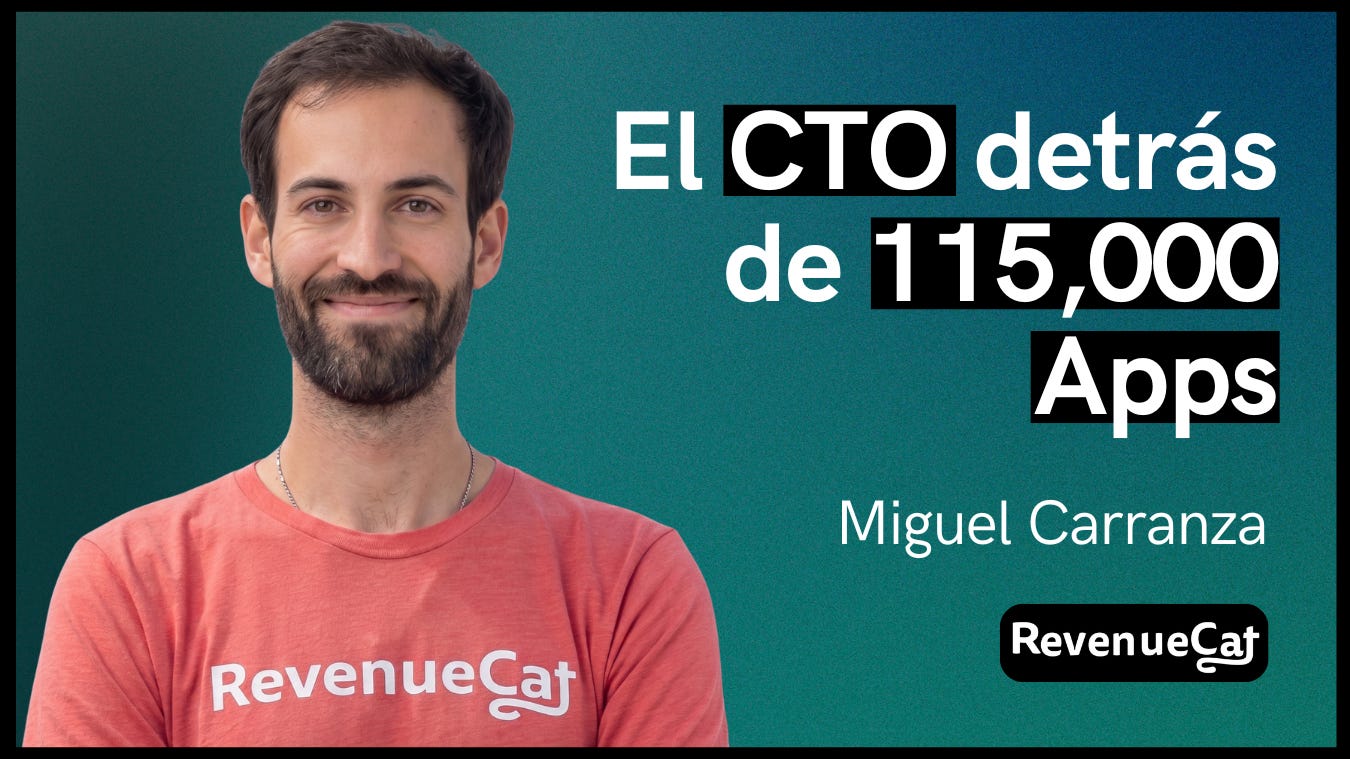
Today I interviewed Miguel Carranza, cofounder and CTO of RevenueCat, the subscription system behind an enormous share of the apps on the App Store, including ChatGPT.
Miguel arrived in Silicon Valley from Seville on a six-month internship and stayed eight years. Before he left, his calculation was simple: he did not know what the path was, but he knew that staying on the consulting circuit would not take him there.
His most uncomfortable thesis: a lot of people got used to building with AI, but very few know how to build products that are AI native. And in his opinion, almost nobody is doing the second one well.
Structure and Key Highlights
Seville Before the Internet
- His passion for computers went back to long before he studied, to a time without Twitter, when information arrived through magazines
- What he knew: that a place called Silicon Valley existed, without even knowing it was in California
- His nuance about school: the level of demand was high, even if the teaching was uneven
- The detail that marked him: they programmed on paper, and there were classmates who passed with code that did not compile but matched the template
- What they told him there: that programming was a low-level job and that an engineer manages projects and talks to the client
- His correction years later: building product means programming
- His decision in his early twenties: he would rather try something and take a hit than enter an environment where nobody was motivated
- Almost everyone’s reaction: they told him he was crazy
On Programming Today
- His position: anyone who in 2026 thinks it is not going to be built this way is very wrong
- What does disappear: the guru who boasts of mastering JavaScript or Python as a craft
- What still has value: understanding the fundamentals and being able to drop down a level of abstraction
- His example: he studied assembly and he never writes it, but knowing the layer below shows in that stretch from 80 to 100%
- On prompt engineering: he compares it to compiler optimizations, low-hanging fruit that the labs are going to solve, so it is transitory
- The nuance he holds onto: whoever understands a model’s context limitations better will keep getting better results
- What does last: solving problems and having agency, plus the usual advice, build something people want
RevenueCat and the Calculations that Went Wrong
- They started eight years ago, when the app boom already existed but subscriptions did not
- His initial calculation: how many apps they needed to capture to reach 100 million in annual revenue
- His conclusion back then: there are not that many applications. It is impossible
- What he learned afterward: that the market grows, and that you also help it grow
Where He Sees an Infrastructure Opportunity
- His caution: it is very hard to predict, and many things that look defensible today will stop being defensible when the models absorb them
- Where he does see defensibility: critical infrastructure, because you are not going to spend tokens on something that does not differentiate your product
- Nobody is going to build their own alternative to Supabase, Firebase, or AWS, because afterward you have to maintain it
- His read of the bubble: here everyone tries everything, and from there to the end consumer it can take a long time or never arrive
Building with AI Versus Building AI Native
- Level one: using AI to build products
- Level two: putting AI into traditional products to solve a concrete problem
- What almost nobody does well: the specialized agent that solves things autonomously
- His diagnosis of last year: everyone stuck the AI label on because it was the thing to do, between models that were not ready and nobody knowing how to do it
- The change in mindset it demands: stop designing deterministic systems where A, B, and C always return the same thing
- And accept that one part you want to be deterministic and another part you want to be creative
- Who will have a harder time: he does not split it into technical and non-technical, but into who entered the industry for the wrong reasons after 2012
- His observation: someone more junior but genuinely interested can get ahead of someone who has been at it for 20 years with no desire to learn
Apps as the New Dropshipping
- The barrier to building an app dropped enormously, and that brings in the guru of the moment selling you the course to get rich
- Why it does not hold up: churn in mobile consumer is extremely high and almost everyone ends up canceling
- Unless you create a product that delivers real value, which is one of the hardest businesses there is
- Where the vibe coder’s ceiling is: today it is feasible, without being technical, to build something that delivers value and makes money
- What lowering the bar does not change: the next calculator or the next to-do app will not be a profitable business
- His line for the moment: it is a great moment for the idea guy, as long as he executes
What Makes a Product Last
- His answer: constant value, something you use every day and that justifies paying for a subscription
- His comparison: you pay for Netflix or Spotify without pain as long as the catalog keeps growing
- The two things almost nobody does: really talk to users, and not convince yourself that you already solved it
- His personal hack: he identifies with his type of user because he was that person
- His warning to anyone who gets in only for the money: they are at a disadvantage against someone who is genuinely passionate
- His concrete advice: build on something that is your passion, even if it is a niche, where you know more than anyone
- The example he gives: a user obsessed with credit card points who left his job for an app that tells you which card to use on each purchase
- His observation about niches: the smaller it is, the more the people inside depend on you
On Venture-Scale Apps
- He still believes the mobile format is the one that converts best for the general public
- But his practical recommendation: it is easier to build a sustainable business without venture capital than a venture-scale one
- His nuance: what could have been a great lifestyle business sometimes gets forced into something else and does not work
Subscriptions Outside the United States
- The markets that spend the most are still the United States, China, and Japan, and iOS above Android
- His recurring comment when he goes to Spain: that people should pay for software
- How it changes: people get used to it when looking for the pirated alternative takes more work than paying
- The same pattern with AI: at first it seems absurd to pay 20 dollars a month, and later you end up interested in the 200 plan
Eight Years Documenting the CTO Role
- He started writing it down because almost all the advice is aimed at the CEO founder
- What he did: talk to anyone who was at his stage, one stage earlier, or one stage later
- His conclusion after eight years: there is no concrete definition of the role, and very different CTOs have succeeded
- His method: hire people better than him at everything he can
- Where his role sits today: closer to the founder, with all the context and the long-term commitment, than to the technical leader
Why He Stopped Programming and Why that Is Changing
- The original reason: he put himself on the critical path and then another fire came up, or he had to travel
- The worst thing that can happen: handing someone half-finished code written by the CTO
- What changes now: you can do it while you sleep, without so much context switching
- What that allows: a manager doing technical work at the same time, though not with 18 windows in parallel
- His nuance for his company: it is extremely technical, for technical users, so a manager who is not becomes a bottleneck
- The risk both of them identify: when the founders stop being in the product they lose context, and today that cost can be lethal
Code Became Cheap
- His precise point: cheap not because of the tokens, but because you can throw it away and rebuild it
- What that changes: code stops being the intellectual property where the company’s value lives
- The practical consequence: you can prototype, research, and develop much faster
- And communicate an idea with a prototype instead of with a spec or a design
On the One-Person Company
- He is against it: you end up needing so much parallelism that one person cannot cover it
- What he does grant: a team of two or three can do what eight people used to do
- His underlying observation: most of the problems you end up having are about people, communication, hiring, and performance
On Selling the Company
- It was never the motivation: as an engineer in Silicon Valley, going to a big tech company with stock is safer and more realistic
- His stance: they are still optimistic and they believe the asset is worth more
- What they decided from the beginning: set the IPO as a declared goal
- Why: not for the IPO itself, but to show the team that they are building something generational
- His argument: if your goal is a quick flip, you are not even going to get to that, because there will be too many long nights
The Weekly Updates
- Every week he sends the whole team what he did, what he is planning, shoutouts to whoever stepped out of their comfort zone, and a last paragraph with what worries him
- What it does for him: realizing that a problem that seemed serious is not so serious compared with what they have already gotten through
- The other exercise he does: listing what gives him energy and what takes it away
- What he found: what gives him the most energy is working with people who are as motivated as he is, or more
- And what burns him out: someone rowing in the opposite direction, however good they are technically
Who He Thanks
- His wife, and his observation that partners are the least thanked people in the ecosystem, who are there seeing what there is and what there is not
- His mother, who never told him he was smart and always told him he was a very hard worker
- What he learned from that: over the long run, hard work beats talent that does not want to work
- His cofounder Jacob, the optimist to his pessimism, a combination he considers a good one in critical infrastructure
- His argument about setting goals: the first year they said one million in revenue and the next year three, based on nothing, and they got there
- His conclusion: they got there because they believed it and they put it on the whiteboard
Silicon Valley Glossary
| Term | Meaning | Context in the episode |
|---|---|---|
| Churn | The percentage of customers who cancel | Why consumer apps are a hard business to sustain |
| AI native | A product designed around the model, not with AI added on | What he says almost nobody is doing well |
| Deterministic system | One that always returns the same output for the same input | What you have to stop assuming when you build with models |
| Prompt engineering | The discipline of writing good instructions | What he considers transitory, like compiler optimizations |
| High agency | The ability to figure things out and move forward without being told how | What is still valuable regardless of the tool set |
| Idea guy | The person who contributes ideas without executing | The moment is a good one for him, but only if he executes |
| Lifestyle business | A profitable business with no venture-scale ambition | What is easier to build on mobile today |
| Jevons paradox | Making something cheaper sends its consumption up | The frame for the explosion of apps |
| ARR | Annual recurring revenue | The goal they put on the whiteboard and hit |
| Critical path | The chain of tasks that blocks everyone else | Why he stopped programming day to day |
People, Companies and References
People Mentioned
- Miguel Carranza: cofounder and CTO of RevenueCat
- Jacob: his cofounder, the optimist in the pair
- His wife and his mother: the two people he thanks first
- Enzo Cavalie: host of the podcast
Companies and Organizations
- RevenueCat: subscription infrastructure for mobile apps
- Y Combinator: where they went through
- Jóvenes con Futuro and Exponential Fellowship: the programs that take Spanish talent to Silicon Valley
- Supabase, Firebase, and AWS: the examples of infrastructure nobody is going to rebuild
- Netflix and Spotify: his references for constant value that justifies a subscription
- Card Pointers: the niche credit-card-points app he cites as an example
- Andreessen Horowitz: whose partners he interviewed on the RevenueCat podcast