The audio and video are in Spanish. These notes are a translation.
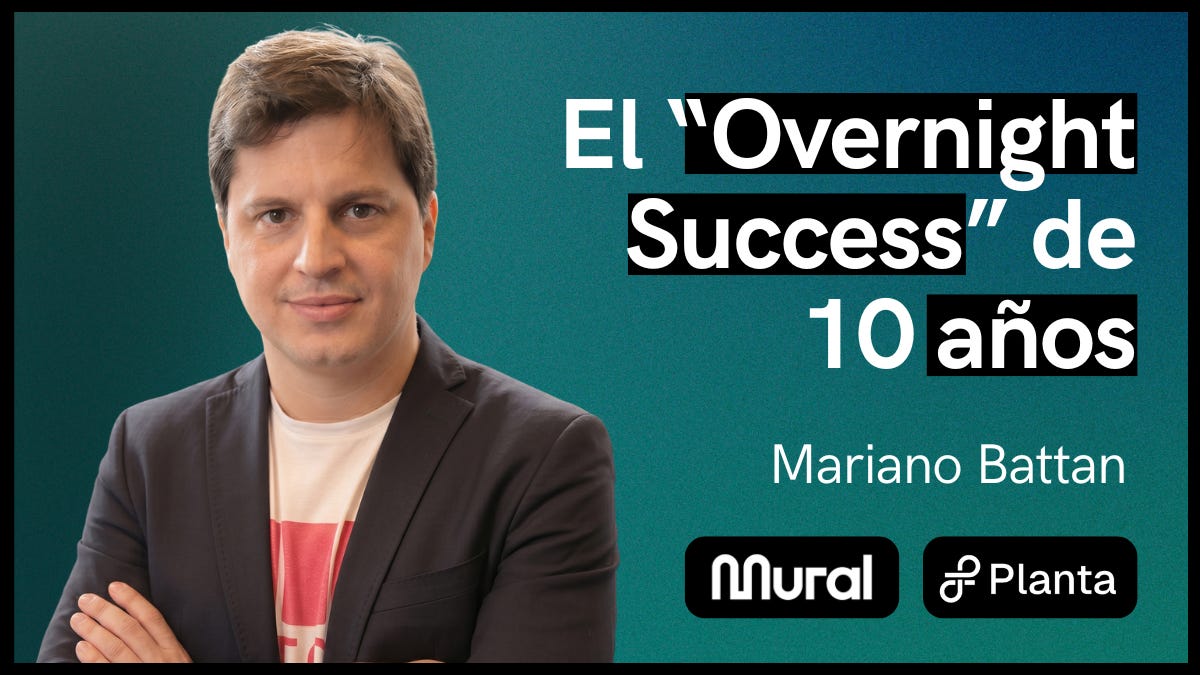
Today I interviewed Mariano Batán, cofounder of Mural, the collaboration platform Fortune 100 companies like IBM and Microsoft use, which generates more than $200 million a year in revenue.
From the outside, Mural looks like a rocket that took off in 2020. From the inside it is nine years in which the company was not dying but was not taking off either, two near-bankruptcies, and a 2017 recapitalization in which the founders themselves put in the money they had left.
Today Mariano is building Planta, a network that uses agents to connect the right people at the right moment. The conversation is about the thread that ties all of that together: human connection, and what is left of it when you spend more time talking to agents than to people.
Structure and Key Highlights
The 12-Year-Old on IBM’s Network
- In 1992 he connected from Argentina with a friend in the United States over IBM’s internal network, where his father worked
- He had lived a year in the United States and had to learn American culture from scratch, arriving as the new kid at school
- His reading of that: at 12 he was not thinking about connecting, he was thinking how cool
- What he does recognize today: it is the same pain he feels every time he arrives at an event with new people
Collaborating with Non-People
- His current observation: there are days when he talks to nobody, and yet his head had forty-five conversations
- The cycle that used to take him weeks now happens extremely fast, and what changed is that his work is more about vision than about creation
- He recognizes he is spending a lot of cycles inefficiently, but also finding shortcuts between projects that had nothing to do with each other
- The parallel that comes to him: people who go deep in one industry and use that know-how to see another one differently
- What he did with his kids: a story generated with his own cloned voice, to walk them through the process of understanding that what they hear may not be real
- He is installing agent tools with his son, and he calls it his mini team for trying things at home
- The framework he cites from Tina Seelig, of Stanford: imagination, then creativity, then innovation when someone uses it, and only then entrepreneurship at scale
The Nine Years
- Before Mural there were two companies: one that did not go so well, and Three Melons, a video game company, bought by Playdom and then by Disney
- What they learned there: that their past did not define them, and that they could get better
- Mural was founded in 2012, with several small seed rounds from institutional and individual investors
- In 2013 Mariano moved to the United States with his family and a one-year-old son
- By 2017 there was a serious cash hole: Intel Capital was leaving Latin America, Alta Ventures was changing priorities, and there was no more money
- What they did: put in their own money as founders, something he recognizes as a position of privilege that not everyone can copy
- Why they kept going: they had customers asking for things, a business that generated some cash, and a long list of things they still wanted to do
- The personal context: his second daughter was born in San Francisco, as expats, with everything expensive
- How they survived: a bit of equity, a bit of debt, and then they paid the debt
The Hard Conversations
- The same conversation had to be had with the investors and with the employees
- His description: we all start from zero in some way
- His general reflection: they are not easy, but they are necessary, because that is where the issues get put on the table
What the Investors Were Saying
- The metric of the era in San Francisco: if you do not grow 3x, 3x, 3x and then 2x, 2x, you are nobody
- His critique of that metric: it was built by looking at the ones who reached $100 million, pure survivorship bias
- Their real situation: they were growing 50% year over year, with very little capital raised
- The other argument against them: there is no market, because their segment was the people who believed in working visually and remotely
- The risk that was real: IBM was their very large customer and had not renewed the contract yet
- His conclusion about the pandemic: they were not prepared for it, but they had spent years preparing for the wave it brought
What He Would Do Differently
- Move to the United States first and raise capital afterward, instead of the other way around
- His reasoning: in 2012 he went to see American funds while living in Argentina, with no product and no market
- The other change: having presold the concept to companies before building, because if the problem is urgent and large someone should pay to solve it
- His general rule: put yourself in a position of privilege before opening a round
- And raise only when you are clear on the next milestone and you truly need money, because sometimes what you need is a sale, a partner, or a person
- The third change: having had someone very good at growth and top of funnel earlier
- And grow the team a bit more slowly, to protect the culture and avoid burnout
The Three Founding Moments of Mural
- The original idea: a digital whiteboard that he himself needed while traveling and working on a game about emotions
- The second: the residency at IDEO, where they learned design thinking methodologies and decided to put them into the product
- The third: selling to IBM and discovering that large companies wanted that methodology distributed all over the world
- All three happened between 2012 and 2014, and his conclusion is that all that time they should have been in exploration mode with few people
- How they got into IBM: an introduction from an investor, the residency at IDEO, and Phil Gilbert at South by Southwest, who had 400,000 people and wanted to make them more design centric
The Round that Did Make Sense
- In 2019 Radian Capital showed up, a fund created to finance companies in remote places, underinvested, that did a lot with little
- Their model: look for 3x to 5x in three to five years in companies that Silicon Valley ignored for not growing enough
- What Mariano had validated by then: good net dollar retention, customers that grew with them
- Why he accepted: the backlog was piling up, competitors were growing, and the team was small for everything the large companies were asking for
- The Series B was something else: 33 initial meetings in one week, with almost every relevant firm, except the funds that were already looking at Figma
Building from Argentina and Selling in the United States
- Until 2019 every engineer and designer was in Buenos Aires
- His mandate: all written communication in English, because if it is not in English the documentation does not exist
- What happened when they hired Americans: they Argentinized very quickly
- What he had to learn as the one arriving from outside: what each college means, the profiles, the company cultures, things a local absorbs without trying
- What wore him down the most: changing his leadership team many times and reconnecting each time, telling the same story eight times in three months
- The book they wrote about that: Collaborative Intelligence, whose second chapter is relational intelligence, the foundation for building trust
Why He Stopped Being CEO
- His reasoning: he had just written a book about collaborating well, which requires wanting to interact with people, and he was tired of that
- His criterion: he could not sell something he was not being authentic about in that moment
- What he had achieved: more than $100 million in revenue, enormous customers, and a good part of the product backlog resolved
- His message for leadership teams: take care of the founder, because if the CEO leaves, things change
- The family cost he recognizes: his wife gave up a lot as a mother and an expat without family support, while during the pandemic he got up at 6 and went to bed at 9
Bocho and Planta
- Bocho is his collaboratory, inspired by Alan Faena, for exploring and helping friends with projects
- How Planta started: he went to events in Israel and in Comporta, and noticed he lost the first day and a half getting oriented
- The other case: arriving late to a dinner and ending up seated with two people with whom nothing happened
- His diagnosis: what applied at Mural to the ten-hour workshops also applies to an event. Prepare beforehand, maximize the time together, follow up afterward
- The detail that caught his attention when he started: he set up the company, the Mercury account gave him credit, and he was left with a positive balance from day one
- The first prototype, in three or four weeks: you talked on the phone with an AI before the event and then you received suggestions of who to talk to
- Its more distant origin: a 2011 video game about emotions, with creatures that reacted to the collective mood on social networks
Where the Line Is Between AI and the Human
- What he wants to solve: the coordination, logistics, and information layer, so there is more possibility of human connection
- What he does not want: surveillance, or plugging in his whole inbox so an agent knows everything
- What he does want: discretion, tact, and diplomacy, because sometimes you have to say no
- His thesis about people: they want the power of the technology, but to keep being the actors in their relationships, not the followers
- The opportunities that get lost today: a friend in the same city, two people who want to go to the same place, someone who could have solved a problem for you
- His idea about saying no: give away a version of your knowledge that is not you but solves the problem, and ask them to tell you if it worked
- The parallel Enzo brings in: he set up an agent with his own framework to give pitch feedback, because he was giving the same advice too many times
- What that also allows: giving a second or third impression to someone whose first one was poor but who is very good
The More Extraordinary Vision
- Agents attentive to connection opportunities, individual or group, personal or professional
- Less time coordinating and discovering, more time doing things in real life
- His foundation: beyond what you eat, relationships determine health and longevity
- His concrete mission today: connect the technology people in Miami, a city he says is invisible to itself
- His close: if you do not have a strategy for how you spend your time and with which people, one day your life has gone by
Silicon Valley Glossary
| Term | Meaning | Context in the episode |
|---|---|---|
| Net dollar retention | How much your existing customers’ spend grows | What they had validated before raising in 2019 |
| Survivorship bias | Drawing conclusions only from those who survived | His critique of the metric of growing 3x year over year |
| Pay to play | A clause that forces investors to keep investing or lose rights | Part of the 2017 recapitalization |
| Buyback | Buying back an investor’s stake | What they did with some of their early investors |
| Design thinking | Applying design methodologies to business problems | What they learned at IDEO and put into the product |
| Top of funnel | The initial part of the acquisition funnel | What they recognize they did poorly for years |
| Backlog | The accumulated list of things to build | What was piling up on them and motivated them to raise again |
| Term sheet | An investor’s preliminary offer | The one from Radian, who did not want it to be the only one |
| Collaboratory | A structure for exploring and collaborating on several projects | How he describes Bocho |
| Human in the loop | Keeping a person in the decision | His explicit limit in the design of Planta |
People, Companies and References
People Mentioned
- Mariano Batán: cofounder of Mural, now building Planta
- Pato: his cofounder, chief architect of Mural and now at Planta
- Augusto Petrone: from the games company, now also on the project
- Phil Gilbert: from IBM, key to getting into the account
- Tina Seelig: Stanford professor, for the framework from imagination to entrepreneurship
- Alan Faena: for the collaboratory idea
- His wife and their three children: the other side of the cost of building a company as an expat
Companies and Organizations
- Mural: more than $200 million in annual revenue, Fortune 100 customers
- Planta and Bocho: what he is building now
- Three Melons: his video game company, sold to Playdom and then to Disney
- IDEO: the residency that gave them methodology and the first customers
- IBM, Intuit, Autodesk: the customers that came through that path
- Intel Capital and Alta Ventures: the investors who did not continue in 2017
- Radian Capital: the fund that came in in 2019, with a thesis of underinvested companies
- Figma: the competitor that kept some funds out of the conversation
- Mercury: where he opened the account for the new company