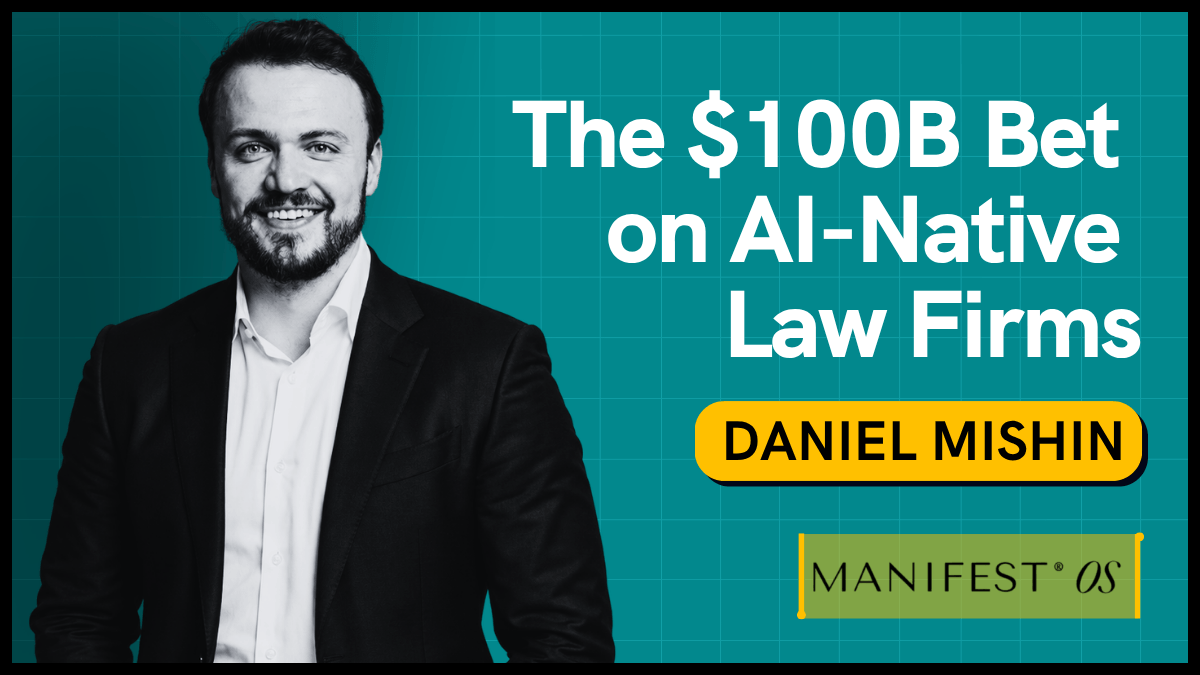
Today I interviewed Dan Mishin, founder and CEO of Manifest, an AI-native law firm rebuilding legal services on top of its own software.
He started his first company at 11 in post-Soviet Ukraine, came to the US as an immigrant, spent seven years building June Homes, and with Manifest raised one of the largest Series A rounds in legal tech history.
The interesting part is the structure. Every investor told him to just sell software to lawyers. He refused and split the business in two instead: Manifest OS, a venture-backable technology company, powering Manifest Law, a 100-lawyer firm. The bet underneath it is that AI finally lets a services business carry software margins.
Structure and Key Highlights
The Crazy-Founder Bucket
- A VC once told him there are two types of founders: polished Stanford graduates with the right CVs, and the crazy ones
- The crazy ones take more risk, so they tend to either become very successful or fail miserably
- He spent years pretending not to be one, then accepted that he is
- He has only ever started companies. He calls himself extremely unemployable and too rebellious to be hired
Growing Up in Post-Soviet Ukraine’s Wild West
- He was born the year the Soviet Union collapsed, and grew up in Crimea as every institution stopped working
- There were no rules, no regulations and no market for basic things: in the Soviet Union you could exchange an apartment, but not sell it
- Criminals filled the vacuum, while scientists and professors suddenly had no work
- His family’s savings, tens of thousands of rubles when a car cost a couple hundred, went to zero in a day
- That much freedom left two paths, entrepreneur or criminal, with nothing in between
Risk Tolerance Is Learned, and So Is Trust
- What knocks most people off their feet is, for him, a regular Tuesday
- He insists risk tolerance is a skill, not a gift, built one mistake at a time
- A week after raising a large round, he slept in his car because the wire hadn’t arrived and he couldn’t pay rent
- Where he grew up, building a company usually meant breaking the law. He loves being a law-abiding citizen
- The skill he had to learn in America was trust: he says nobody in the US has ever cheated or betrayed him
- His line on the difference: the system in America trusts you by default
Companies that Open Doors
- A chain of hostels for travelers, then June Homes, apartments for people with no credit score, and now Manifest, for immigration
- SaaS bores him. He can’t wake up excited about incremental improvements
- June Homes served the immigrant renting a first apartment without a credit history, a limbo millions of people go through
- Access to justice feels like a mission to him, more than the next round or the next valuation
- Immigration came first because he went through it himself and sponsored many visas, often hiring immigrants for their grit
- What he saw in immigration law firms: small, slow, manual and cookie-cutter
Three Companies, Three Motivations
- The first company was financial hunger. He was broke and wanted a full life
- June Homes was about proving himself in America, where none of his previous achievements mattered
- He had to relearn every social skill like a toddler, from making an introduction to holding a conversation, and says the first three years were painful
- Manifest is about serving people he loves: his friends’ green cards and their co-founders’ O-1 visas go through it
- They run events for immigrant communities with no ROI, simply because they care about that community
Engineered Calm
- He is intense by nature and trains calm on purpose, with breathing, meditation and long hikes in remote places
- A phrase stuck with him: most of a person’s problems come from not being able to sit alone in silence for 30 minutes
- Meditation is both his hardest habit and his biggest unlock. His thoughts jump 24 times per second
- Every year around Thanksgiving he goes on a three to five-day silent retreat in the forest, with a voice recorder and no phone
- Most of what he records doesn’t matter, but about 10% turns into clear decisions
- The decision to leave June Homes, one of the best he has made, came out of one of those retreats
The AI Slop Phase
- After adopting AI, Manifest shipped software 10 to 20 times faster, which he notes is not unique
- Two or three months in, they looked under the hood and found AI slop built on top of AI slop
- Engineers were pasting three-sentence PRDs into Claude Code and shipping code they couldn’t explain
- The new rule: if you can’t explain clearly what you’re shipping, you don’t ship it
- Product defines the problem, the why and what success looks like. The engineer posts a one-page plan in Slack for anything over 20 minutes of work
- Enzo’s analogy: when you can DoorDash any food you probably eat worse, and when you can generate any code you probably code worse
Clarity Is the CEO’s Job
- He lists four jobs for a CEO: vision, clarity in every room, allocating resources and hiring
- In every meeting he asks whether they should build this at all, and whether there’s a simpler way
- He borrows Elon Musk’s order of operations: trim the scope first, accelerate only after
- Hiring the smartest people from Harvard, Stanford and UPenn has a side effect: they overcomplicate. He calls it the chronic disease of 2026
- Twitter ran a simple product with a thousand engineers that 30 could maintain. Telegram became one of the largest messengers in the world with 30
- He calls himself a dictator and isn’t ashamed of it: ambiguity is worse than one wrong decision, and walking the middle ground is walking nowhere
The Problem Software Alone Can’t Fix
- He never wanted to sell software to lawyers, because the problems of this market are structural
- America has 1.3 million lawyers, ten times the per-capita rate of any other country except Israel
- Yet 80% of Americans can’t afford an attorney when they have a legal need
- 80% of attorneys work at firms of one or two people, and spend two-thirds of their time on non-legal work: sales, hiring, accountants, insurance
- Low utilization means few billable hours, and few billable hours means a very high price per hour
- The fix is removing every non-legal task from the lawyer, through software and business model together
Splitting the Company in Two
- Manifest Law is an Arizona alternative business structure, a license that lets a law firm have non-lawyer owners
- About 150 of those licenses exist in the US. Manifest’s was one of the first, approved by the Supreme Court of Arizona
- Manifest OS is the technology company. Manifest Law is the firm it incubated, now 100 lawyers
- Lawyers log in, complete the tasks the system prepared for them, and log out
- Manifest handles marketing, business development, intake and every tool, so the price per case drops while speed and quality go up
Start with the Problem, Not the Business Model
- Many founders wait for an idea they love, jump between markets and give up when the model doesn’t land
- His playbook: pick a problem, or even just a market that excites you, and stop there
- Then spend months going deep, until you reach the layer of knowledge that isn’t visible from the surface
- They didn’t know Manifest’s business model when they started researching. It only appeared months in
What Investors Had to Believe
- Two and a half years ago AI-native services wasn’t a category, and everyone asked why he didn’t just sell SaaS
- He had seen Harvey at Series A and Legora at seed, so he knew what the software route could do. He didn’t think it solved the industry’s problem
- He self-funded, and by the time he raised, Manifest had been growing 30% month over month for months
- The three questions any VC asks: is the market big enough, is there a moat, and do the margins and growth support long-term returns
- Market: a trillion dollars in legal services, against maybe $10 to 20 billion in legal software
- Moats: the regulatory license, being the system of record for clients’ immigration data, and network effects if one firm serves a company across many countries
SaaS Margins on Services Revenue
- Manifest OS is the company that would go public, powering around 100 firms, roughly one per region or practice area
- Each firm operates only under the Manifest Law brand, with strict quality guidelines
- Revenue comes from licensing, software and services fees. Enzo’s summary: the best of a SaaS company with a franchise
- A VC told him the model is an American dream: SaaS-level margins on services-level revenue, and services bill more than software
- The goal is for every attorney to handle ten times the cases of a traditional firm. He is clear they aren’t there yet
- The benchmark: the largest law firm in the world makes $7 billion with 1,200 attorneys, more revenue per employee than Apple, Google, Netflix, OpenAI or Anthropic
- 11,000 of the 18,000 immigration attorneys in the US have applied to Manifest Law. It accepted 100
- He puts the ceiling at $100 billion, maybe $200 billion or more, and sees nothing stopping expansion beyond legal
Why Immigration Came First
- Immigration is formulaic because the government tells you exactly what it wants and how
- The same applies to taxes and employment. Contentious law, like contracts or litigation, is much harder, and he hasn’t seen anyone do it well with AI
- Working with lawyers taught him what “two lawyers, three opinions” means, so every feature has clear owners
- Each feature has a legal DRI with the final say on how it works and an engineering DRI who builds it, plus business and product owners when needed
- The lawyer brings the why and what success looks like. The engineer brings the cleanest, most scalable solution
- They no longer have pods: one engineer and one legal DRI per piece of work
Where the AI-Native Services Boom Could Disappoint
- AI services are easier to start than SaaS, because they tap an existing budget and demand is already validated
- The first thing that breaks is quality at scale. Tech-enabled services grew fast between 2019 and 2021, and then their customers started hating them
- His case for why this time is different: technology can now standardize quality in a way that was impossible three years ago
- The second question is margins: can a services business reach $1 billion in revenue with 20 points more gross margin than its competitors? Few growth-stage companies have proven it yet
- He doesn’t think SaaS-level gross margins are out of reach
- The model fits any professional services, a $5 trillion space, but they are taking one big market at a time. The 2019 generation went too broad
Product and Taste Still Win
- Nothing replaces product-driven go-to-market. Fast revenue without a strong product breaks at scale
- His advice: invest in product from day zero and have a strong technical co-founder. He didn’t have one, and was torn between engineering and selling early on
- He is naturally a go-to-market founder, and says the real superpower is being able to build and sell
- The bar in legal is low: the competition is 75-year-old firms without an engineering culture
- Manifest was mobile first from day one: answer four questions on your phone, photograph five documents, and the government forms fill themselves
- An AI agent flags problems as they happen, like a birth certificate in Spanish that needs an English translation. That back and forth used to take 10 days
Brand in an Industry that Never Marketed
- Law has barely marketed itself, apart from the Better Call Saul lawyers on highway billboards
- He quotes Steve Jobs: Japanese companies never talk about quality because they actually have it. Marketing can’t fix quality
- The other ingredients are a clear voice and clear taste
- Manifest OS is a product company and Manifest Law is a services company, and manifestlaw.com is meant to look and feel different from a traditional law firm
The Lawyer of the Future
- The best lawyers don’t want to sell or push paper. He compares it to asking a New York cop to become a salesperson
- He spends hours every day talking to lawyers and to clients
- He imagines Manifest Law law schools and AI certifications, with tuition paid and a guaranteed job at graduation
- Graduates would be asked which kind of law they care about, from family to criminal to M&A, and pointed to the city where that practice would thrive
Who Pushed Him to Think Bigger
- Ankur Jain, founder of Bilt and his partner at June Homes, taught him that there are no closed doors
- His other rule: if a human has done it, or physics allows it, you can do it too
- He thinks building companies is simple: are you adding value or not
- It gets hard when you fake it, pretending to have product-market fit or running when you should be crawling
- His closing line: we’re all going to die anyway, so we might as well have fun
Silicon Valley Glossary
| Term | Meaning | Context in the episode |
|---|---|---|
| AI-native services | A services business whose delivery runs on its own AI software | The category Manifest belongs to. It didn’t exist when they started two and a half years ago |
| Alternative business structure | A license that lets a law firm have non-lawyer owners | Arizona’s version is what lets a technology company own Manifest Law |
| Utilization rate | The share of a professional’s time that is billable | Small-firm lawyers bill few hours, so each hour is expensive |
| System of record | The software that holds the canonical data for a process | Manifest holds its clients’ immigration data, which makes it hard to leave |
| Moat | What makes a business hard to copy | The license, the system of record and network effects across countries |
| Gross margin | Revenue minus the direct cost of delivering it | The open question: can services reach SaaS-level margins at scale |
| PRD | Product requirements document | Three-sentence PRDs pasted into Claude Code produced code nobody understood |
| DRI | Directly responsible individual | Every feature has a legal DRI and an engineering DRI |
| O-1 | US visa for people with extraordinary ability | What Dan’s friends use Manifest for when bringing in co-founders |
| TAM | Total addressable market | A trillion dollars in legal services, $5 trillion across professional services |
| Cold start problem | The disadvantage of a newcomer when the incumbent already has scale | What any competitor in immigration law now faces |
People, Companies and References
People Mentioned
- Dan Mishin: founder and CEO of Manifest, previously founder of June Homes
- Ankur Jain: founder of Bilt and Dan’s partner at June Homes, the person who taught him that nothing is impossible
- Elon Musk: his reference for trimming scope before accelerating
- Steve Jobs: the quote about Japanese companies and quality
- Tara and Abby: colleagues and friends of Dan whom Enzo spoke with before the interview
- Enzo Cavalie: podcast host
Companies and Organizations
- Manifest OS: the technology company, the venture-backed side that would go public
- Manifest Law: the law firm it incubated, 100 lawyers, with immigration as its first vertical
- June Homes: apartments for people without a credit score, which he built for seven years
- Bilt: Ankur Jain’s credit card company
- Harvey: legal AI he saw at Series A, the software model he chose not to follow
- Legora: legal AI he saw at seed
- Claude Code: the coding agent engineers were feeding three-sentence specs into
- Twitter, Telegram, WhatsApp: his examples of how few engineers a simple product really needs
Data and References
- $7 billion and 1,200 attorneys: the largest law firm in the world, with more revenue per employee than Apple, Google or OpenAI
- 1.3 million: lawyers in the US, ten times the per-capita rate of any other country except Israel
- 80%: Americans who can’t afford an attorney when they have a legal need
- Two-thirds: the share of time small-firm lawyers spend on non-legal work
- 150: alternative business structure licenses issued in the US
- 11,000 of 18,000: immigration attorneys in the US who applied to Manifest Law, which accepted 100
- 30% month over month: Manifest’s growth, sustained for months, when it went to raise
- $10 to 20 billion vs. $1 trillion: legal software against legal services
- $5 trillion: professional services across every category
- 10x: the cases per attorney Manifest is aiming for, a goal it hasn’t reached yet