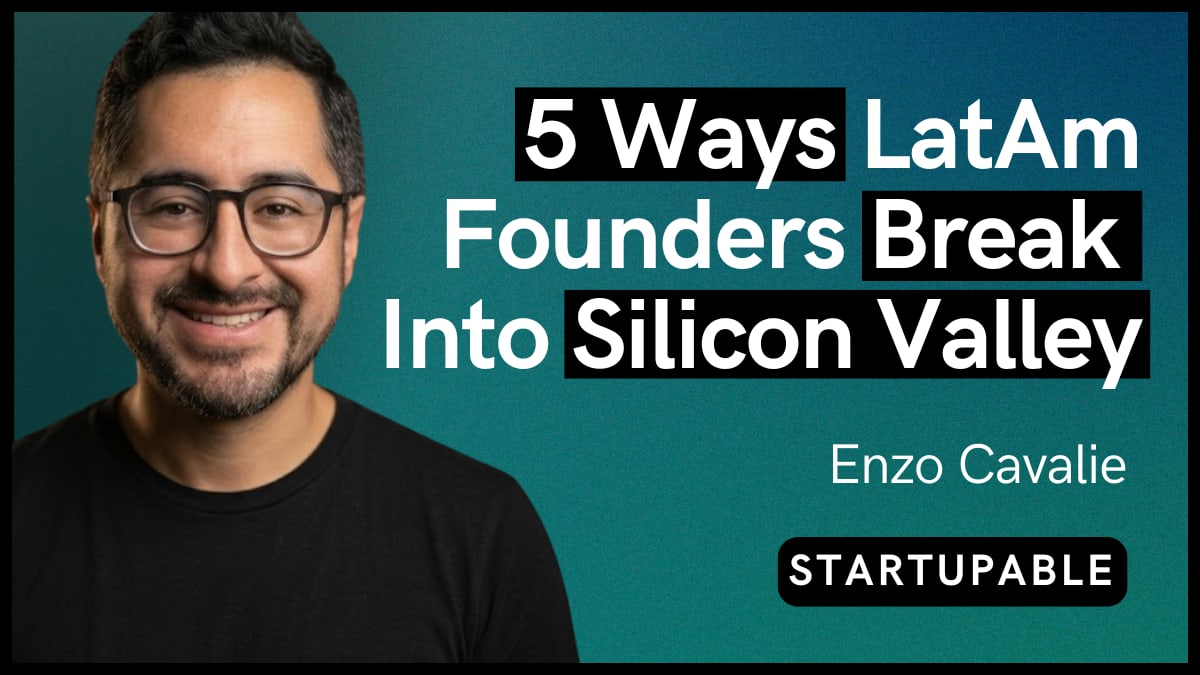
This time I am the one being interviewed. Recorded live in front of an audience, with Santiago Zavala of 500 Startups asking the questions.
Five years ago I launched Startupeable out of Peru with no contacts and no idea how to run a podcast. The show has since crossed 10 million downloads, with guests including the founders of Mercado Libre, Nubank, Vercel, Runway and Auth0. That podcast is how I broke into venture capital, from Peru to Mexico to San Francisco.
The core of the conversation is a claim I have come to believe after five years here: what gets you funded is not the YC or Stanford logo, it is the circle of trust those logos put you inside. And the way in is not networking events.
Structure and Key Highlights
From Lima to San Francisco
- Grew up around machines because my father is an electronic engineer with a car workshop
- Set up my own PC at five to play Age of Empires and StarCraft
- Sold 200 or 300 wallets to teachers in high school, then imported supplements from the US to sell in Peru at double the money
- Grew up asking my grandfather and my aunt, both entrepreneurs, why they did what they did
- Discovered venture capital in college, listening to podcasts, which is why it is funny that I ended up making one
- Helped start Winnipeg Capital, one of the first venture firms in Peru
- Cold emailed my way into Dila Capital in Mexico with no network outside Peru
- Cold DMed my way into Reach Capital, on Twitter, because San Francisco lives on Twitter and not on LinkedIn
Why the Podcast Existed at All
- Before Dila met me I had spent six months listening to roughly ten venture episodes a week
- The realization: content is an enabler for an investor, because it is a relationship business and founders need a reason to want to meet you
- Nobody was doing it in Spanish, while Harry Stebbings and Jason Calacanis were doing it in English
- What convinced me it was possible: those guys were not billionaires or ex-Google before starting
- What gives me the most satisfaction now: meeting founders in the US who say the podcast is part of why they started a company
San Francisco Runs on Different Physics
- My line for it: Austin is probably closer to Mexico City than San Francisco is to Austin
- Everywhere else runs on a scarcity mindset, fighting for scarce resources
- Here the scarce resource is good ideas and people willing to execute
- What that changes: how you hire, how you sell a vision, your own conviction about what the product can become
- How long it took me to actually internalize it: about three years of living here
- The concrete difference in speed: in Mexico an investor can take two weeks to reply. Here I have lost deals for being one day late
The Circle of Trust
- The frustration I had from Mexico: reading about an 18-year-old raising $10M while friends with real revenue struggled
- What I assumed at first: it was the YC or Stanford logo
- What I believe now: those are proxies for being inside a circle of trust
- The practical test: an investor opens your LinkedIn and sees zero connections in common
- The parallel: would you hire someone with no shared contacts, even if they looked great
- What it is really about: emotional security, being able to reference someone with a WhatsApp in a minute
- The example from my portfolio: I connected an investor friend to a LatAm founder, she loved the business, and still could not sell it internally because her partners had no context on the market
- She went as far as asking me for intros to founders who could reference them, which most investors will never do
- The company raised from PayPal Ventures and Floodgate, both outliers by design
How Conviction Actually Gets Built
- The first half of my six years was rational: markets, product, traction, being the smartest person about why something works
- The second half is closer to psychology: I value the depth of the relationship with the founder
- What that looks like in practice: spending time with founders over a beer, in places where they can be themselves
- What I look for beyond the checkboxes: edge
- The example: a Colombian founder building an AI CRM against ten competitors twice his age, who is a designer by training and had a philosophical take on how the product should look
- Where I differ from some colleagues: many investors pass if they cannot see themselves spending ten years with a founder
- Why I think my range helps: in high school I hung out with the cool kids and with the kids I played Dota with
How a Fund Actually Decides
- Reach manages about $600M, closing fund five near a billion, and I call it a tier two firm bluntly, having lost deals to tier one
- Checks from pre-seed to Series A, one to ten million
- Votes are weighted by seniority, and the number required scales with check size
- Senior partners have a super vote up to a budget of the fund, which they can spend at discretion
- Reach also has a scout check budget under $250k that needs no votes
- Santiago’s counterpart at the Latin fund: four voting partners, one wants to do it and it gets done, with an informal veto they removed last fund
- Why they removed it: veto contradicts letting one person write a check alone, and groupthink produces average investments
What AI Changed About Investing
- Products give investors a false sense of security, because you are investing in a team
- What changed: a product could pivot in 12 months before, and now it can pivot in the same week
- The conclusion: go deeper on teams faster, ask harder questions, and open up yourself first
- The uncomfortable part: it requires internal work before you can pull it out of someone else
- What I look for at seed now: the lift in contract value. If AI promises to do the work and your ACV equals the old SaaS price, you are not capturing the value
- The example I angel invested in: a European team rebuilding the ERP to compete with ServiceTitan, after realizing there were a hundred inbound agents and no differentiation
- Their numbers: ACV grew 10x in a month, from about 200k in revenue last year to 600k in February alone
- Why that is hard: building software is easy, building systems that do the work is brutal, because 95% is not enough when someone is replacing an assistant or a support agent
What AI Changed About Content
- My blunt claim: most of what I learned building content probably does not work today
- The story that made it click: a one-person media company published an AI-made documentary podcast about the Epstein files, went viral, and is now launching a production company of one
- What follows from it: if your content is purely informative, AI will do it better
- Why this is personal: Startupeable is in growth phase in Spanish and at zero to one in English, so I cannot apply the pre-AI playbook
- The rule I use now: what are the stories AI cannot tell, too messy, too human, too emotional
- The ideas I am working on: an Anthony Bourdain meets startup podcast, filming founders in the hole-in-the-wall restaurant they go to on a tired Friday
- The other one a founder pitched me: record interviews in Waymos, which is Comedians in Cars Getting Coffee for San Francisco
What Does Not Change
- Consistency: five years without missing a week
- The craft of making people comfortable enough to open up
- My early mistake: not sending questions in advance so guests would not overprepare
- Why it was wrong: technical founders are often self-conscious about communication, and more preparation gives a better interview
- What sending questions two weeks early really does: gives psychological safety even when they do not read them
- The other thing I do: send the unedited audio afterwards with full veto power. Nobody ever edits anything, but knowing they can changes everything
- Santiago’s read: it removes the fear that a hard question is coming at any moment
The Advice that Is Not About Networking
- Do not go to big events. Tech Week is every week in San Francisco
- Why: big events attract people who do not live here, and the circle of trust is made of people who do
- The insight from Luciana Reznik, cofounder of Wolox: San Francisco is a city that happens indoors
- What that means: you have to get into dinner parties, birthdays, barbecues, sports groups
- The actual advice: come for a few months so interactions repeat, then just live your life
- My own evidence: the most impressive people I have become friends with came from playing soccer, not from events
- Through soccer I know a founder of Base10 and a partner at YC
- Why it works: almost everyone here is in tech or venture, so doing what you like puts you in front of them anyway
The Question Nobody Asks
- Everyone asks how they can get value from the Bay Area
- Nobody asks how they can provide value to it
- Why insiders skip the big events: nobody enjoys a room where everyone will ask them for something
- What I stopped doing after two years: taking coffees with people I would see once and never again
- The contradiction that results: San Francisco is extremely helpful to people who are here for the long run, and feels like the most closed community to everyone else
The Real Gap
- My original hypothesis in 2020 was a knowledge gap about startups and venture in Spanish
- What I believe now: the gap is ambition and standards, not talent or knowledge
- What triggered the change: meeting people and asking how they are raising so much money
- The pattern: 18-year-olds with no experience pitching a bold idea and making it happen
- The conclusion: with ambition you attract the talent, knowledge and resources, because this is a city of abundance
Silicon Valley Glossary
| Term | Meaning | Context in the episode |
|---|---|---|
| Circle of trust | The network of people who can reference you | My core argument about what YC and Stanford actually buy you |
| Scarcity vs abundance mindset | Competing for limited resources versus assuming they exist | The deepest cultural difference I found in San Francisco |
| ACV lift | Whether your contract value exceeds the SaaS it replaces | What I look for at seed to know if AI value is being captured |
| FSM | Field service management software | What the ServiceTitan competitor rebuilt from scratch |
| Scout check | A small check an investor can write without a vote | Reach’s sub-$250k budget |
| Super vote | A senior partner overriding the committee within a budget | Common structure across firms |
| Groupthink | Consensus that produces average decisions | Why the Latin fund removed its veto |
| Tier one / tier two | Informal ranking of venture firms by brand and access | How I describe Reach bluntly, having lost deals to tier one |
| Deal flow | The volume of companies a fund sees | The denominator behind a fund saying no to almost everything |
| Do things, tell people | Building and then sharing it publicly | Santiago’s framing of how the podcast and the investing fed each other |
People, Companies and References
People Mentioned
- Enzo Cavalie: the one being interviewed this time
- Santiago Zavala: of 500 Startups, asking the questions
- Luciana Reznik: cofounder of Wolox, source of the city that happens indoors
- Harry Stebbings and Jason Calacanis: the English-language precedents for the podcast
- Amy: the investor friend who went to unusual lengths to reference a LatAm founder
- Gustaf: the YC partner he plays soccer with
- My father, grandfather and aunt: the engineer and the two entrepreneurs
Companies and Organizations
- Reach Capital: about $600M under management, closing fund five near a billion
- Startupeable: over 10 million downloads
- 500 Startups: Santiago’s fund
- Winnipeg Capital: one of the first venture firms in Peru
- Dila Capital: the Mexican firm he cold emailed into
- PayPal Ventures and Floodgate: the investors who did the LatAm deal
- Base10: whose founder he met playing soccer
- ServiceTitan: the incumbent being rebuilt from scratch by a European seed company
- Mercado Libre, Nubank, Vercel, Runway, Auth0: podcast guests