The audio and video are in Spanish. These notes are a translation.
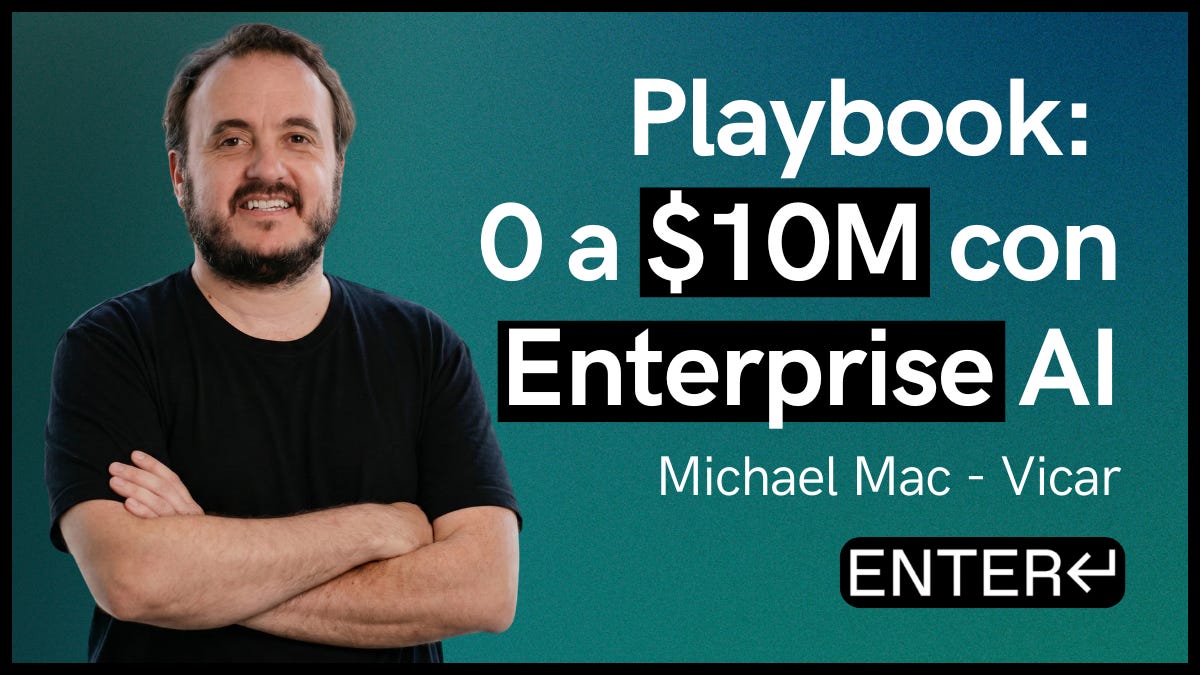
Today I interviewed Mike Mac-Vicar, cofounder and CTO of Enter, the artificial intelligence startup that Sequoia Capital just valued at around 150 million dollars, in the largest investment in an AI company in Latin America.
Before Enter, Mike cofounded Wildlife Studios, the Brazilian video game company that reached a value of 4 billion with more than 3 billion downloads. He spent 12 years there as CTO and then left everything to start from zero.
In less than two years Enter went from zero to about 10 million in revenue selling legal AI to Nubank, Mercado Libre, Itaú, Santander, and Airbnb.
We talked about why most enterprise AI projects never reach production, why Sequoia first passed and then changed its mind, and why he came back to Latin America when he could have stayed in Silicon Valley.
Structure and Key Highlights
The Gap He Saw in France
- He went to do a master’s at a French university known for physics and mathematics, and as part of the French course they took him on an industrial tour
- He saw nuclear technology, fuel recycling, a nuclear plant, a spent-fuel repository that receives material from Germany and the United States, and a submarine plant
- It happened that they were building the submarines Chile was buying
- And that industry does not stop there: they also make cars, planes, and some of the most modern tanks in the world
- What he describes as desperation: seeing that the most sophisticated piece of technology we make is ridiculous next to that, and that closing that gap would take 50 years of training PhDs and a public policy that straightens the incentives
- His underlying reading: the lack of that industry lowers our mental ceiling on what we believe we can do
What Silicon Valley Did Teach Him
- He got there thanks to Francisco Larraín, one of his first bosses. He says he felt rescued by that fact
- What Francisco gave him was making the grand feel ordinary: he talks to you about Google as if it were the company on the corner, or about someone famous as if they lived on his street
- Once he was there he confirmed it was literally like that. In every house lives someone trying something similar
- The other experience was seeing the Curiosity landing on Mars, broadcast at a NASA base surrounded by the people who had worked on each piece
- His lesson from that day: 90% was willpower. We assign an unreachable complexity to what we do not know
- The parachute people explained to him that it was a parachute, that they kept improving it to withstand more heat and more load. But a parachute
- The contrast he draws: there are technologies where there does seem to be illumination, like a magnetic resonator. Most of what companies do, no
Why He Came Back to Latin America in 2012
- One of the reasons was personal: one of his future partners was a close Brazilian friend he had met in France
- The other was a disappointment. After the Groupon IPO he saw that when things go badly, some save themselves and the rest sink, even if the mission had been told with enormous conviction
- And the thesis: when something appears that nobody understands, the barriers to accessing a market drop radically. At that moment that was mobile gaming
- Put that together with the volume and the quality of engineering the Brazilian education system produces, and with access to a global market with no barriers
- His conclusion: that gives you an unfair competitive edge. They cannot do it because their talent is much more expensive
- How he got to Brazil: without speaking Portuguese, without having visited the country before, with his dog and his then wife, who was pregnant. In retrospect he describes it as reckless
How Wildlife Competed from Brazil
- Their main advantage was not being contaminated by the games industry. None of them came from there, so they learned everything from zero
- The benefit of the blank slate: they could take sound off the roadmap because most people play in silence. They launched games without sound in several countries
- They invested ridiculously little in graphics, because their tests said the user did not care that much
- Why console and PC companies got stuck: they faced the problem the way they were used to, and almost all of them ended up buying a mobile company
- The first company was literally called Top Free Games, and that was the legal name. When Apple or Google questioned that it was trying to manipulate the ranking, they could show that was what it was called
- The second was called Fun Games for Free
- Their culture was extreme pragmatism: games that died in a week and others that started the next. Killing a game is violent for whoever assigns it sentimental value, and the culture was designed to avoid that
How They Broke Their Own Ceilings
- The pattern he still sees in local companies: what they consider a success is, for him, a failure, for lack of a reference
- Their early decision was to compare themselves with the world, not with the locals. They hired people saying they were going to make the best game in the world and they compared themselves with Nintendo, with two games, one of a penguin and one of a motorcycle
- His observation about that: telling that story 50 times while hiring makes you start to believe it and to justify it
- Then came the methodical work. Each area went to understand what the references did in analytics, marketing, and engineering
- The scale of that climb: they went from a game that made a few thousand dollars a day to others much larger, knowing that at that moment there existed a game generating 5 million dollars a day
- The marker that they were doing something right: one year they launched one number-one game, the next year two, and so on up to five in the fifth year
- But they knew that in monetization they were still far off
Closing the Window Before It Closed
- Around 2015 it became evident that the traditional companies had already bought mobile studios and were starting to have hits
- What that meant: the room for amateurism, the hacky, and the ugly art was running out
- The phase they called 2.0 consisted of getting the house in order so they would coincide with them when they finished learning, and not fall behind
- They went from investing a few million in performance marketing to spending 100 million profitably
- And they hired an art director to teach them what the quality bar was and to create the foundations of the team
The Low Hanging Fruits of a New Market
- His rule: when nobody knows how to do something and demand exceeds supply, you take the market with quantity, not with quality
- In their early days they got as far as holding the first eight places on the Brazilian ranking, and it was not because of quality
- They reverse engineered the App Store using every signal Apple left: its own page, the APIs, the intercepted traffic
- When an iOS beta came out with new pages in the App Store, they immediately started figuring out what made a game get there
- The result was sometimes shameless: they completely dominated a new recommendations page because they tuned all of their metadata
- His reading of the cycle: those windows close. The stores became editorial around 2018 and 2019
- And it repeats. It happened with Google, then with the Reddit tricks, and now with what is being learned about models
The Three Things that Get Confused in AI Today
- First, the promise of artificial general intelligence. It is separable, and there is no reason to assume we will get there
- Second, the market for foundational models, which makes complete sense as something that exists, but which got contaminated by the race for AGI. That race for resources is hard to justify if you do not reach that destination
- Third, applied AI, which uses models that already exist and that are not promises
- What he sees at Wildlife today: art that used to take 20 days is now produced in three minutes, and generating variants of assets to test versions of a game is a matter of minutes
- The same in marketing, where most of the creatives are already made with AI
- His point about legal work: they are not replacing work that humans used to do, they are doing the work they could not do
- And his historical analogy: applied AI has the same characteristic mobile has had since 2012. Every industry is going to have to adapt, and the barriers to entry are extremely low
What Enter Solves
- The definition: apply AI to problems that really matter, with responsibility, explainability, and in a way that is auditable
- The fact that frames the market: Brazil spends close to 2% of GDP keeping its judicial system running, about five times more than second place relative to GDP
- It is not corruption or fraud. It is a system designed with good intentions, so the citizen has access to justice no matter their money
- The problem is one of volume: 200 and some million Brazilians against far fewer companies, and tens of thousands of new lawsuits a month
- Why they chose legal and not summarizing texts or generating art: legal has consequences. A badly made defense is read by a judge
- The gains they generated: efficiency in the process, consistency in the defenses, and control over the lawyers who work on each case
- Their metaphor: they gave tools to a coach whose team was playing with three balls on the field. Now he can define the formation, the techniques, and measure everyone
- For the lawyers it also gets better: reading 500 pages and listening to two hours of audio, which in practice they did not do for lack of time, is now done by the AI
- And what closes the sale is the final metric: the success rates go up, and with that the ROI justifies itself
Why Enterprise AI Fails
- What people ask him: agent orchestration, which models they use, fine tuning, prompt engineering
- What he says actually matters: the adoption challenge
- First problem, actions with irreversible consequences. If the model acts and nobody can review it beforehand, you are already in serious trouble. That is a design error
- Second, explainability. A doctor can look at a marked X-ray and tell himself a story. If you hand him a treatment derived from 15 years of research, he would have to read 250 papers to understand it
- Third, the black box. For generating art it makes no difference, because you discard it and ask for another one. With immediate consequences you need precision, and the failures create a reputation problem for you
- Fourth, people want to see credible companies using the same tool before they adopt it
- His advice that follows from that: at the start, instead of chasing many customers, pick one or two and put all the meat on the grill. For them it was two banks
- And the point he stresses most: the hard part is not the model, it is the context. An employee has a coffee, finds out that a project was canceled, has already seen ten similar documents, and knows which number relates to which
- Reproducing that asks for a disproportionate effort in classification, segmentation, connecting systems, and documenting the company’s entities and relationships
- And then making it auditable. An impressive result that cannot be audited or edited has zero value
Copilot or Agent
- At Enter almost everything works as an agent, with a key difference: the agent practically never makes the final decision
- The flow: the case comes in, an agent analyzes it and summarizes it, looks for information in the company’s systems, and leaves tasks for the lawyer so he can review its conclusions
- The typical example: the agent detects that a piece of the plaintiff’s data is wrong, proposes the correction, and the person approves it
- The rule: if the agent acts alone it is because the action is reversible. It never does something irreversible on its own
- His comparison with programming: it started with autocomplete, then the copilot beside you, and there are already studies that say that makes the person slower
- What convinced him that this changes everything was seeing an autonomous agent do the work, because he no longer tries to understand its code
- What he gives the agent is the same thing he would give a team: the project, his opinions on architecture, which technologies he would use, four things to watch, and start with an integration test
- The real difficulty is that giving instructions and context to a team is not natural for someone who is not yet senior
- How they apply it to lawyers: the lawyer’s work and the agent’s work do not mix. It is not an assistant talking in your ear, they are other members of the team doing things
Selling to Corporates Without Depending on Them
- Last year’s FOMO helped, but what defines the sales cycles is the integration and the compliance
- The advice they received from large companies: at no moment can the sales and implementation process end up depending on the customer
- If you ask when they will deliver the API, the answer is going to be five, six, or even nine months
- Given that is unacceptable, the only way out is to design the product so the first integration takes a while and the following ones take less and less time
- The tactic that follows: integrate with the vendors that repeat across customers, the nice way or the hard way, via APIs or scraping
- The Nubank case: they built with them the largest number of integrations he has done in his life, something that would not be justified today, but that laid the foundations of their architecture
- They solved compliance and security by learning, automating, and getting certified, until they had a package ready. Today they even use AI to answer the questionnaires
Why Sequoia Passed at First
- At the start, the idea was to go to the United States. Mike even warned his partner that with three kids in Brazil, moving would be out of his reach for several years
- They started conversations with a crypto exchange, with US airlines, and with banks
- In early 2023 they switched from selling to law firms to selling to the companies’ legal teams, and the numbers in Brazil started to come together
- Sequoia, which kept in contact, asked when they were going to go to the United States. The answer was that they had decided not to go
- It seemed so crazy to them that they asked permission to talk to Nubank and other customers, only to understand what those customers saw
- They were impressed by the answers and their conclusion was that the market has no plan B: plan A is you
- What he liked about that process: a fund spending considerable time understanding why someone makes a decision that is normally read as giving up access
Stay or Leave
- If the local market is really small, as in Chile, he believes you have to go straight outside
- But you have to question other things. In the United States you probably compete for the top 70% of engineers and you lose the rest to companies with extreme visibility
- In Brazil he can reach the top 0.1%
- His nuance about the US supply: there are very good outliers, but the market is saturated and telling the good ones apart is much harder than in your own market
- The model he finds interesting is Francisco Larraín’s: teams in Chile with a constant presence in the Valley
- When staying local does make sense: if you use that period to understand the problem better before looking for revenue
If Software Gets Commoditized
- If the marginal cost of making software goes down, and the number of people needed goes down, software becomes accessible at another scale
- Two paths. One: custom software for everyone, down to the bakery on the corner with its own ERP
- Two: giant companies that built their software with 3,000 engineers competing against others of 20 or 50
- His reasoning: if those 3,000 each have five agents, no piece of software needs 15,000 engineers. The ones who have 20 can reach the productivity that used to require 3,000
- The barrier that does remain in B2B is reputation and contacts. A Chilean company selling B2B software in the United States needs something that anchors how serious it is
- The markets where that does not matter: gaming, productivity tools. Nobody cares who made the game if they had fun
- Who he thanks: his father, who even though he had his own ceilings saw that there was something on the other side and never questioned his decisions. And Francisco Larraín, for what he did with a whole generation of Chilean engineers
Silicon Valley Glossary
| Term | Meaning | Context in the episode |
|---|---|---|
| Applied AI | Using models that already exist to solve concrete problems | The category he separates from the promise of AGI and from foundational models |
| Foundational model | The base models trained from scratch | The market that got contaminated by the race for AGI |
| Explainability | Being able to understand why the model concluded something | One of the three blockers to adoption in enterprise |
| Auditable | Being able to review and edit what the system did | His condition for a result to have real value |
| Irreversible action | A decision that cannot be undone | What an agent must never do alone |
| ASO | Optimizing for the ranking of the app stores | What they did by reverse engineering the App Store |
| Low hanging fruit | The easy opportunity nobody has taken yet | What was abundant when Apple and Google were still learning how to control their stores |
| Window of opportunity | The period in which a new market can still be taken | What they saw close in mobile around 2015 |
| Sales cycle | How long it takes to close a corporate customer | Defined by integrations and compliance, not by the product |
| Context | The company information the model needs in order to get it right | What he says matters more than the model or the prompt |
People, Companies and References
People Mentioned
- Mike Mac-Vicar: cofounder and CTO of Enter, previously CTO of Wildlife Studios
- Mateus: his partner at Enter, the one who kept the contact with Sequoia
- Francisco Larraín: one of his first bosses, who took him to Silicon Valley, today at Topsort
- José Noblecilla: former VP of AI at Wildlife, cited on the team’s mental ceilings
- His father: who never questioned his decisions and gave him the confidence to take risks
- Enzo Cavalie: host of the podcast
Companies and References
- Enter: legal AI for legal teams, about 10 million in revenue in less than two years
- Sequoia Capital: the fund that first passed and then led the investment
- Wildlife Studios: reached a value of 4 billion with more than 3 billion downloads
- Top Free Games and Fun Games for Free: the company’s original legal names
- Nubank, Itaú, Mercado Libre, Santander, and Airbnb: the customers he cites
- Groupon: the IPO that disappointed him and pushed him back to Latin America
- Curiosity and NASA: the landing on Mars that taught him about willpower
- Nintendo and Supercell: the references they compared themselves with when they had two games