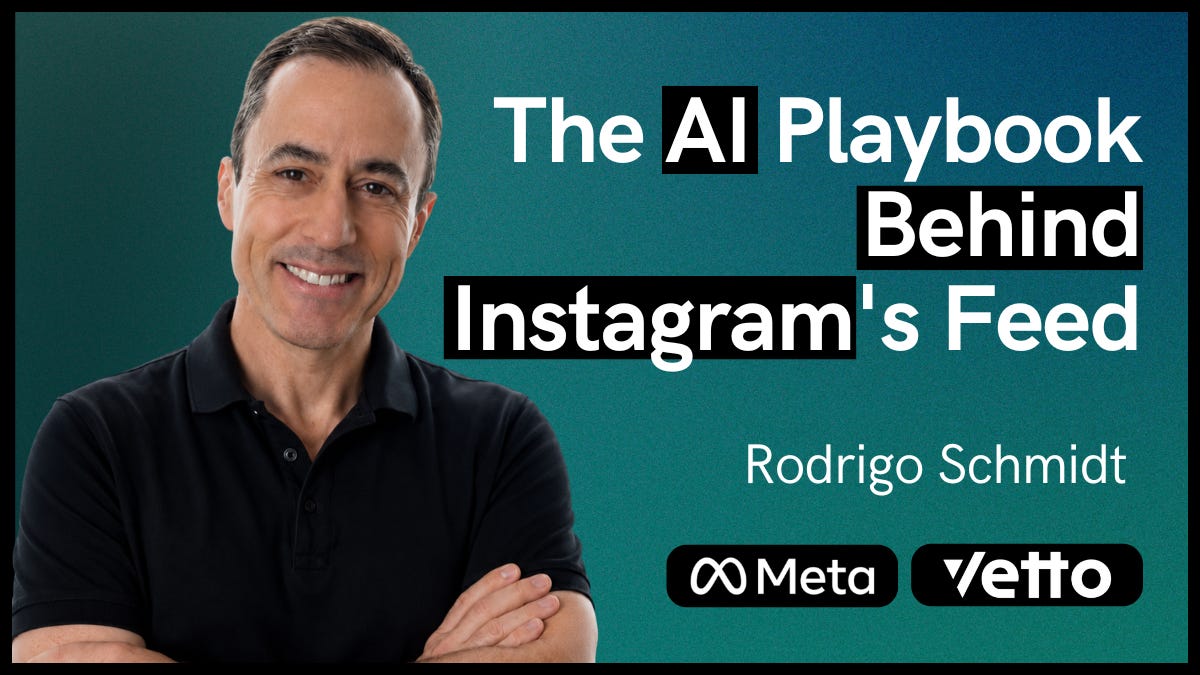
Today I interviewed Rodrigo Schmidt, co-founder of Vetto AI, a startup rethinking how data improves frontier models. Before that he built the systems that personalize Instagram for two billion users.
He did not start in Silicon Valley. He grew up in a small, cold port town at the southern tip of Brazil, in a very poor and dysfunctional family, earned a PhD in Switzerland, and became one of Facebook’s first international hires in 2008, back when Facebook was still smaller than MySpace.
His central argument is counterintuitive: a bigger context window is not a training problem, it is a memory hierarchy problem. And forgetting is not a bug, it is what lets you prioritize.
We also talked about why prompt engineering is numbing the models it sits on top of, and why treating a lab’s research as an API is fated to fail.
Structure and Key Highlights
The Town at the Tip of the Cone
- Brazil is shaped like a cone, and he comes from the very bottom of it, where the winters are cold and almost nothing looks like the rest of the country
- His family was poor and the situation dysfunctional, with his father absent
- Of six siblings, his mother was the one who stayed in extreme poverty while his aunts and uncles climbed out
- What that planted: the reality you are born into is not permanently attached to you, and there are usually things within your control
- Once you have that, it generalizes: why stay in this town, why settle for this job
- His mother told him, before he ever left, that she was afraid he would never be happy, because he was constantly frustrated with what surrounded him
- When he landed in Silicon Valley, it felt like home
Biology, Then Computer Science by Accident
- What drew him first was biology, because complex biological systems are nature’s programming: DNA as personal code, the brain as a stochastic network
- The strongest high school in his town happened to be technical, with three options: electricity, computer science and refrigeration
- What made him switch allegiance: with biology you study systems from the outside, with code you build them
Being Present as a Father
- His daughter’s first word was mom, and she used it for both parents because it worked
- His reading of it: a lazy-smart kid solving the problem with one word for two people
- She is six now and it still slips out, and he takes it as a badge of honor
- What made it possible: by then he knew how to work smart, not just hard, using the 80/20 principle to prioritize
- His view on identity: putting all of it into one thing is a trap, because one day you are too old to run that company or be a gym rat
- What he did not compromise: her months as a baby were more limited than any project, and would never come back
- He notes it did not cost him intensity at work, and he got a couple more promotions after she was born
Why Instagram’s Founders Resisted Personalization
- The biggest challenge was convincing Kevin and Mike that personalization was not harmful, and it took years
- Their fear was legitimate: around 2013 people were growing skeptical of Facebook’s ranking, asking who was in control
- Why doing nothing was not an option: a time-ranked feed is trivially gameable
- The concrete abuse already happening: a celebrity with an entourage posting every five minutes to stay at the top of everyone’s feed
The Objective Function Problem
- Showing people what they like most has a very short half-life
- His analogy: candy for lunch is wonderful once, and disgusting if you try it every day
- What you have to optimize for instead is long-term value, even if that means fewer hours today
- Why you cannot just ask users: the Henry Ford line about faster horses
- What happened when they did ask: people said they wanted educational material, and then did not use it
- The distinction he draws: you are asking system two, the philosopher in their head, not system one
- His conclusion: the answer is a balance, because present happiness gives you the strength to pursue long-term goals
- How they solved it: multiple objective functions tested over long periods to see which maximized the right kind of engagement
- The era detail: the models were not dynamic, so a lot of it was manual setup and manual tests, the way Karpathy reportedly spent 25% of his time labeling data at Tesla
What Translates to AI Products
- The core lesson: the simplest solution is not good enough, and that was as true then as it is now
- The failure mode in models today is sycophancy, telling users what they want to hear
- What the labs are doing: adding layers to reduce it, without being able to remove it entirely
- The hard problem is identifying the user’s real long-term motivation, which they cannot state directly
- His complaint about current tools: the prompt engineering built on top is numbing the models
- If the recipe is too general, it kills the personalization the model is capable of
- The image he uses: you can have a Ferrari engine, but what matters is the whole car
Context Windows and Forgetting
- His reframe: when a bigger context window makes answers worse, that is not overfitting and not a training problem, it is a memory hierarchy problem
- The rare condition he brings up: a handful of people worldwide who cannot forget any personal experience
- Why it is considered debilitating: it makes prioritizing hard and makes overcoming trauma harder
- What that tells him: we are not running out of brain capacity, so forgetting must be doing something useful
- His own memory is terrible, and he calls it a blessing
- The connection to transformers: attention is all you need means finding which tokens matter
- Where the responsibility sits: the application layer knows what is important in that window, and the model does not
- If you dump the raw window into the model, it will do its best, but you did not do your job
Why Startups Need Research in House
- The obvious part: we are building the road while driving the car, and nobody can wait for research to finish
- The historical parallel: FAIR started around 2012 in New York, and integrating it into product was hard because it was structured like academia
- The collaboration model that resulted: consulting-style, where they tested ideas with FAIR and then implemented alone
- He spent a year researching internally which projects succeeded, and the necessary condition was deep integration
- What did not work: research and product as separate teams with an API in between
- His warning for today: treating a lab’s research as an API has the same failure mode
- Either research advances and you play catch-up, or your product craves something the model cannot give you
- His caveat on the future: if the models commoditize, whether you still need research will depend on the application
How to Attract Researchers to a Startup
- His own credential: he went far enough into academia to have faced the choice at the end of his PhD
- What he claims does not motivate researchers most: money and status, because they would have picked another career
- What does: interesting problems, mastery, autonomy and purpose
- The concrete pitch he used at Instagram, which had zero recommendation systems at the time: a green field
- What they were actually doing: the first sparse models in production at Facebook, requiring new infrastructure and new indexing systems
- The risk if you lack that DNA: using the wrong carrot, which pushes researchers away rather than attracting them
Adapting to Silicon Valley
- Friends who moved from Brazil to Switzerland and returned in six months without finishing
- His verdict on Switzerland for startups: there is a recipe that works for biotech, and consumer tech does not fit it
- What surprised him most in the valley: candor as a form of politeness, and suspicion toward anyone who hides things
- The feedback that defined his first month at Facebook in 2008: you are not trying hard enough, because you have not brought facebook.com down yet
- The logic behind it: breaking things is not sufficient for success, but it is evidence you are pushing
- His Brazilian contrast: watching a talent show where nobody scores below nine, and realizing he had been away long enough to find that dishonest
- His framing of the adaptation: polishing your outer layers is easy when your inner layers already crave the change
Who He Thanks
- His wife, who was with him for almost the whole journey
- His nuance: they were not pushing each other, they were exploring the world together
- His caution about attaching gratitude to a single person: it can be more debilitating than helpful
Silicon Valley Glossary
| Term | Meaning | Context in the episode |
|---|---|---|
| Objective function | What a ranking system is optimizing for | The core of the Instagram problem, and why short-term engagement fails |
| Memory hierarchy | Deciding what to keep close, what to store, what to drop | His diagnosis of the context window problem |
| Context engineering | Choosing what an agent sees, remembers and ignores | The current name for what he spent years doing at Instagram |
| Sycophancy | A model agreeing with the user regardless of truth | The engagement trap the labs are still fighting |
| Sparse models | Models with vast numbers of mostly-zero features | What they put into production first at Facebook |
| System one / system two | Fast instinct versus deliberate reasoning | Why asking users what they want gives you the wrong answer |
| Long-term retention | Whether users keep coming back over years | The metric he argues you should optimize for, over hours today |
| FAIR | Facebook AI Research | The research org whose integration into product he studied for a year |
| Attention | The transformer mechanism for weighting what matters | His analogy for what the application layer must do with context |
| Green field | A problem space with nothing built yet | What he used to recruit researchers to Instagram |
| 80/20 principle | Most of the result comes from a fraction of the effort | How he balanced intensity at work with being present at home |
People, Companies and References
People Mentioned
- Rodrigo Schmidt: co-founder of Vetto AI, formerly built Instagram’s personalization
- His wife: who he credits for the shared journey
- His mother: who feared he would never be happy
- His daughter: who called both parents mom
- Kevin Systrom and Mike Krieger: the Instagram founders who resisted personalization
- Andrej Karpathy: cited for spending a quarter of his time labeling data at Tesla
- Julio, from Atlantico: who told Enzo the story about his daughter
- Henry Ford: for the faster horses line
- Enzo Cavalie: podcast host
Companies and Organizations
- Vetto AI: his current company, doing research on the data that trains and evaluates models
- Instagram and Meta: where he built personalization at two billion user scale
- Facebook AI Research (FAIR): the research org he studied and later worked alongside
- Runway and Krea: examples he gives of application companies building research teams
- Cursor: the other example, at larger scale
- MySpace: the size reference for how early he joined Facebook