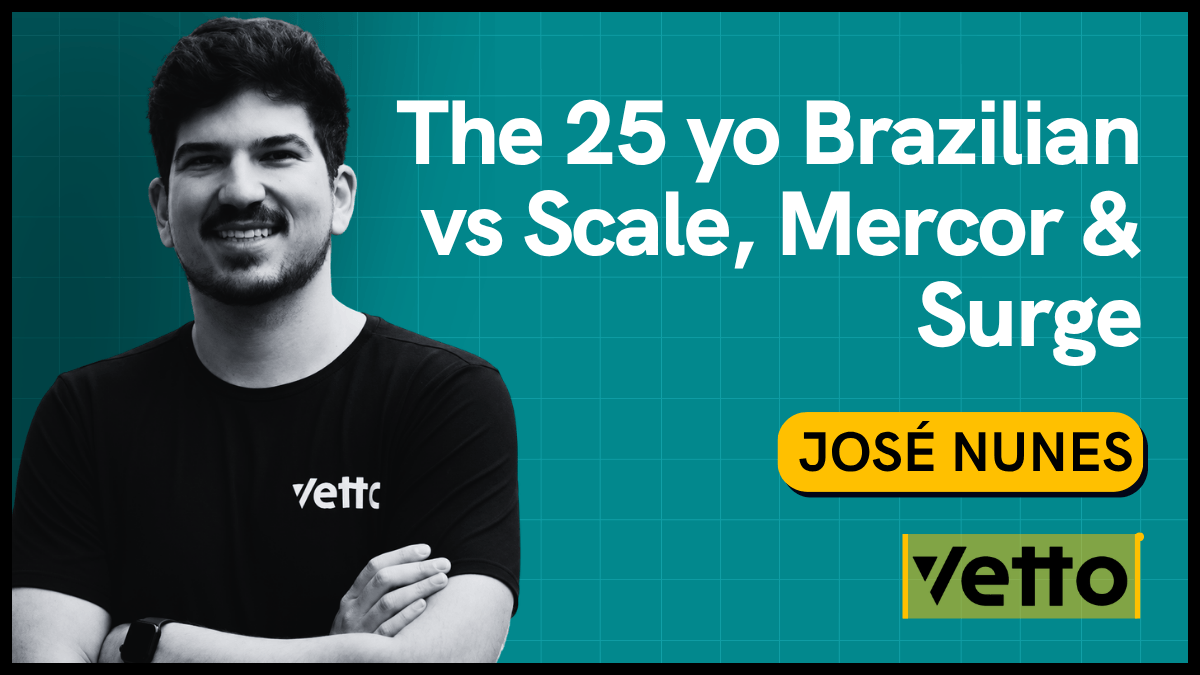
Today I interviewed José André Nunes, founder and CEO of Vetto AI, a research lab that helps frontier AI labs improve their models.
He came to Silicon Valley from a small town in Brazil with no network and barely any English. Vetto entered a crowded market late, against Scale, Mercor, Surge and Handshake, and reached tens of millions in revenue.
The reframe that made it work is the whole conversation: Vetto does not see itself competing with other data suppliers. It competes with the labs themselves, in research, and then sells them what it finds.
Structure and Key Highlights
The Fighter Pilot Who Was a Few Centimeters Too Short
- His childhood dream was not a startup. It was to fly, specifically fighter jets, after watching a lot of Top Gun
- What he wanted was the freedom of birds: the same feeling as getting a driver’s license, but for the whole world
- He passed the exams and got accepted. Then failed at the measuring stage, and it was not something he could change
- Because the path to fighter pilot in Brazil runs through the air force’s engineering school, preparing for it meant physics, math and physical training
- Looking for alternatives he found ITA, known as the hardest university to get into in Brazil, and picked it as a challenge
- What sold him was the people: ITA graduates working as engineers at Google and big tech, which was very far from his reality in a small town
Studying Hard as the Only Way to Get on a Plane
- He first flew at fifteen, to the International Math Olympiad in Argentina
- The logic was simple: he had no money for a ticket, but the government paid everything if he qualified. Studying was the price of the flight
- That meant gold in the state olympiad, then the national one
- He didn’t know how hard it was, so he just did it. A recurring pattern in his life
- Two hours in the air took him to a different country with a different language. His first time outside his world
- The olympiad circuit turns out to be a mafia: a striking share of the founders and operators building the interesting things in AI came through it
Dropping Out When Dropping Out Is Not a Badge of Honor
- In the Valley people go to college wanting to drop out. In Brazil he never told anyone he had
- Here he says it and people who don’t know his university’s name know that he dropped out of it
- The real story is less romantic: he never planned to drop out, he just kept choosing where he was learning more
- He only quit when keeping both became impossible and he was doing neither well
- He had been working since his first year to support himself and his family, so the risk was not abstract
- His parents still don’t agree. They see it working, so they’re happy, but they probably still expect a degree someday
Raising in the Valley with Barely Any English
- The team was paying itself nothing and didn’t know what venture capital was a few years ago
- When they realized they needed money, the information was roughly “that exists, and it’s in California”
- He arrived with no money and nowhere to stay. A Brazilian fellowship for high-potential students opened the first doors
- Meeting investors in Brazil and in the Valley around the same time let him build his own opinion from both sides
- His read on Brazilian VC: it works like a mini private equity, asking for financials from day one. Here people talked about vision and dreaming big
- Dreaming big was the only thing he could do. He couldn’t speak English, but he could do that
- The founder who raises in Brazil is usually the MBA founder who studied in the US and went back. The Valley is full of technical founders
- He had no degree and no pedigree, but he was technical, which is why raising here was easier than at home
Competing with the Labs Instead of with the Suppliers
- The motivation was never product. AI is changing the world, the frontier is research, so the question was how to do research on their side
- The business came as a consequence of the research, not the other way around
- “Our competitors are not the other data suppliers. We are trying to compete with the labs, but not with the same customers. We are competing in research”
- The model: do the same research, and if you get a better result, sell it to them
- The alternative business was a marketplace, finding tens of thousands of annotators fast. They know it works, but it’s a margin game
- Their bet is that the gains are in iterating to find which data improves the model, not in who produces it
- They want to be seen as research partners, not suppliers. The relationship is entirely different
The Problem Is Defining Good Data, Not Collecting It
- Everyone in the space talks about quality, but the definition is blurry and it’s genuinely hard to prove a dataset improved a model
- With so many data companies competing, the labs’ own problem is separating good data from bad
- So the bottleneck was never access to annotators. It was defining what good data is, and that is a research problem
- They never wanted to collect the data. They wanted to be the best at designing the guidelines
- Hard to retrofit: a marketplace employing millions of people cannot easily become research-first. The pace, the design and even the customer relationship are different
Why They Think They Can Design Guidelines Better Than the Labs
- He doesn’t claim to be the only one, and says he hopes not, because that would slow AI down
- The argument is environmental: the labs are far from the real world, from the annotators and from how models actually behave out there
- Labs are focused on algorithms and compute. Vetto sits closer to the ground
- They have access to top financial experts, accountants and lawyers, and use them not to collect data but to iterate on the format of the data
- The thesis in one line: how do you distill human knowledge into the models
Compute vs. Humans as the Substrate
- The labs do research with compute as the substrate. For Vetto the substrate is humans, and right now that is cheaper
- That gives them freedom to iterate on problems the labs can’t justify, since the labs are always prioritizing against compute cost
Recruiting Researchers You Cannot Outbid
- They can’t compete on salary, total comp or stock with the frontier labs
- What attracts researchers is a strong opinion. So they write their own manifesto about how models will improve and what data’s role will be
- They tell candidates their beliefs, and the ones who already believe something similar come. That’s stronger than any benefit you could offer someone who loves the problem
A Go-to-Market with No Sales Team
- There is no sales team. It’s him and the research team
- His job is packaging the research so that it can be sent to someone who will immediately understand how the data improves models
- Selling top-down opens doors, but the person who understands the value is the researcher leading that specific domain, not the VP
- They know most of their research won’t be state of the art next to the labs. Some of it will, and that’s the part that works
- They keep internal benchmarks that are state of the art today, still unpublished
How He Built a Network Here Without Trying to Sell
- Connecting in the Valley is hard for business and easy for learning, so he approached it as learning
- Meeting Sam Altman was about how to build a research company where researchers are the core, not about selling to OpenAI
- The key: the best way he found to build a network here is not trying to do business with anyone
- His favorite question is a vulnerable one: what would you do in my place right now?
- He thinks people rush to sell or to raise before knowing anyone deeply
- To grow himself he travels deliberately to leave the bubble. In the Valley everyone is in the eye of the hurricane; in Brazil he can breathe and get perspective
How the Market Keeps Changing Under Everyone
- Scale started with autonomous vehicles, labeling bounding boxes. Last year it was RLHF. Today Vetto does none of that, only verifiers and rubrics
- He doesn’t expect the shape of the work to survive the next six months either
- Labeling as such will keep getting automated. The problem that doesn’t go away is which data improves the model
- We’re still in the era of human data, feeding models the knowledge of the world’s best people, and that pool keeps shrinking
- After that, the data problem still exists. It just stops being a human data problem
Where the Labs Actually Want to Improve
- Going from 80% to 82% on a public benchmark is hard and rarely the best ROI
- What labs want is a benchmark where the model scores 20%, and take it to 70%
- Finding a 20% benchmark in coding today is genuinely difficult, because the models are that good
- And there’s gaming: you can build a dataset where the model always fails by writing the rubric so it always fails, and it’s very hard to catch
- Their answer is to run post-training on small models for every dataset they create, and show the before and after
Environments, and the AlphaGo Argument
- Defining an environment is much harder than it looks. Try defining the environment of a VC analyst: a few actions, plus a knowledge base that is the whole internet and a network of people
- Building one that reflects every VC analyst in the world means simulating the world, which nobody can do
- So you shrink the problem: not replacing the analyst, just one task, with an environment simple enough for a model to learn in
- AlphaGo is the reference. Fed with top human games it performed brilliantly. A year later, with no human games at all and self-play, it produced move 37, something no human would play
- The implication: if you want superhuman models you probably cannot feed them human data. You need the environment and the right verifiers
- But that costs enormous compute, because the model needs billions of experiences. Seeding it with top human data brings the cost down, which is what Vetto is trying to do
- So better models likely need less and less human data, while more and more humans are needed to design the environment
The New Shape of Company
- Before AI the fastest-growing companies were application companies. Now the fastest-growing ones have research inside
- Being state of the art in your domain is the best competitive advantage available, and he doesn’t believe in the moats of a few years ago
- Vetto’s internal product is what they call data engines: an ecosystem of small models, humans and software that produces the final datasets. They don’t sell it
- As the models get better, their machine gets better with them
- On data as a moat: having the data is not the point, knowing what to do with it is. An app that captures data with no R&D behind it is almost nothing, because others can get good data too
Helping AI Get Better as a Job
- His first company helped young people in Brazil find jobs, and he sees the move to Vetto as continuous: distilling human knowledge into AI is itself work
- Humans are part of the environment, so being an assistant to an AI is a job
- They hire annotators across Latin America, where most people don’t know this kind of work exists. It’s remote and it pays well, and the adoption cycle will take a while
What Emerging Markets Have to Do with the Frontier
- They went remote-first and get together every two months, because with talent that scarce you cannot impose geographic boundaries
- They hired researchers in Brazil, some from Nubank, who perform alongside people who had been inside the labs for years
- Brazil is among the top countries in the world by ChatGPT usage, which he reads as a real advantage: the people who use it most understand the problems best
- On the cynical view that emerging markets just become training labor for rich countries: the researchers inside the labs are mostly immigrants anyway, and DeepMind is in London
- Saying you must be in Silicon Valley to improve AI slows AI down more than it helps
The People He Thanks
- His co-founders, who he lived with in college and went through the hard moments with
- In a space with as much noise as AI, having solid foundations in house is what lets you stay for years
- When he doubts himself they tell him to stop overthinking and go
Silicon Valley Glossary
| Term | Meaning | Context in the episode |
|---|---|---|
| Frontier lab | The labs training the largest models | Vetto’s customers, and in research terms, its competitors |
| RLHF | Reinforcement learning from human feedback, where humans rank model outputs | What the whole market was doing last year and Vetto no longer does |
| Verifier | A check that decides automatically whether an answer is right | Lets a model learn without a human in the loop |
| Rubric | The criteria used to judge an answer | Whoever writes it decides what counts as correct, which is where the gaming happens |
| Guidelines | The spec defining what data to produce and how | Vetto’s actual product, the thing they wanted to be best at |
| Environment | The simulated world where a model practices a task | Defining one for a VC analyst would mean simulating the world |
| Move 37 | AlphaGo’s move against Lee Sedol that no human would have played | His argument that superhuman models cannot come only from human data |
| Post-training | Everything done to a base model after pretraining | They run it on small models to prove a dataset actually helped |
| Data engine | Their internal ecosystem of small models, humans and software | What produces the final datasets, and what they never sell |
People, Companies and References
People Mentioned
- José André Nunes: founder and CEO of Vetto AI
- Lucas: his co-founder, also from the olympiad circuit
- Sam Altman: met through an investor, as a conversation about building a research company rather than a sales pitch
- His parents: still don’t fully agree with the decision to drop out
- Enzo Cavalie: podcast host
Companies and Organizations
- Vetto AI: the research lab that designs the data that improves frontier models
- ITA: the hardest engineering school in Brazil, which he entered and later left
- Scale, Mercor, Surge, Handshake: the incumbents in the market he entered late
- DeepMind: cited for AlphaGo, and as evidence that the frontier is not only in the Valley
- Nubank: where some of the Brazilian researchers on his team came from
- OpenAI: a lab he was never trying to sell to when he met Altman
Data and References
- Tens of millions in revenue: what Vetto reached in around six months
- 15 years old: his first flight, to the math olympiad in Argentina
- 21: his age when Enzo first met him, around the first fundraise
- 80% to 82% vs. 20% to 70%: the difference between an improvement a lab won’t pay for and one it will
- Every two months: how often the remote-first team gets together
- Second or third: where he places Brazil among the world’s heaviest ChatGPT-using countries