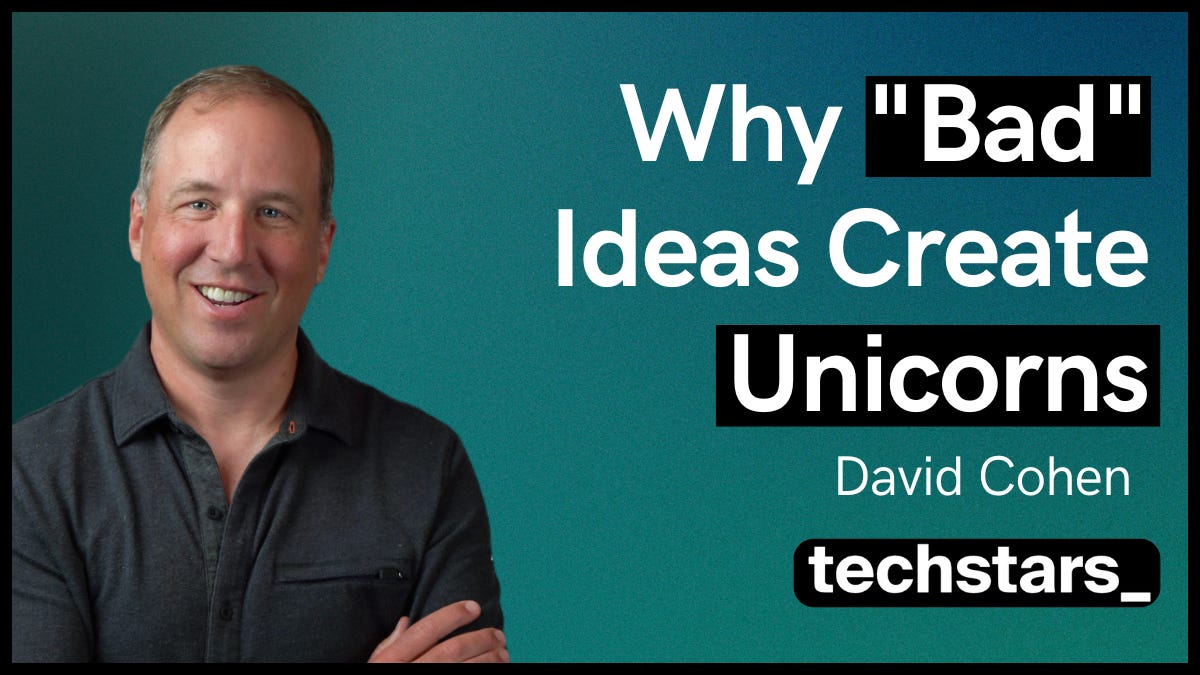
Today I interviewed David Cohen, founder and CEO of Techstars, one of the largest accelerators in the world, behind companies like SendGrid, ClassPass, PillPack, Chainalysis and Remitly. More than 4,000 companies have gone through the program, raising over $30 billion and producing 22 unicorns.
Separately, as an angel, he was an early investor in Uber and Twilio. He also had the chance to invest in Lyft and passed, which is the miss he still thinks about.
He founded Techstars 20 years ago from Boulder, stepped away from the CEO role, served as chairman for four years, and came back last year.
We talked about what had drifted while he was away, how AI changes what you look for in a founder, and why he thinks AI agents doing venture capital will beat a good chunk of the market.
Structure and Key Highlights
Why He Came Back
- He was still on the board as chairman, so he was involved but not operating day to day
- His framing on his successor: a different CEO will make different decisions, and that is neither bad nor good, just different
- What the pandemic gave him: a break, time with his family, and enough distance to see the company from the outside
- The three recommitments he came back with
- First, the founder is the center of the universe and the only customer. They have many partners, but one customer, and he felt that was getting lost
- Second, embracing startup communities. Techstars works because of the communities it operates in, a cast of many thousands rather than a few hundred employees
- Third, a cultural one: bigger is not better, better is better
- What that changed in practice: the company had been focused on doing more investments in more places, and he refocused on quality, improved the investment offer, and started measuring growth as the value of the portfolio and nothing else
Boulder, 19 Years Later
- He still lives there and used to say he imagined himself in Boulder 20 years out. It has been 19 and he has no plans to move
- The belief underneath it: you can build a great company anywhere, as long as there is some startup community, connectivity, capital and experience
- What he calls pure mythology: that you must be in a particular place to build an interesting company
- His observation about the current trend: most companies in the Bay Area did not start there, they moved there once something was working. Even their best known competitor
- Moving for leverage is natural. Saying you must start there is silly
- What Boulder gave him: an underdog mentality and an open door, give first culture in a city of about 100,000 people that still ranks in the top ten of venture charts
- His clarification about give first: Techstars did not create the idea, it adopted it. His co-founder Brad Feld started writing about startup communities, and that became a playbook other small places could follow
What He Tells Founders Asking Whether to Move
- If you want to be in San Francisco, be in San Francisco. It is the best startup community in the world
- But you can publish software now and anyone in the world can use it now
- It depends what matters to you as a human being. If the only thing that matters is density of people doing the same thing, that may be the right choice
- If you have family or you love where you are, it is a balance. Maybe you get on a plane
- What he objects to is the you have to part
- His point about the data being biased: many of those companies moved there after they were already working
- And a competitive note: raising money there is probably harder, not easier. Though a higher valuation might follow
- The two biasing principles he names: everyone thinks they are in the top 5%, and everyone thinks they can identify who is in the top 5%
- His counter: you do not know who the top founders are until they do their thing, and that takes ten or twenty years
Does AI Level the Playing Field
- Ironically, it might do both
- What he sees across their global footprint: creating a prototype is now a zero talent, free thing. That front end signal is gone
- So it democratizes getting going and conveying an idea, which also creates a lot of noise
- But if you are building infrastructure, the actual LLM technology, being in a dense place matters enormously
- His compression of time: being ten years ahead used to be meaningful. Now being a month ahead is
- He calls it a barbell effect. It matters at the very beginning and at scale. In the middle you still have to prove customers want it
How the Founder Profile Shifted
- The weights move toward what insight you have into a market and what network you have in it, and away from early technical skill
- You can recruit technical talent once you prove product market fit and there is excitement around the business
- Design skills also matter a bit less at the beginning
- What matters more, earlier: storytelling, generating excitement, the ability to recruit a team
- His analogy: you would not invest in an auto repair shop with no mechanics. But now that the robots fix the cars, you can. What matters more is the owner’s experience and how they attract customers
- What he thinks AI will not have disrupted in 20 years: the networks people have, artistic creativity, and the ability to sell
- How that shows up in their process: they use AI in the pipeline as another voice in the room. They do not screen on what AI thinks, but they are getting close
- The scenario he describes: everyone thinks it is stupid and the model says hang on, there is something here. So they take another look
- They are tweaking their model weights toward the market opening and the background and passion of the people, and away from whether someone has a computer science degree
Whether the Accelerator Model Still Makes Sense
- His honest framing: it is a way, and the best way depends on the founder
- The value proposition: grow your human capital and network fast, get in front of appropriate investors, and access a built in customer network from twenty years of alumni
- His comparison: it is like picking a school. Harvard and Stanford are both good, with different vibes and philosophies
- What it is not: the education. That can be on demand and does not have to happen during the program
- The alternative model he uses as contrast is the venture studio, where they build it for you. And the obvious follow up is whether AI can build it for you
- His conclusion: what sustains are the things with networks around them, because in a world where everyone outsources their intelligence, human networks still decide who trusts you and who buys from you
Techstars’ Differentiation
- The ten year goal is a trillion dollar portfolio market cap. They are somewhere around 300 to 350 billion
- The way to go faster is not more accelerators in more places
- Their geographic distribution is the advantage. They reach founders in London, New York or Boston before those companies pick up and move
- So the network is distributed and it is a get to them early network
- Where the growth comes from: reinvesting in alumni, in the five or six thousand mentors they work with, and in the new companies those people start
- The scale of that pool: 5,000 portfolio companies, roughly 15,000 founders, dozens of whom have built unicorns and hundreds of whom have built smaller successes
- His summary: be network investors around the network they already built
What He Has Learned About Scaling Networks
- It is really hard, and he does not claim they have done it perfectly
- Their network has been more siloed than they would like, and that is precisely one of the things that makes it work
- The reason: the New York or London network does not feel as big as the global one, and scale can be the enemy of a network that feels personal
- The failure mode: a group where everyone posts and everyone responds is just noise
- What works instead: segmenting into vertical networks, like fintech, marketplaces, or founders who have raised above a certain amount
- His example of a valuable subgroup: the unicorn founders, who share deals and have built in trust from a shared experience
- And you have to stoke those fires. Segment it and water it carefully
Competing in an Institutionalized Asset Class
- He likes that there is more capital and more smart people. That is how the industry evolves
- His pushback on the phrase best founders: it treats it like walking into a grocery store where you can see the five best apples because they have no bruises
- You just do not know. And a lot of people are under networked, underestimated or undiscovered, in places that would surprise you
- Their role is providing opportunity where there is less of it
- Their specialization: they are not putting five million into something, they are putting a couple hundred thousand
- His conclusion about focus: if you have a game and get good at it, it is hard to beat you at that thing. It is easy to beat you at a very broad thing like finding the best founder
How They See Talent Others Miss
- A willingness to take a chance on people who will figure out the right thing over time
- What they learned: which market a founder cares about matters way more than their idea
- At their stage it is two people, a dog and an idea
- Why the reward is disproportionate now: a thing can scale out of control very quickly. They are looking for ten person unicorns, then five person, then one person, and eventually zero person
- The system view: when you invest in a hundred companies, you can almost predict how many become big. As long as you do not scale it out of control, it works
Advice that Changed Because of AI
- The internal meme at Techstars: just replace the word AI with software
- The parallel he draws: it used to be whether to be a mobile first company. The answer was you do both, it is just another way people engage
- What does not work: saying you are an AI company to get in front of the capital that is out there. That is what everyone does
- What he pushes founders toward: proprietary data and proprietary relationships. Something somebody else does not have
- His concrete example of what is not a business: searching your database using natural language. Who does not have that
- What is a business: data collected from sources no one else has, plus channels no one else has, put together
- The honesty he thinks founders need: if the data is out there, Gemini or ChatGPT will give the same answer. You have nothing special now or in a year
- The dynamic behind the bubble talk: one existing company shipping one feature kills a thousand startups. They add AI to mailing list software and a thousand companies are dead overnight
The Apparent Contradiction About Capital
- On one hand, smaller teams can do much more and burn less. On the other, the successful AI companies are raising enormous rounds
- His reconciliation is that these are two different games
- On one end: you build something that wows a market, you own almost all of it, it is worth $50 million and it took six months and little capital. A life changing exit without a big raise
- On the other end: you are doing something foundational, training your own model, and that requires enormous infrastructure, power and compute
- What is happening around both: the world is becoming AI native but is not there yet, which is part of why he expects some kind of correction
- Where the risk sits: the middle. Companies that create some value but end up with a crowded cap table, priced above what they turn out to be worth
- His description of that limbo: SaaS unicorns that stopped growing, not IPO ready and not acquired
AI Agents Doing Venture Capital
- He has already seen a few, and thinks they can be better than what a lot of investors do
- His easy example: an angel makes seven investments, they do not work, and they quit. An AI with any sense would never try that, because you have to be diversified
- So he expects some agents to beat a chunk of the market fairly quickly
- The question that follows: what is valuable then. You can take money from a bot and spend it at the grocery store, but you do not get the human network behind it
- The parallel he draws is public markets: fees are what kill you, and venture has high fees
- The bar he sets: you do not need to beat the market, you just need to be average with no fees
- His reference is Jack Bogle at Vanguard, and Bogle’s line that on average the finance industry subtracts value from society
The Pattern in His Misses
- The commonality: they were just bad ideas. He looked at them and thought that is a bad idea
- The Venn diagram someone drew for him years ago that he still remembers: seems like a bad idea, actually is a good idea. The tiny overlap in the middle is where people make tons of money, because nobody thinks it is a good idea
- His classic examples: nobody is going to ride in a car with a stranger, nobody is going to stay in a stranger’s house
- The specific miss: he was an angel in Uber and had the chance to be an angel in Lyft
- Matt Van Horn was mentoring at Techstars and is still a friend. But back then the company was Zimride, intercity transport for college kids going home for the summer
- His reaction at the time: a tiny market, I don’t get it. What happened next: a great team pivoted, fast followed Uber and built their own meaningful platform
- The lesson: when the idea sounds dumb, you stop looking closely at the people. And the team that figures out the idea is dumb is not a dumb team
- The counterexample from his own record: he never met Travis or Garrett at Uber. He met Ryan Graves, who mentored at Techstars, clicked with him, and Graves became the first employee and sat on the board until the IPO
- His conclusion: you can talk yourself out of a great team at the early stage because you do not like the idea. Ask instead whether you like the market, because they will probably stay in it
How His Philosophy Changed in 20 Years
- He used to think he had to be in all the good deals, which leads to group think and a lemming mentality
- Now he thinks he just has to make sure the deals he is in are good
- The second filter is a life is too short mentality: he has to want to work with the people
- Why he thinks that is not soft: when you click, you help more and they work with you more closely
- What he does when the founder is great but there is no click: there is another good deal to go do. There is no way to be in every good deal
- And his broader belief: if you are building a startup because you made a spreadsheet called fantasy XLS and you are doing it to get rich, without a why, you are probably going to fail. And so is he as an investor without a why
- Who he thanks for pushing him to think bigger: he sneaks in Brad Feld, then names Jack Bogle, whom he never met but who changed the financial industry through what he wrote
Silicon Valley Glossary
| Term | Meaning | Context in the episode |
|---|---|---|
| Give first | Helping without expecting a return, as a community norm | The core value he felt had drifted while he was away |
| Startup community | The local ecosystem of founders, mentors and capital | What Techstars operates in partnership with, everywhere |
| Barbell effect | Something matters at both extremes and less in the middle | How AI shifts where geography matters |
| Product market fit | When the product clearly matches real demand | What lets you recruit technical talent afterwards |
| Proprietary data | Data nobody else has access to | One of the two moats he tells founders to look for |
| Vertical network | A segmented subgroup within a larger network | How they keep a global network feeling personal |
| Cap table | Who owns what percentage of a company | Where the risk sits for companies stuck in the middle |
| Index fund | A low fee fund that tracks the market instead of beating it | His model for what AI could do to venture |
| Fast follow | Copying a working model quickly and executing better | What Lyft did after pivoting from Zimride |
| Portfolio market cap | Combined value of every company a fund has backed | Their metric of growth, currently around $300B against a $1T goal |
People, Companies and References
People Mentioned
- David Cohen: founder and CEO of Techstars, back in the role after four years as chairman
- Brad Feld: his co-founder, who wrote extensively about give first and startup communities
- Jack Bogle: founder of Vanguard, whose writing made him think big
- Matt Van Horn: mentored at Techstars, still a friend, and part of the Lyft miss
- Ryan Graves: the Uber connection he actually met and clicked with
- Enzo Cavalie: podcast host
Companies and References
- Techstars: 4,000+ companies, over $30B raised, 22 unicorns
- SendGrid, ClassPass, PillPack, Chainalysis and Remitly: companies from the program
- Uber and Twilio: his angel investments
- Lyft, formerly Zimride: the pass he still thinks about
- Vanguard: the low fee model he expects venture to eventually resemble
- Boulder: the city of 100,000 people that keeps ranking in the venture top ten