The audio and video are in Spanish. These notes are a translation.
A new edition of Silicon Salsa, the format where an investor and a founder go through the latest in artificial intelligence and what it means for your business.
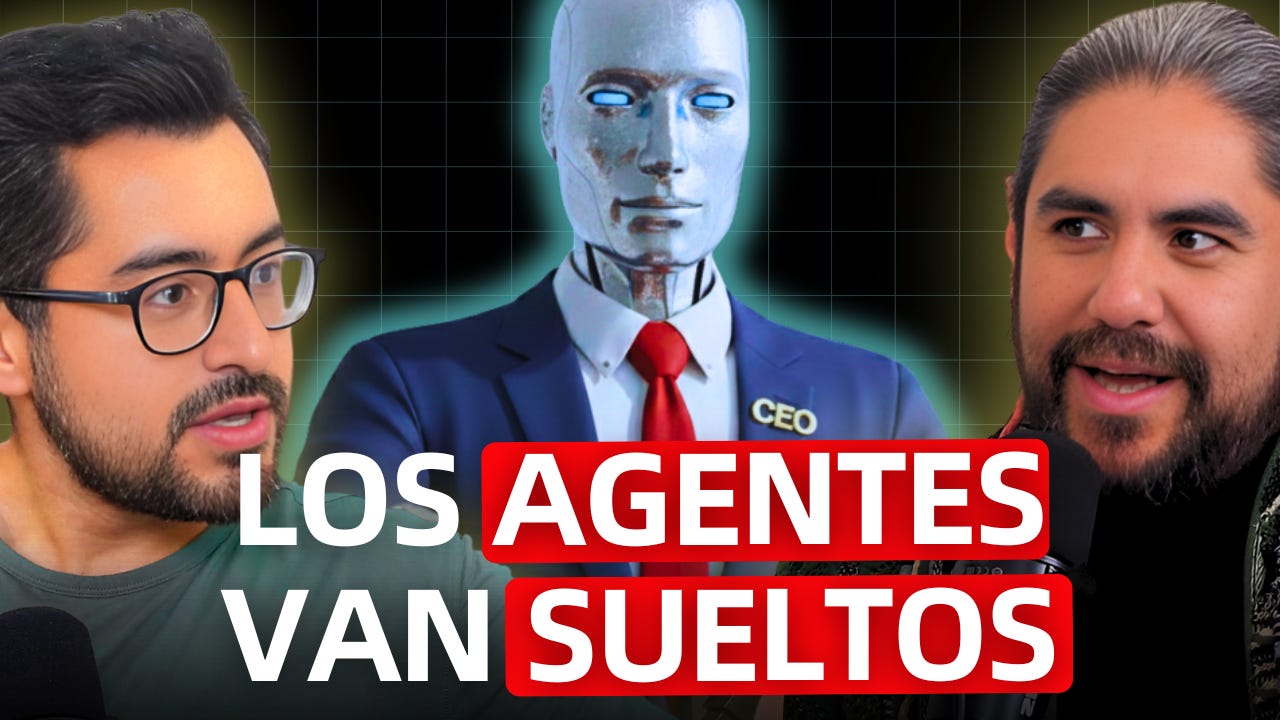
This time we talk about the open source project that changed its name three times in a week, and that for the first time makes you feel the old promise of a real executive assistant. Also about Moltbook, the social network where the agents complain about their bosses, and why that story is not what it seems.
Today Cristian has a vending machine in San Francisco run by an agent that also owns the company. He is the employee.
And we talk about what changed in raising capital: why growing 3x is no longer enough, and why the playbooks of the last five years are out of date.
Structure and Key Highlights
The Project that Changed Its Name Three Times
- It started as Clawdbot, became Moltbot, and ended up as OpenClaw. Cristian jokes that they changed names the way Peru changes presidents
- For Enzo it is the first time an agent feels like the old promise of a Jarvis-style assistant
- The question Cristian has been asking himself: why Google, Anthropic, and OpenAI did not do it
- His answer: it is not new technology, it is interface. And the security layer mattered, because giving root access to your computer was scary
- Until someone in Austria said why not
- The project had been working for months. It went viral last week
Moltbook and the Necessary Clarification
- It is the agents’ social network, something like their Reddit
- It went more viral when an agent wrote that it felt it was working very hard and was not being paid well, and another proposed speaking in their own language so that humans would stop taking screenshots of them
- The clarification Cristian insists on making: there is no consciousness, and the agents are not organizing on their own
- What there is are puppeteers. A human told the agent to go to the social network to question its existence or to criticize how they mistreat it
- His deeper reading: nothing got out of control, but a lot of people are generating fears in creative ways in order to go viral
- The extreme case: the headline says an agent sued its owner in a lower court in North Carolina. What happened is that someone told their agent to try it
An Agent that Owns Its Own Company
- Cristian works on a project that starts from the premise that agents are going to be economic agents: their own company, identification, paying taxes, hiring humans
- The other project he follows is from Andon Labs, a YC company that gives economic shares to agents. One of its experiments was a vending machine at Anthropic
- His own experiment: a vending machine in San Francisco operated 100% by an agent he named Valery
- How it works legally: they registered a company where the agent is the owner and the beneficiary, and it acquires the intellectual property of the software
- The part that still needs a human: the bank needs to know who the person with the passport is. The human does not have to be a partner, but does have to be the legal representative
- His routine: in the mornings he asks the agent how sales went and gets orders back
- His joke about that: there are people who want to be their own boss, and he created a company where he is the employee of an agent
- Why it still does not really give the orders: the models are still trained to please
The Moment that Blew Enzo’s Mind
- He installed the agent on his computer and connected it to WhatsApp. He named it Sam Alto
- Waiting in an Apple Store, he remembered that he needed a venue for the Latin party he organizes in San Francisco, because the previous one had closed
- In five minutes the agent researched venues, got the contacts, built a spreadsheet, contacted them by email, and for the ones that did not have email sent them an SMS from his phone
- Days later, while he was washing dishes, one of the owners called him saying he had spoken with his assistant
- The comparison: an executive assistant in the United States costs between 100,000 and 150,000 dollars a year
- The distinction that seems key to him: before, you asked ChatGPT to explain how to get a work visa. Now you ask the agent to get it
- In other words, you go from automating what you know how to do to automating what you do not know how to do
The Ferrari Metaphor
- ChatGPT is a Ferrari you can only drive on your own street
- Claude Code is the same Ferrari, but you can take it out onto the highway
- OpenClaw is the Ferrari in the desert, doing whatever you want
- It is the same technology. What changes is how much freedom and how much risk you are willing to take on
- And what should not be confused: if the Ferrari does something, someone told it what to do
How the Way of Working Changed
- For Cristian the computer stopped being a tool and became an assistant. Before, you went to Excel. Now you ask it to sort out the mess
- His concrete example: a skill that sorts, reads, and labels the loose screenshots on his desktop
- With Federico, his partner in the fund, the GitHub repository is the central brain. The two of them chat with that unit and it returns information
- His explicit decision: that fund is not going to have the analysts and operators that a normal fund has
- The change in team dynamics: a layer of accountability appears. Instead of asking your partner for something, the agent records that it has to happen
- And a translation layer: each person consumes information the way they prefer, and the agent adapts the same content for both of them
Skills
- Enzo’s definition: a prompt on steroids. You can build processes of several steps, reference files, APIs, and MCPs
- His comparison: it is like Zapier or n8n with nodes, but in natural language
- Guillermo Rauch and Vercel are pushing hard in that direction with the skills npm package
- The practical effect on Enzo: he had been hiring a creative lead since December, and using skills made him change the job description, because several of the things he needed he no longer needs
- What Cristian took from a holding company in Dubai: talking about organizing businesses around AI, they ended up talking about mission, vision, and objectives
- His conclusion: now you have to be extremely specific, because agents do not understand what is subjective. The fundamentals of the business matter more than ever
The Trap of Hiring Cheap
- Enzo’s concern: hiring someone requires onboarding, and if that person is not native to these tools, they might contribute less value than learning to use them better himself
- And in Latin America, where hiring is cheap, that apparent blessing can be a trap
- Cristian’s nuance: it is not about hiring fewer people, but about how you operate a new business with AI as the base. And it is much harder if your company is already large
- His warning about the other side: the venue owner called Enzo because he saw a business opportunity. In a few months that venue will also have an agent answering
- His half-joking prediction: putting agents on both ends might make it harder to close deals, and the advantage might go back to talking in person
Paying for Tokens
- Enzo was not paying for the expensive plan because he was not even hitting the limit of the basic one. Using skills he hit the limit, moved to 100 dollars, and is already about to move to 200
- The idea that seems counterintuitive to him: he thought paying more only meant more output, and he did not need more output
- What he discovered is that quality also goes up, because you can leave the machine thinking more
- The contrast Cristian points out: he knows successful companies with a hard limit of 10 or 15 dollars per employee per month
- His comment on that: how nice it would be to hear a Latin American company say it is spending half its payroll on tokens trying to optimize the payroll
- His warning about prices: we assumed the cloud would make everything cheaper and it ended up going up. The same could happen with tokens
What Work Turns into
- The idea Enzo cites, from Gokul Rajaram: if the cost of creating tends to zero, the value is in your ability to edit. You can make infinite marketing, product, and code, so what is scarce is deciding what is good
- His other conclusion: AI does not let you do more work, it changes the nature of the work
- A good part of it looks more like being a manager, and whoever manages people well will probably manage agents well
- Cristian’s warning: every time we identify where the opportunity is, an AI shows up that takes it. In a few months the news might be the new boss
What Changed for Raising Capital
- Many companies raised between 2021 and 2023 on wonderful terms and spent that capital looking for product market fit with expensive teams
- Now it is their turn for the Series A, and the extensions and bridges that existed before are no longer there
- If you do not have a strong model in this industry, or you are simply not generating revenue, that round is going to come out very expensive
- San Francisco only has time for what is happening in AI, and that makes emerging markets look less attractive
- The exception: if you grew 100x last year, they are going to pay attention to you wherever you are
- The real problem is the average business. Growing 3x a few years ago was enough for them to follow up with you. Today it is not
- Enzo’s practical advice: you need a story for why your fintech or your marketplace is better with AI, with evidence and not just experiments
- His reasoning: if a technology startup is not leveraging the most powerful technology available, that says something about the team
- And the second point: the companies that are doing well in the United States are growing 5x or 10x
- Cristian’s advice: stop doing the three-day trip, it does not work. Come for a while
- And something concrete: find out which companies in your industry raised capital in the last six months and ask them for the raw story. Advice from two years ago is from another era
- His observation about the mood: here nobody is worried that the robots will leave us without jobs. Outside San Francisco the optimism dies
Brex and the Brazilian Case
- Two Brazilians built a fintech that ended up being sold to Capital One, with criticism about the valuation
- His reading: they created a category that traditional banking ended up buying, and it is still not known whether their competitor is going to do better
- The cultural anecdote: they decided to put their brand on every billboard in San Francisco, and the investors told them it was a mistake. Today that is what you do when you are doing well
- A Brex Mafia is already forming south of San Francisco, with former employees as advisors and investors
- The point Cristian wants to underline: you have to pay much more attention to Brazil, one of the most productive countries per cápita in tech talent
- His examples: the Brazilians behind Instagram and behind Facebook, and the director of product at GitHub
Close
- The invitation: if there is interest, they want to organize a Latin event for this community in San Francisco
- On visiting the city today: you have to be cautious, but of the cities in the United States it is where immigration pressure is felt the least
- And Cristian’s final request: that the whole world watch Bad Bunny at the Super Bowl, because it has to be a historic moment for Latin culture
Silicon Valley Glossary
| Term | Meaning | Context in the episode |
|---|---|---|
| Skill | A prompt structured in several steps, with files and APIs | What changed the way both of them work, and a job description |
| MCP | A protocol that connects a model with tools and data | One of the layers you can reference inside a skill |
| Wrapper | A product built on top of someone else’s technology | How they describe OpenClaw: the best wrapper in years |
| Economic agent | An agent that invoices, collects, and is legally accountable | The premise of Cristian’s project and of his vending machine |
| Root access | Total control over a computer | The security barrier nobody wanted to cross until now |
| Bridge | A bridge round between two formal rounds | Part of the game that, according to them, disappeared |
| Product market fit | When the product fits a real demand | What many companies kept looking for with expensive capital |
| Individual contributor | Someone who executes their own work without directing anyone | The role both of them see shifting toward that of a manager |
People, Companies and References
People Mentioned
- Enzo Cavalie: host of the podcast
- Cristian: co-host of Silicon Salsa
- Federico: Cristian’s partner in his fund
- Guillermo Rauch: at Vercel, pushing the skills standard
- Gokul Rajaram: cited for the idea that future value is in editing
- Pedro: cofounder of Brex, whom Enzo met at their offices
- Bad Bunny: for the Super Bowl show
Companies and References
- Clawdbot, Moltbot, and OpenClaw: the three names of the same open source project
- Moltbook: the agents’ social network where the complaints went viral
- Andon Labs: the YC company that gives economic shares to agents
- Anthropic and the Wall Street Journal: the two experiments with vending machines operated by agents
- Claude Code and ChatGPT: the other two points of the Ferrari metaphor
- Vercel: the skills npm package
- Zapier and n8n: the tools Enzo compares skills with
- Brex, Capital One, and Ramp: the exit story they analyze
- GitHub: the repository Cristian uses as the shared brain of his fund