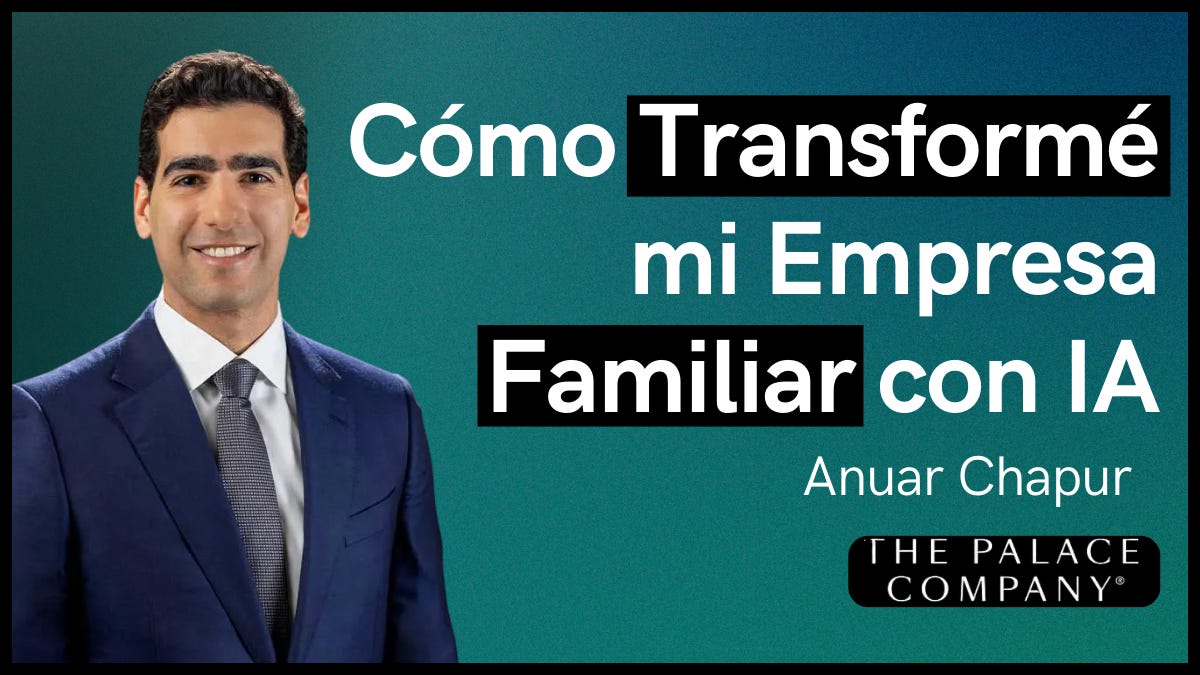
The audio and video are in Spanish. These notes are a translation.
Today I interviewed Anuar Chapur, chief product and technology officer of The Palace Company, one of the largest hotel chains in Mexico, with more than 15,000 workers across seven countries.
It is a family company of more than 40 years. His brothers are the owners. And when he decided that the way technology was done had to change, his own phrase sums up what happened: if he were not part of the family, they would have fired him.
They went from spending many millions a year on internal projects that nobody used to building products that impact the experience of hundreds of thousands of guests.
We talked about why developing everything in house was crazy, about how you convince a former Booking CTO to move to Mérida, and about what is happening when 14,000 people start building their own solutions with AI.
Structure and Key Highlights
Why Transformations Take So Long
- His answer to what made the transformation possible is a single word: the team
- The chicken-and-egg problem: you cannot transform a company without the right team, because the rest of the organization does not trust a team without the capabilities. And that team does not want to join an environment where there is no trust
- That is why transformations are not a project with a beginning and an end. Every day something happens that seems to say the team is not trusted, and every day something happens that shows the opposite
- His analogy: it is like the Mario game. You fall and you go back, but not to the starting point, to a level from which it becomes easier
The Conversation with His Brothers
- He joined technology three or four years ago to do faster what they already believed had to be done: a new reservations system, a new website, an application
- He took coding courses and Scrum courses, all on the delivery side, nothing on the side of understanding the problem
- When what did ship did not deliver results, the conversations changed: stop assuming, let us understand the problem in depth
- The real problem they discovered: they wanted customers to book without calling the call center, because the company was growing and the Miami call center had limited physical space
- And a new application was not the solution. They found that out after the research, and they ended up improving the website they already had
- His brothers were the last people he managed to convince, and he says he is still convincing them. He thanks them for the trust after so many broken promises
- The last name did not help: they are Chapur too
- What unlocked the tension: dedicating a full day of meeting to talking in depth about what had happened, about the small wins, and about what had failed
What Generated the Most Friction
- That he did not come from the world of technology and therefore it seemed hard to believe that he understood what can be done
- And that the team did not have business context, which made it seem as if the sales and operations directors already knew what the customer needed
- His answer: he indeed does not design the architecture or write the software, but what he was talking about was product, where he did have business context from years in the company
- And data analysis, which makes conversations stop being opinions and perceptions
- His diagnosis of the broken telephone: the directors do understand the business, but they communicate it in one way and it is not heard the way they meant to express it
- His advice for someone in the same position: start with data, as long as it is objective and not a story someone wants to tell
Marty Cagan and the Turning Point
- A friend recommended Lenny’s podcast with Marty Cagan talking about Inspired
- His first reaction was that this was for technology companies, not for Mexican family hotel companies
- Even so he subscribed to his newsletter, kept listening, and read the book. Through that newsletter he found out about a workshop in New York on Transformed
- He was about to cancel it. He went, and that was the turning point
- The phrase that hit him the most: outcomes over outputs
- His personal translation: why would I get up and go to the office to finish an application that nobody uses. If nobody uses it, it means nothing
- What the workshop and the book gave him and the podcast did not: the fundamentals explained clearly, and the understanding that they are the same whether the product is physical or digital
What He Found When He Arrived
- The strategy was to develop everything in house, with the idea of eventually selling it as SaaS to other hotels
- That led them to build their own CRM, their own PMS (the core system of a hotel), their own payment processor connected directly to the bank
- His verdict: it was crazy, because they were dedicated to doing things that already existed
- The mindset shift: buy what already exists and do not reinvent the wheel. HubSpot for CRM, Opera Cloud for PMS, Adyen for payments
- And build themselves only what is unique, what sits on top of those systems
- They are still paying for those sins. They are still carrying things they should never have built, like the staff clock-in time clock
- How much they were burning: many millions a year, not counting the opportunity cost
- The detail that makes it worse: what they were replacing had already matured and worked, even if the screen was not pretty
The Breaking Point
- Two enormous projects almost at the same time, with many sleepless nights and a lot of commitment from the team
- When it was released, the previous version was better. They made an extreme effort to end up worse
- It was a sales platform for travel agencies, so all the agencies complained and it affected sales
- What he learned: that something looks right in Figma, that it gets approved in the company, and that it seems necessary does not mean it is the right thing
- And what carried the project forward: key hires of people who understood the problem in depth
From a Software Factory to Product Teams
- The change is not that the engineers have more or less context than the business people. It is that they know what can be done with the technology
- And that matters more than ever because it moves too fast
- His argument for why these are full-time jobs: nobody would expect the person who designs Instagram to also be a manager of something else
- His example with design: if all you tell the designer is that they know how to use Figma and you hand them a screen drawn on a napkin, you are not getting value out of them
- His rejection of handoffs: they imply little collaboration. They have to be sitting together, looking at each other’s screen
- He even changed the physical space, in addition to the job profiles
- How the role of the leaders changed: a design leader no longer puts their hands in to get things out. Now they make sure each designer works inside their team and they build a design system
- The result: 90% of the team changed. A lot of people came in and others left, some by their own decision and others not
- His nuance on that: it was the same chair and the same office, but the company and the way of working had already changed
Hiring in Mérida
- It took him two years to find the right CTO, interviewing weekly with a specialized headhunter
- His rule: hire slow, and do not hire out of desperation
- The ethical component he adds: if the person is going to move, choosing badly is not only your problem. The doubts get resolved first
- What convinced David, his CTO, who came from Booking and from Amsterdam: the way they think technology can impact the customer experience
- His point: it is easy to think that a hotel only needs wifi, licenses, and computers. That is IT and it is important, but it is something else
- His method with candidates: come meet Mérida and the team, and when we see that it flows we make the offer
- Who moves without a problem: young people, or people with very young kids, or with kids who are already grown. The hard part is the in-between age
- The data point that backs it up: the corporate office of 1,000 people moved from Cancún to Mérida and the people are happy
How Value Is Measured
- There is no metric that gives full certainty. But they do use metrics
- One of their first AI applications, about two years ago: analyzing all the comments from the guest surveys with Amazon Bedrock and Power BI
- They categorize them by topic and subtopic and analyze the sentiment, to know whether the problem is the restaurant and, within that, the temperature of the food or the service
- What they discovered: their main problem was not in the hotel, it was in transportation
- Guests spent their vacation calling the call center to reschedule their transfer, and sometimes nobody answered
- What they did: optimize that time, allow the reservation to be edited, and above all give the customer certainty about where and at what time they leave
- And there the metric is real: calls to the call center go down and satisfaction goes up
Why Technology Does Not Always Show Up in the Result
- In a traditional company, technology can be disconnected from the result. If the service is bad or the food is bad, nothing else matters
- And the reverse: a company can do very well for reasons that have nothing to do with its technology area
- His example of why it is still worth it: they analyzed consumption patterns to distribute guests across restaurants according to the time and which ones they had already visited
- They do not sell more because of that. But that customer comes back happier
- Another concrete example: the breakfast restaurants get saturated because everyone goes to the buffet. In the application they recommend a restaurant according to the location of the room
- His warning against complacency: if things work and you do not touch them, you stay at your local maximum
When 14,000 People Build Software
- His frame: the technology team is never going to be fast enough or numerous enough to handle the problems of 14,000 employees and 500,000 guests
- So the goal is for technology to be an enabler and not a bottleneck
- What they are doing: seven sessions open to the whole company, on Friday afternoons, where people show not how they used ChatGPT but what they built
- An internal demo day. They choose the proposals that are scalable and well formulated
- The effect: the curious ones get encouraged, the people who built get more motivated, and the technology team learns what needs exist
- His read on banning it: you cannot cover the sun with a finger. Better to understand what they are using ChatGPT for and give them an enterprise license
The Two Examples that Worked
- His practical finding: Lovable is good for prototyping and more useful for the technology team, but it does not end up as a complete product
- What does work very well are custom GPTs. It is so simple and so useful
- The special reservations case: groups send them arrival lists in whatever format their own system spits out, with the names in one column or combined, the check-in and the check-out in the same cell
- Someone had to go through hundreds of reservations line by line, for every hotel
- They trained a GPT with their format and now they upload the file however it comes and it returns theirs. Those people today do more useful things
- The purchasing case: a GPT that cross-checks the order ID on the supplier’s invoice against their catalog and against what shows up in SAP, comparing price, quantity, and description to detect discrepancies
- His reflection on the two: they are inefficiencies that technology would never have prioritized, but they were the most important problem in the day to day of those people
Evaluating So Many AI Pitches
- He is looking for a person dedicated to this, because there is a lot of hype and it is hard to separate what is real
- The concrete problem: the legal area is important and does not have a product or technology team. How do they evaluate and implement a tool like Harvey?
- The profile he is looking for is a combination of product, technology, licenses, IT, software asset management, and robotics
- On robotics: he believes there is a lot of potential for operations, but not for the guest. They are not going to put a robot to do the check-in, because that is a welcome
- Where they would: a robot that takes the food up to the floor and takes the dirty plates away, or that cleans convention halls at night
- His general rule: that it can be done does not mean we want it
The Hotel Redesigned from Scratch
- Without screens and without apparent technology
- Things should work without the guest having to enter information in an app or a kiosk. Do not hand them our work
- His scene: if we already know which van they are coming in from the airport, let them be welcomed at the gatehouse, the bell boy and reception, with all the information ready
- With the restaurant reservations preloaded according to their preferences, and him only confirming, the way a butler would
- And with room for the guests to connect with each other according to their tastes, because an important share comes to build community
- The data point that justifies it: 60% of their customers are repeat customers and 40% have a membership
- His phrase about the moat: people say that memory is the moat of AI. They believe that knowing their customers’ preferences well is what makes you come back to one hotel and not another
What Happens to Whoever Does Not Transform
- His answer in one word: disappear
- His nuance: for some companies the threat is going to arrive sooner and for others later, but that does not authorize them to get careless
- What he sees as a concrete mistake today: banning ChatGPT, or not allowing Cursor, Claude Code, or Figma Make out of fear of the uncertainty. That is cutting your people’s hands off
- The final advice he gives a CEO in the position he was in three years ago: lean on quantitative and qualitative data, and talk to users
- And do not lose patience. It demands stubbornness and it is tiring, but it is more tiring to do something that does not make sense
Silicon Valley Glossary
| Term | Meaning | Context in the episode |
|---|---|---|
| Outcomes over outputs | Measuring the result achieved, not what was delivered | The Marty Cagan phrase that was his turning point |
| Software factory | A team that executes projects other people define | The model they left behind |
| Product team | A team that understands the problem and proposes the solution | The model they arrived at |
| PMS | Property management system, the core system of a hotel | One of the ones they tried to build from scratch |
| Discovery | The work of understanding the problem before building | What was missing when he arrived in the area |
| Handoff | Passing the finished work to the next link in the chain | The practice he eliminated because it implies little collaboration |
| Design system | A shared library of components and design rules | What frees the designer from thinking about the pixel |
| Custom GPT | An assistant configured for a specific task | What did work in the hands of non-technical areas |
| Local maximum | The best possible result without changing approach | Where you stay if you do not touch what already works |
| Hire slow | Waiting for the right candidate instead of filling the vacancy | It took him two years to find his CTO |
People, Companies and References
People Mentioned
- Anuar Chapur: chief product and technology officer of The Palace Company
- His brothers: owners and leaders of the company, the last people he convinced
- David: his CTO, formerly of Booking, who moved from Amsterdam to Mérida
- Jorge Cerna: his technology recruiter, who came from the startup world
- Marty Cagan: of Silicon Valley Product Group, author of Inspired and Transformed
- Ricardo Rubio: the person who recommended the podcast that started everything
- Enzo Cavalie: host of the podcast
Companies and Tools
- The Palace Company: more than 15,000 workers across seven countries, with hotels under construction in several destinations
- HubSpot, Opera Cloud, and Adyen: what they decided to buy instead of build
- Amazon Bedrock and Power BI: the analysis of guest comments that revealed the transportation problem
- ChatGPT and custom GPTs: the tool that non-technical areas adopted the most
- Lovable, Cursor, and Figma Make: the prototyping tools he mentions
- SAP: the purchasing system they cross-check invoices against
- Harvey: the example of a legal tool they want to evaluate well
- Mérida: the city they operate from and the one they bring talent to