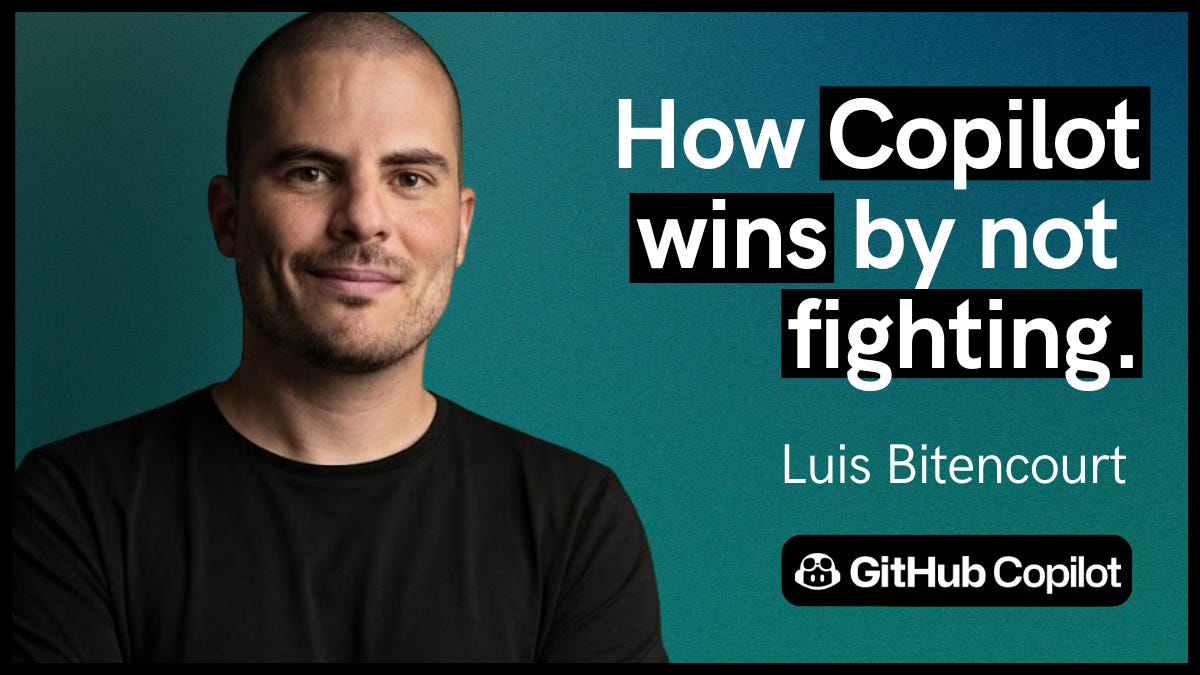
Today I interviewed Luis Bitencourt-Emilio, SVP of Copilot Agents at GitHub and board member of the Wikimedia Foundation. Before this he spent a decade at Microsoft, founded Reddit’s first AI team, sold his own startup to Meta, and was CPO at Rappi and Loft.
His LinkedIn handle is linkedin.com/in/artificialintelligence, claimed a decade ago when nobody wanted it.
I put the elephant in the room to him directly: when I talk to builders in SF I hear about Claude Code, Cursor and Codex, not Copilot. His answer is that all of those run on GitHub, and that his job is not to win with one agent but to make every one of them successful on the platform.
We also talked about why nobody in his customer meetings asks how to replace developers, why no model has stayed on top for more than three months, and what happened when he investigated GitHub’s number one token spender.
Structure and Key Highlights
Leaving Brazil at Twelve
- Landed in the US in December 1994, going from Brazilian summer to snow
- Started mid-way through sixth grade, without the language, in a school where everyone already knew each other
- The morning it clicked: he was twelve, he could not move the family back, so he decided to enjoy it instead
- His first friend was a Russian-speaking kid, and they bonded over the word for square being quadrado in Portuguese and kvadrat in Russian
- What he took from it: while you are inside something hard it is terrifying, but looking back at what you overcame builds the confidence to face bigger things
Going Back the Other Way
- After a decade at Microsoft he left for a nine-person Series A startup in LA, and his mother thought he was crazy
- What told him it was right: it looked insane to everyone else and obvious to him
- What made him uneasy in hindsight: he built Microsoft’s recruiting pipeline in Brazil, bringing out the best talent, which was contributing to the brain drain
- His defense: at the time there was no competitive offer in Brazil to compare against
- He moved to Colombia for Rappi having never set foot in the country, landing on a Saturday to start work on Monday
- His rule for decisions: is this going to make me grow, and does it open more doors afterwards
- What excites him about the region now: not tropicalizing US models but the companies that only make sense there, like what Pix enables in Brazil
What Rappi and Loft Taught Him About AI
- The rain in Bogotá: he assumed it was a traffic modeling problem, until he learned couriers on motorcycles pull over under an overpass for 20 minutes and someone’s dinner is waiting
- COVID tripled demand and the first months were purely about keeping servers up
- Then came Mother’s Day in Colombia, a Sunday, with every restaurant closed and the entire country ordering brunch at once
- The systems held, and the calls that came instead were from mom and pop restaurants with dozens of couriers wrapped around the block, asking them to stop sending orders
- The lesson he carries into dev tools: the human in the loop is not a slogan, and these problems are not solved in the digital layer alone
- His favorite Reddit value, written on the wall: remember the humans
On Whether Founders Need to Be in San Francisco
- His answer: no, but it is not easier
- Wikimedia is his proof that globally distributed and remote-first works, and also his proof that it takes enormous effort
- The argument for density: luck favors the prepared, and the more chances you have to run into someone, the more likely one of them matters
- If you are not there, you have to manufacture that chance deliberately through communities, open source, or working remotely for a company that is
- On Nubank and Mercado Libre: both founders spent significant time in California, and he does not think that is a coincidence
- His framing: humans are pattern-matching animals, and a limited set of patterns limits what you can create
Is Copilot Still Relevant
- His context: dev tools used to be worse off than AI during the AI winter, because the assumption was that AWS or Microsoft would buy you and end you
- The turning point he names: roughly the last nine months, when dev tools went from the coldest category to the hottest
- His reframe of the enterprise question: it is less about enterprise and more about what the product optimizes for
- GitHub is inherently multiplayer, and their original tagline was social coding
- Where that trade-off shows: when resources force a choice, they pick the team or company use case over the individual developer, which reads as enterprise
- The platform argument: Claude, Codex and the rest are all on GitHub, and his job is making all of them successful
- They already have third-party agents on the platform alongside Copilot, and want agents across the whole software development lifecycle, including code review, SRE and debugging
What Customers Actually Ask
- In executive briefings, every question is about training developers, measuring efficacy and ROI
- Not a single customer has asked how to replace developers or reduce headcount
- His read: we are far from a world where humans are not in the driver’s seat
- The abstraction argument: compilers already moved us off assembly, and this moves the conversation one layer up so product people and engineers talk in the same language
One Agent or Many
- His bet is a multi-model world, and his evidence is that no model has stayed on top for more than three months
- The human analogy: you would not staff a team with the same person in every role, and models differ the same way
- His favorite feature is rubber duck: have one model critique another model’s solution, then bring in a third to judge both viewpoints
- What he does when a new model launches: throw it into that conversation to develop a taste for what it is good at
- On tooling: not everyone will move to the CLI, and new harnesses and interaction paradigms will keep appearing
- On the harness itself: he does not think there is a huge secret sauce there
- His analogy: knowing whether a developer uses Windows, Mac or Linux tells you nothing about whether they are good
Distribution Versus Speed
- The perennial battle he describes: incumbents leveraging distribution against startups leveraging speed
- Distribution gives a head start, not a guarantee, and if you take too long to capitalize the disruptor gets distribution too
- What is different this generation: the speed from founding to large distribution is record-breaking, so incumbents get a year instead of a decade
Microsoft Training Its Own Models
- He welcomes it, and works weekly with the MAI team
- The enterprise angle: when you control the supply chain you can give guarantees about training data and licensing
- What enterprises actually ask, and individual developers never do: what liability do I have if this model produces code deemed copied from someone else
- The parallel he draws on knowing how to code: great engineering leaders generally know how to code, and if the model is a black box to you, you will be less effective at building a harness for it
Enterprise Adoption Is Spiky
- Some companies are all-in and some have not started, and it does not track neatly with being a tech company
- The example that surprised him: a semiconductor company far ahead on measurement, education and enablement
- The measurement trap: everyone starts with token spend, and then token spend leaderboards
- The Dilbert reference: pay people per bug fixed and they will write themselves a car
- What happened at Microsoft: their number one token spender for a week turned out to have added something to a CI/CD pipeline and was not even looking at it
- His actual recommendation: tie the work to business outcomes, the way every team at Rappi and Loft had a backlog of hypotheses about moving a business metric
- His caveat: that is less satisfying than a dashboard, and some of it is lagging indicators
- The honest comparison: we never solved measuring human developer productivity either
What Agent Sessions Make Possible
- Before, the conversation that led to a feature was ephemeral and lived only in your head
- With agent sessions, the whole thread exists: what data you pointed it at, the source code, the versioning, the PRs
- They shipped Chronicles so you can ask your own past sessions how to be more efficient, which model takes fewer iterations, how to improve your prompting
- The next step he imagines: learning from your team’s sessions, so a new employee can ask what the first three months actually required
- His broader question: how should leaders and managers evolve to run companies with this toolset
- Teams are already running standups inside the canvas feature, with the agent moving things on the board
Coding Agents as Personal Assistants
- His pitch from an offsite in late last year: the journey from a coding agent to a personal assistant is much shorter than from a chat interface to one
- The reason: code is inherently flexible, and an assistant needs that flexibility
- His analogy: a coworker who can only reply in your messaging app and do nothing else is not a useful coworker
- Where it leads: all developers are information workers, and not all information workers are developers today, but that overlap is growing
- The operating system question: he used to be the orchestrator on top of applications, and now the OS itself might become the orchestrator
On His Own Team Blurring
- Engineering, product and design are blurring heavily, toward a full-stack builder mentality
- The precedent from Reddit: he staffed ML engineers who could do data science, modeling and service creation, minimizing hops between humans
- What has not blurred much yet: other disciplines beyond EPD
- The exception that surprised him: GitHub’s biggest non-engineering consumer of AI tools is the legal team
Why Enzo’s Podcast Team Moved to a Repo
- Most of their work now happens in agentic workspaces, with the video tools only for the last mile
- His editor with an engineering background told him the answer was GitHub, and he resisted before trying and failing to make Notion work
- Luis agrees from experience: project management features inside AI assistants are basic, with limits on files and context
- His answer on where this goes: GitHub stays focused on professional developers, raising the ceiling and lowering the floor
- His warning: getting distracted from the core mission by shiny things would be a negative outcome
- The organizational signal: VS Code now sits in the same org, and they want sessions to become a GitHub primitive the way PRs are
- With his user hat on: making GitHub the home for knowledge work is a Microsoft play, not a GitHub play, given Office
Is More Autonomy Always Better
- Generally yes, as long as the right outcome is reached
- What you do not want: five hours of work before you learn it went the wrong way, which is now expensive in tokens too
- The human framing: a new hire needs more coaching early, less context over time, and eventually just tells you the results
- The failure mode: three months of hands-off work that turns out to be treading water, or building A when you needed C
- Why they built mission control: autonomy cannot be a black box, and humans need to see sessions and course correct
Wikipedia in the AI Era
- Wikipedia and Reddit are consistently among the top cited sources for these models, and both are close to him
- He has been on the Wikimedia board for about six years, and the AI conversation predates GPT, going back to voice assistants
- The concern he names: does this disintermediate Wikipedia
- His answer: the mission is to further free knowledge, and how it surfaces is a tactic, not the strategy
- The one caveat: it has to stay sustainable, because the most important part of Wikipedia is the community of editors, and a broken feedback loop makes that dwindle
- On hallucinations: the fix is the same one Wikipedia already had, citation needed
- The school conversation with his son: teachers used to say do not trust Wikipedia, and now it is inverted
- The community detail he offers: Jimmy Wales officiates weddings, and Luis has already told him he will be officiating one at Wikimedia in Paris
Who He Thanks
- His father, who he says could carry his own podcast: taught himself piano and guitar, set up the first elections in East Timor, worked for the UN, was dean of multiple universities, has a PhD in political science and teaches marketing at Georgetown
- What joining the Wikimedia board meant: the message from his father, and the pride in finally overlapping their paths
Silicon Valley Glossary
| Term | Meaning | Context in the episode |
|---|---|---|
| Harness | The layer wrapping a model that defines how it is used | His claim that there is no huge secret sauce in it long-term |
| SDLC | Software development lifecycle | Where he wants agents, not just in coding |
| Multiplayer | Software built for teams rather than individuals | How GitHub describes itself, going back to “social coding” |
| Third-party agents | Agents from other vendors running on your platform | Claude and Codex already on GitHub alongside Copilot |
| Token spend leaderboard | Ranking people by how much AI they consume | The measurement trap companies are now shutting down |
| Chronicles | GitHub’s record of agent sessions | What lets you learn from your own and your team’s past work |
| Mission control | Interface to watch and correct running agents | Their answer to autonomy that cannot be a black box |
| Human in the loop | Keeping a person in the decision path | The thread connecting his Rappi experience to dev tools |
| Brain drain | Best talent leaving a country for opportunities abroad | What he realized in hindsight about his Microsoft recruiting work |
| Tropicalization | Copying a US business model into another market | What he finds less interesting than natively local opportunities |
| Rubber duck | Having models critique each other’s work | His method for developing taste on a new model |
| EPD | Engineering, product and design | The disciplines he sees blurring fastest |
People, Companies and References
People Mentioned
- Luis Bitencourt-Emilio: SVP of Copilot Agents at GitHub, board member of the Wikimedia Foundation
- His father: UN work, first elections in East Timor, dean of multiple universities, teaches marketing at Georgetown
- Felipe Villamarín: cofounder of Rappi, who explained the rain problem in Bogotá
- Jimmy Wales: founder of Wikipedia, who officiates weddings within the community
- Mustafa Suleyman: leading the MAI team they work with weekly
- Vinícius Júnior: his Flamengo reference for going abroad and coming back
- Enzo Cavalie: podcast host
Companies and Organizations
- GitHub and Copilot: where he leads the agents organization
- Microsoft: a decade there, plus the MAI models team and the Windows announcements at Build
- Reddit: where he founded the intelligence group
- Meta: acquired his startup
- Rappi and Loft: where he was CPO, in Colombia and Brazil
- Wikimedia Foundation: where he sits on the board
- Claude, Codex, Cursor, Devin: the competitive landscape, all of it running on GitHub
- VS Code: now inside the same organization
- LM Studio: what he keeps on his laptop to try local models