The audio and video are in Spanish. These notes are a translation.
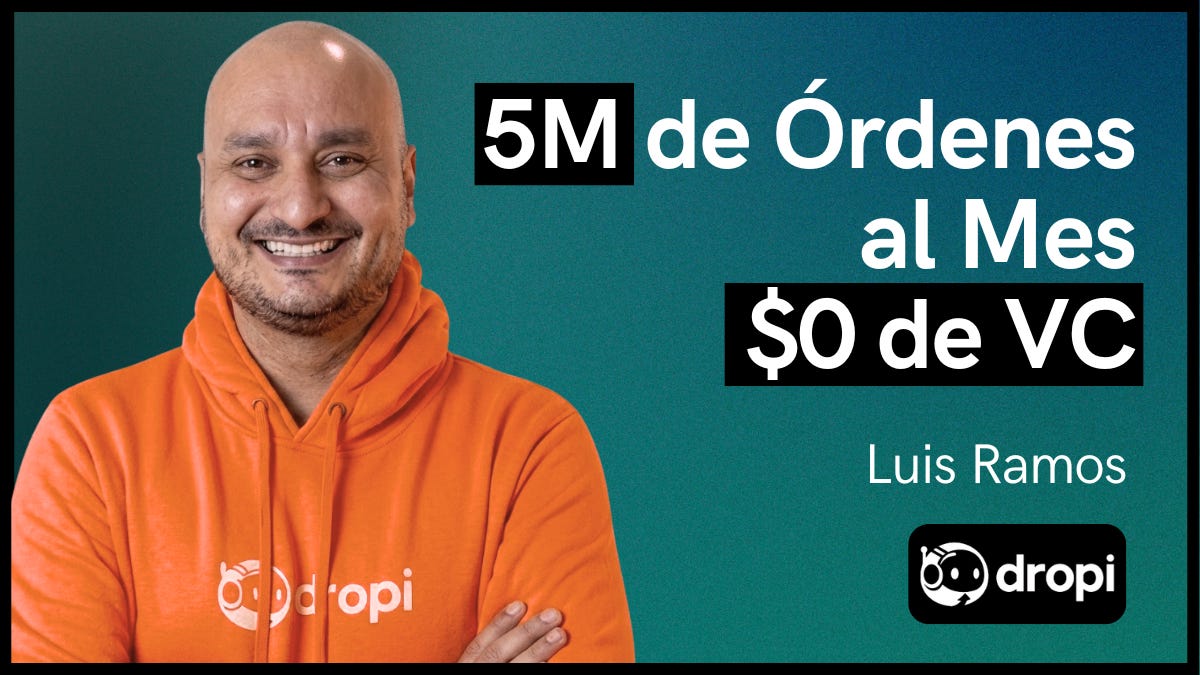
Today I interviewed Luis Ramos, founder of Dropi, the largest dropshipping platform in Latin America, with more than 5 million monthly orders across 10 countries and without having raised external investment.
Dropi started as the software Luis built to solve his own problems as a dropshipper. It went viral by word of mouth, with no marketing, and today it is the infrastructure on which thousands of sellers do e-commerce in the region.
The figure that surprises people most: they advance up to 3 million dollars a day to their users, with their own capital. His line for explaining why they can: Dropi has a bit of everything, but it owns nothing.
Structure and Key Highlights
The HTML Course in a Club Nintendo Magazine
- His mother had the monthly subscription for him, and one month an HTML course showed up, published in installments
- He was 12 years old, in 1997 or 1998, and he completed the whole course from Notepad
- His first website was about Zelda, with the story and the tricks he had found
- From then on he made websites for whatever crossed his path: the school, a coffee shop, a barbershop
The Sentence that Changed His Focus
- At an event at another university he met Mauricio Duque, from Seminarios Online
- What he told him: that his websites were useless, because they were not built to sell
- What he did with that: he became obsessed, learned Google AdWords, and got into the business of selling leads
- His first real business: monthly packages of leads for beauty clinics, surgeons, and real estate agencies
- Later he set up a digital marketing agency when almost nobody offered that model, and he resold software from India in Colombia
- His summary: of the business models on the internet, he has done almost all of them
How He Got to Dropshipping
- He was coming off the sale of a hosting company, an early exit
- What he saw: since he already knew how to do digital marketing, the model seemed simple and scalable to him
- The turn that changed everything: the products he was bringing from China were also carried by suppliers in the center of his city
- And those suppliers let people buy by volume, even on credit
- The context of 2015: anything you put on Facebook sold, with no competition and no bans
The Problem that Led Him to Build Dropi
- Putting together the shipping waybills was an Excel mess that had to be redone from scratch if it threw an error
- A customer would call you and you had no idea who they were
- When a supplier asked him how many units he had sold, he had to go and check waybill by waybill
- His conclusion: they could not grow any further, because growing made them less efficient
- What he built: software in PHP just for himself, taking advantage of the fact that the carrier had just released an API
How It Became a Product Without Him Meaning to
- He was in communities where people learned about traffic, Facebook Ads, and Google
- One day someone asked him how he managed his shipments, he showed them his system through an IP address, and they asked to have it
- In one week his two engineers added a users table and roles
- That person showed it to other people, and without him noticing it turned into enormous word of mouth
- The moment he understood the scale: he saw on Facebook that someone had made a tutorial of his platform, and he never met that person
- The figure that sums it up: Dropi’s traffic was 100% organic for almost its first five years
The Metaphor of the Children in the River
- You are calm on the bank and you see a drowning child coming downstream, you jump in and you save them
- When you look back, two are coming, then four, and each time twice as many
- What a normal person does: ask for help, but knowing whom to choose, because someone who does not know how to swim is no use
- How he applies it to his own story: every problem in his operation was a child coming down the river
- His general reading: the rivers are all the things you take part in, and sometimes those children become part of the scenery and you stop seeing them
- His conclusion: if you find those children in your river, you already have the basis for a company
What He Understood and Others Did Not
- His direct answer: he understood that this was not a technology business, it was a business of relationships, people, and communities
- What he did with that: he formed e-commerce communities that would use the platform
- His line: if nobody uses your technology or loves it, that technology does not exist
- Why he believes the global players did not see it: they were at their computers and they were not walking the city centers or talking to importers
- What he did know: that all of the product was already local and there was no need to wait for international shipments
The Trick for Getting the Ecosystem Started
- The chicken and egg problem: his suppliers came from a traditional market of physical warehouses
- What he did: he became the platform’s first supplier himself
- How he convinced them: by showing them how he imported, how the products sat in the catalog, and how he was pulling hundreds of orders a day
- What happened after that: the shops next door saw hundreds of packages going out and wanted to get in
- Within a few months he was no longer convincing anyone. His phone was full of people asking to be suppliers
Dropi Is Actually a Fintech
- In traditional dropshipping with cash on delivery, the seller collects 15 or 30 days later
- What Dropi does: it pays the full amount of what was delivered, immediately, every day
- How he got there: when he asked his users why they were not selling more, they told him that at a certain hour they ran out of money for advertising
- His conclusion: an efficient store is a store that never stops, and this model is more financial than anything else
- The extra piece: virtual credit cards so the money goes straight into advertising without waiting for a transfer
- The volume they finance: up to 10 billion pesos a day, close to 3 million dollars
Where the Money Came from with No External Investment
- They came from several earlier ventures, him in technology and his partner in the textile sector, with a base of saved capital
- The key decision: take no profit out of Dropi for almost the first three years
- Everything was reinvested, and they still keep the same discipline
- His personal explanation: they are simple people, they are not chasing excess or sports cars
- His frame: the purpose is to democratize electronic commerce, not to be an extravagant guy
Why They Can Stay So Light
- If he had to define Dropi in one word, it would be connect
- They do not own the carriers, or the suppliers, or the financial technology, or their community leaders
- What that avoids: buying 200 trucks or building warehouses when a destination starts moving a lot of volume
- On integrating vertically the way Mercado Libre did with its logistics: not for now
- On whether they came close to running out of money: never, thanks to financial planning that he attributes to his partner
What the Platform Includes Today
- E-commerce automation: logistics tools, financial tools, and traffic-generation tools
- Its most popular module connects thousands of local suppliers with sellers who do not want to buy stock
- What someone who is just starting finds: all the logistics contracts and suppliers already in place
- And a CRM with artificial intelligence to manage everything from the sale and the confirmation through to remarketing
- Plus payment gateways and import companies
Why It Works in the Region
- Enzo’s reading: in developed countries an entrepreneur has easier access to credit to buy inventory
- In Latin America that access is harder, and that gives dropshipping a natural fit
- Luis’s confirmation: most of his early users started with very little, leveraging what was being built
Shut Up, Step Away, Learn
- What he sacrificed: social life, relationships, family, and hobbies
- The quote that made sense to him, from Denzel Washington: shut up, step away and learn, then win, and then explain to other people how you did it
- How he understands that “shut up”: be humble, you do not know anything, focus
- What he sees when he looks at old photos of friends: he is in almost none of them
- Whether he regrets it: no, and he believes every entrepreneur has to do it
How He Sees Dropi in Ten Years
- His answer: he does not know, because if they had asked him seven years ago he would have missed by a long way
- What he does do every single day: work as if Dropi were small and as if the fridge were empty
- What he says he feels: that this life is not going to be enough for him to do everything he sets out to do
Whom He Thanks
- His mother, who always put the resources for learning on the table, starting with the computer
- Mauricio Duque, whom he has never thanked in person, for telling him that what he was doing was not enough and was not important
- What he does now with other people: he gives the most sincere opinion, even when it is not the one they want to hear
Silicon Valley Glossary
| Term | Meaning | Context in the episode |
|---|---|---|
| Dropshipping | Selling without holding inventory, shipping from the supplier | The model everything at Dropi is built on |
| COD | Cash on delivery, paying when the product arrives | The particular feature of e-commerce in the region that the global players were not serving |
| Shipping waybill | The document that identifies a package at the carrier | The manual process that gave rise to the software |
| Working capital | The money you need in order to operate before you collect | The real constraint on his users, and what they solved by advancing payments |
| Bootstrapped | Growing without external investment | How they reached millions of monthly orders |
| Word of mouth | Growth by recommendation, with no marketing | The 100% organic traffic of their first five years |
| Tropicalize | Adapt a foreign model to local reality | What he did with what he was seeing in other markets |
| Community leader | The person who teaches others how to use the platform | The figure that multiplied their growth |
| Crossdock | A logistics transit point with no storage | One of the assets they decided not to own |
| Winning product | The item that sells on its own in a campaign | The logic of the golden age of e-commerce on Facebook |
People, Companies and References
People Mentioned
- Luis Ramos (Lucho): founder of Dropi
- His partner and cofounder: from the textile sector, the person he credits with the financial discipline
- Mauricio Duque: from Seminarios Online, who told him that his pages were no good for selling
- His mother: who bought him the magazines and the resources to learn
- Denzel Washington: for the formula of shutting up, stepping away, and learning
- Julián Otárola: who told Enzo about Dropi
- Enzo Cavalie: host of the podcast
Companies and Organizations
- Dropi: more than 5 million monthly orders, 10 countries, 200,000 users
- Club Nintendo: the magazine where the HTML course appeared
- Google AdWords: his first customer-acquisition tool
- WordPress, WooCommerce, and Divi: what he used to set up his first stores
- Shopify: it existed, but it was not strong when he started
- Amazon, Mercado Libre, Alibaba, and Tienda Nube: the giants that did not occupy that space