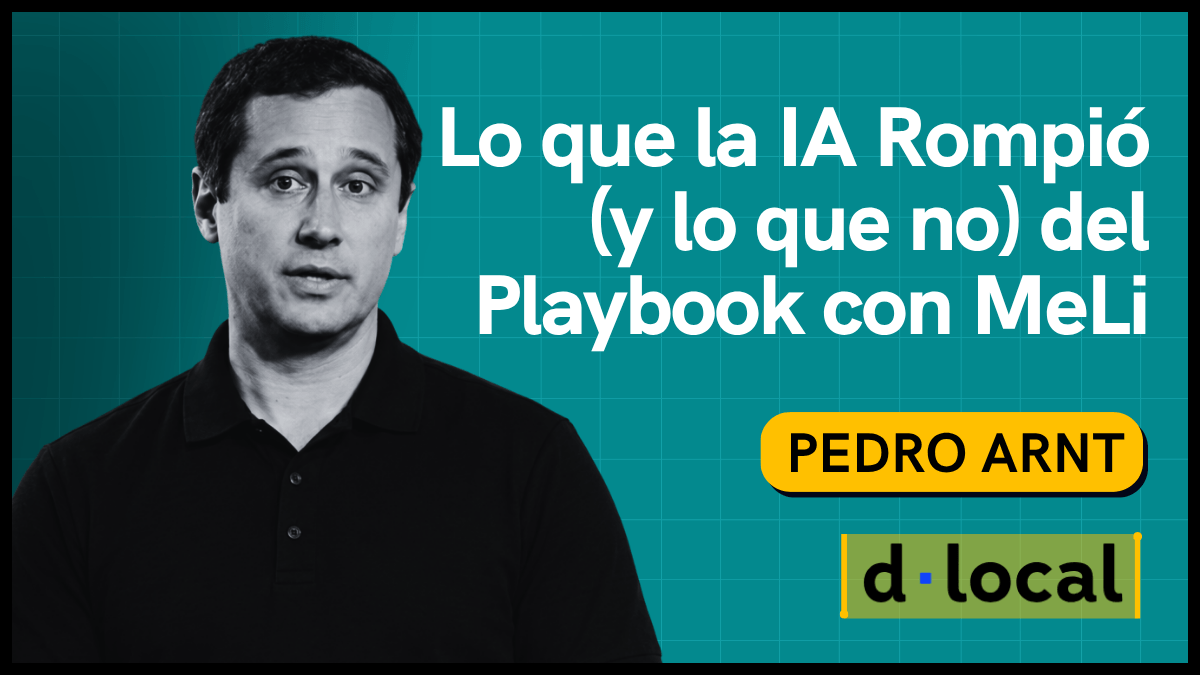
The audio and video are in Spanish. These notes are a translation.
Pedro Arnt is CEO of dLocal, the payments platform companies like Amazon and Uber use to collect payments in emerging markets. Before that he was CFO of Mercado Libre for more than a decade (and worked across almost every area over nearly 24 years). Today he leads a company that generates more than a billion dollars a year in revenue.
He had already been on Startupeable. That first conversation was one of the most talked about: founders wrote by email and WhatsApp, struck by how he thinks about teams and companies. This is the second visit, and the axis changed. Enzo wanted to know which of those frameworks are still alive with AI, and which are not.
The answer is not an adoption deck. It is a tension: a sense of wonder (and concern) about the revolution, against the pragmatism of not breaking execution. You have to fly a lot, but first learn to crawl. Or not even that: to roll over.
Structure and Key Highlights
Personal Wonder, CEO Pragmatism
- The hardest part is combining conviction (almost a sense of wonder) with deep concern about the scale of what is coming
- If he extrapolates the personal feeling to dLocal, he gets bad execution: fly, yes, but with a pragmatic hat. Before flying, crawl. He thinks they are still learning to roll over
- He calls it the fifth industrial revolution
- The meme of the CEO who pastes a Twitter demo into Slack is not the enemy. That part matters. Yesterday he sent his executive level a summary of a Hugging Face hack about civilizations inside OpenAI: “Yes, it can. The limitation is not the agent. The limitation is podemos nosotros construirlo”
- What he cannot do is ask them to build it tomorrow. His role is to define what to do today so that, in one to three years, they are at the level these technologies already allow
The Toolbox No Longer Lives Only in Your Head
- AI makes the management toolkit (and a more complete one) available to every leader
- The prompt to the “CEO agent” has to tell it which set of tools to use for that decision
- He quotes Sun Tzu: a bad plan well executed can beat a good plan poorly executed
- There is not always a correct decision. What matters is which option the leader and their team have the conviction to back, because it fits their reality and their moment
- The toolkit no longer resides in the most experienced leader. It is within everyone’s reach. What remains is the intuition to choose the right tool for the prompt
Experience = Pattern Recognition (and AI Beats It)
- Experience, for Pedro, is recognizing variations of the same pattern you have already seen three, five, or ten times
- That mechanism can also lead you to a bad decision if the pattern was misread
- AI does not have ten examples in 25 years: it has all of them, it can simulate scenarios, and it can reach an almost statistical conclusion
- For decision-making, the value of experience is going to start to decline
- Is Anthropic’s CEO skill already better than Pedro’s? His answer: the difference is not so much about who decides better
Non-Technical CEO: The Disadvantage Grows
- He has always suffered from not being a technical CEO. With AI in every node of the organization, that disadvantage gets worse
- How he compensates: get his hands dirty in the tools, read, listen to podcasts, ask questions. Consume up to the edge of his knowledge
- The phrase he uses most: “Excuse me, a basic question from the non-technical person I am. Could you explain this to me, please?” He dropped the ego of “I am the CEO, I cannot make myself vulnerable”
- Where he connects most is with the engineers. Going low gets harder for a non-technical person in AI
- The glass half full: those low moments are much more productive. Seven out of ten times he goes straight to the internal tool, without waiting for the chain from VP to manager to an answer
His Day-to-Day Agents
- He uses them less than he should. A transformative but basic phase: his role is not very process-driven (communicate, align, human contact)
- Five or six key agents. He had given up on email (WhatsApp is fast, Slack within 24 hours, email is game over). Now an agent curates and rearranges his mail
- Others: information summaries, a pipeline CRM, daily reports, and little financial-analyst agents for boards where he is a member. Before, he did not have time to reach that depth as an advisor
- Two personal concierges (errands, buying something for his kid). They are among the ones that surprise him most, for how fast they take on new tasks
Disrupting Your Own Job (and the Unacceptable Excuse)
- He repeats inside dLocal that everyone has to disrupt their own work. When Enzo asked about his, it gave him imposter syndrome
- You still cannot delegate the CEO role to an agent. The lower you are in the organization, the more that call matters
- He is more productive, with more follow-up and data at his fingertips (Nigeria, Chad, the Philippines). It strengthens the decision. He is not sure it is a total disruption of the role
- With VPs he should be more impatient. He believes in direction of travel more than in speed, and he sees that as something to work on
- The unacceptable excuse: blaming it on “the tech is not ready yet”. He is not ready, and the teams are not either. He accepts a lack of time. He does not accept blaming the technology, which is several steps ahead of adoption
2025: All-In or Defeated
- 2025 was the first year with no option: all-in. A binary outcome: defeated by an AI native company (or by whoever did transform), or they pull off the transformation
- Ignoring it, or entering halfway and expecting a good ending, he says, does not exist
- It was not a year of big wins. It was a year of lessons. In 2026 the second iteration is starting to bear fruit
- Two questions: (1) AI as new revenue or a new business model? In payments, there is still nothing clear, large, and imminent. (2) Does it transform costs, margins, and productivity? Absolutely
- Almost all the energy went into operating differently. They only left “beacons” on new models and financial infrastructure. They are not Stripe: they sit one step behind the research frontier
The Bottoms-Up Mistake and the Engineer’s Click
- First attempt: bottoms-up, with explicit change management. We are asking you to revolutionize what you do until the job description disappears. If you help, there is recognition and learning you can take elsewhere
- The prior step: document a corpus of what each person does and how. You cannot automate without processes and data. At dLocal they had never done it that way
- The result: they learned a lot and advanced little. Asking people who still have a day job to draw flowcharts and help eliminate their own work was inherently unfair
- The click: an engineer said that instead of building agents with the teams, he was going to build an agent that does all of that
- That system went through emails and Jiras, mapped every position (what, how, with whom), sorted them by how automatable they are, and fed Decoder, their agentic coding platform
- They turned the transformation into a product, with a human in the loop, but the first step was done by the agent. Later he saw that the consultancies sell exactly that
An Org Chart that Rewrites Itself
- What excites him most is not the margin. It is redistributing capital and investment: free resources from tasks an agent or an automation does better, and reinvest them in product and in areas that were underfunded
- Not all of that efficiency should drop to the bottom line
- In high-impact areas in 2026 they managed to replace about 30% of the roles with agents and redistribute the people
- Nobody walked in with the final org chart. It stopped making sense once they automated whole chunks. What appears is someone who supervises and optimizes agents. Some roles migrate and some disappear. You have to be transparent about that
Tokens, a Ranking, and When the Process Dies
- Once a month, or every two months, he sent a ranking of areas by token consumption, plus a top 20 and a top 100 of people. “We’re watching”, and healthy competition
- Good governance: access to internal sources without opening what is forbidden, and cost control. On the floors there is already a parallel economy: “who can lend me tokens?”
- Adoption: everyone uses it. What is missing is depth (skills and workflows, versus only looking up a question)
- Individual use: organic and bottoms-up. Embedding new ways of working: more top-down, with metrics and clear goals
- Documenting processes was the request. In an agentic world the process stops existing: it existed to standardize humans whose performance varies a lot. An agent optimizes an outcome. It does not follow a process. That does not emerge from the bottom on its own: a central team, sponsors in each area, and numeric goals for what counts as success
Leverage Program: Fewer Juniors, More Seniors
- He agrees: the top engineers today are 20x or 100x. Agents still do not do design and architecture that well. The junior work, copilots do almost perfectly
- “Leverage program”: replace less senior positions with more senior ones. The endgame is a smaller team that is much more productive. Not necessarily much cheaper, at least not at a product technology company
- The question at 10 or 15 years: if nobody hires juniors or gives them challenging work, who are tomorrow’s seniors? A real problem. He says it will be someone else’s
- Bands and seniority still work. The inputs have to be updated more often. The pyramid gets more skewed toward senior and flatter, not because someone has 17 direct reports, but because you need far fewer engineers
What to Ask a CEO About Adoption
- He started out receiving “hours automated”. The hours went up, but costs and deploys did not: they were automating things they were not even doing before
- The metrics they chose: percentage of PRs with no human intervention (already high, and it will stop being useful); headcount reduction per unit against a clear target (the hardest one to fake); incremental dollars from small AI products or processes
- A usage proxy: agents created, daily usefulness, tokens (almost a DAU/MAU for agents). Five minutes watching how they build those dashboards separates the person in the mud from the one still on the PowerPoint
What AI Does Not Disintermediate (and Why It Can Be a Better Business)
- If they had started from scratch with AI: a lighter organization, higher margins, and far fewer errors. Financial services are loaded with back office and middle office
- It is all bits and bytes, and that is what AI disintermediates. The other half is local presence: stakeholders, processors, the regulator, PR, and the tax and statutory presence in about 60 emerging markets. AI will not do that for a long time
- He feels more at ease as an emerging-markets fintech serving clients in developed markets than as a commoditized fintech in markets where the client already does those things
- The AI native fintechs are the ones that scare him most. The winners will be more efficient and lighter. The digitization of money speeds up: less cash, more payments
- An agent that buys for you generates more payments. It still needs the pipes (a card, Mercado Pago, Pix). It does not remove them, except in the more maximalist scenarios
- On new revenue, they are exploring. Micropayments and the token economy: not where they have the most to contribute. Stablecoins and digital assets, yes, and that business is growing well for them
- On tokens as “capital” (the kind of narrative around Stripe and OpenRouter): for him they are a metronome of AI consumption. You buy that metronome with capital
Moats: SaaSpocalypse in B2B, Brand in B2C
- The first, most basic moat: applying AI more efficiently and more effectively than others. It filters out a lot of companies. Technology pushes even harder toward hyperscalers and concentration
- In B2B (where decisions are more rational) AI breaks more barriers. What is left is human-to-human management: someone decides, someone signs off, someone picks up the phone. He can also imagine agent to agent. That is why the SaaSpocalypse fear started there
- In B2C, even a rational consumer with a good agent will still want some purchases because of the brand, the story, the experience. That is where the Mickey Malka / Ribbit thesis still holds (the trip to Italy to study non-tech brands)
The Agentic CEO: Decides Better, Still Does Not Sign
- Can agents make CEO decisions as well as, or better than, a CEO? Very soon, if not already today, they can make a better one. He is talking about superintelligence, or something very close to it
- A human in the loop is still required: rules, the law, and intuition demand someone who is accountable. As societies we are a long way from handing the whole decision and its consequences to machines alone. Thankfully
- He sees many decisions made by machines with a human sign-off. Not that close to the agentic CEO. Yes to a CEO who delegates a lot of today’s work to the machines
Governments, Gaps, and Capital with a Brake
- An open question: who in government is genuinely worrying about this? He does not believe the story that “as many jobs are created as are destroyed”. His intuition is that many more are destroyed. There will be a lot of wealth. The question is how it gets shared
- The mistake many people in civil society make: they do not see the speed. The people using the models do. Each iteration is a chasm
- A geopolitical gap: the United States and China in compute and electricity, versus everyone else. The last two decades belonged to emerging markets (Asia, and some of the Middle East, closing gaps). He does not know how the rest avoid falling far behind
- On Martín Casado (a16z): small teams with a lot of capital in tokens can deploy without the old disadvantage of over-hiring. He agrees, for the outliers. Most companies, if you give them more capital to spend on AI, will waste it. The token controls at dLocal are healthy: when you know you are about to run out, you write a better prompt
To His Kids, and to Marcos
- He stopped giving specific career advice once he understood the speed. What is left: soft skills, resilience, curiosity. They are going to have to figure things out, and reinvent themselves more often
- His generation was very blessed. Theirs may be more volatile. He is optimistic in the long run, and expects a harder road along the way
- Who he thanks for pushing him to think big: Marcos (Galperin) and the Mercado Libre school. Ambition beyond what you can do today, with your feet on the ground: not a fantasy, and also not “since I cannot, I will not even try”
Silicon Valley Glossary
| Term | Meaning | Context in the episode |
|---|---|---|
| High-low | Thinking five years out and getting into the micro-detail of execution | Chesky’s founder mode. With AI the low is more productive, but harder for a non-technical CEO |
| Founder mode | The leader goes down to the pixel, not only the vision | Enzo brings it in through Brian Chesky and Airbnb |
| Pattern recognition | Recognizing variations of a pattern you have already seen | How Pedro defines experience, and why AI beats it |
| Human in the loop | A human checks the system, or is accountable for what it does | The first step of the transformation at dLocal, and the limit of the agentic CEO |
| Bottoms-up / top-down | From the bottom up, versus imposed from the top | Tool use is bottoms-up. Embedding new ways of working is more top-down |
| Change management | Managing the human side of an organizational change | The first attempt, which failed: asking people to document their work and help eliminate it |
| Agentic / Decoder | Systems of agents, and dLocal’s internal agentic coding platform | The “consultant agent” that mapped the org and fed the automations |
| Leverage (program) | Swapping less senior roles for more senior ones with more impact | How they are redesigning the engineering team at dLocal |
| Headcount | How many people sit in a unit | Their hard-to-fake metric for whether the automation is real |
| Token (AI) | A unit of model consumption | The internal ranking, the parallel economy on the floors, and his view of tokens as a metronome |
| Moat | A competitive advantage that is hard to copy | Applying AI better, local presence, and brand in B2C |
| SaaSpocalypse | The fear that AI breaks B2B SaaS | Why rational B2B loses its barriers faster |
| AI native | A company born around AI, not one that adapts later | The rival that scares him most in fintech |
People, Companies and References
People Mentioned
- Pedro Arnt: CEO of dLocal and former CFO of Mercado Libre (about 24 years at MELI)
- Enzo Cavalie: host of Startupeable
- Marcos Galperin: founder of Mercado Libre, the person Pedro thanks for pushing him to think big
- Brian Chesky: founder mode and Airbnb, the reference for high-low
- Sun Tzu: a bad plan well executed versus a good plan poorly executed
- Mickey Malka: Ribbit Capital, and the trip to Italy to study brand moats
- Martín Casado: partner at Andreessen Horowitz (a16z), and the thesis of small teams plus capital in tokens
- Collison brothers: the letter about tokens as capital (Stripe and OpenRouter context)
Companies and Organizations
- dLocal: payments in emerging markets, with customers such as Amazon and Uber, and more than $1B in annual revenue
- Mercado Libre / Mercado Pago: where Pedro grew up professionally. Pix and Mercado Pago are pipes an agent still uses
- OpenAI / Anthropic / Hugging Face: frontier references (the CEO skill, the hack, the civilizations)
- Stripe / OpenRouter: the contrast (they sit at the research frontier) and the tokens narrative
- Ribbit Capital: the thesis on brands and moats in B2C
- Andreessen Horowitz (a16z): Martín Casado and infrastructure
- Decoder: dLocal’s internal agentic coding platform
Data and References
- More than $1B: dLocal’s annual revenue, which Enzo mentions in the intro
- 2023: the year Pedro joined dLocal (ChatGPT already existed, and it was not yet the center of the public narrative)
- 2025 to 2026: the first all-in year, spent on lessons; the second iteration starting to bear fruit
- About 30%: roles replaced by agents in high-impact areas, with the people redistributed
- About 60 emerging markets: the local presence AI does not disintermediate
- 7 out of 10: how often he goes straight to the internal tool instead of up the hierarchy
- Percentage of PRs with no human intervention and headcount reduction: the KPIs for measuring whether adoption is real
- Top 20 / top 100 token consumers: the internal ranking he used to publish
- Second visit to the podcast: the first one was among the most commented