The audio and video are in Spanish. These notes are a translation.
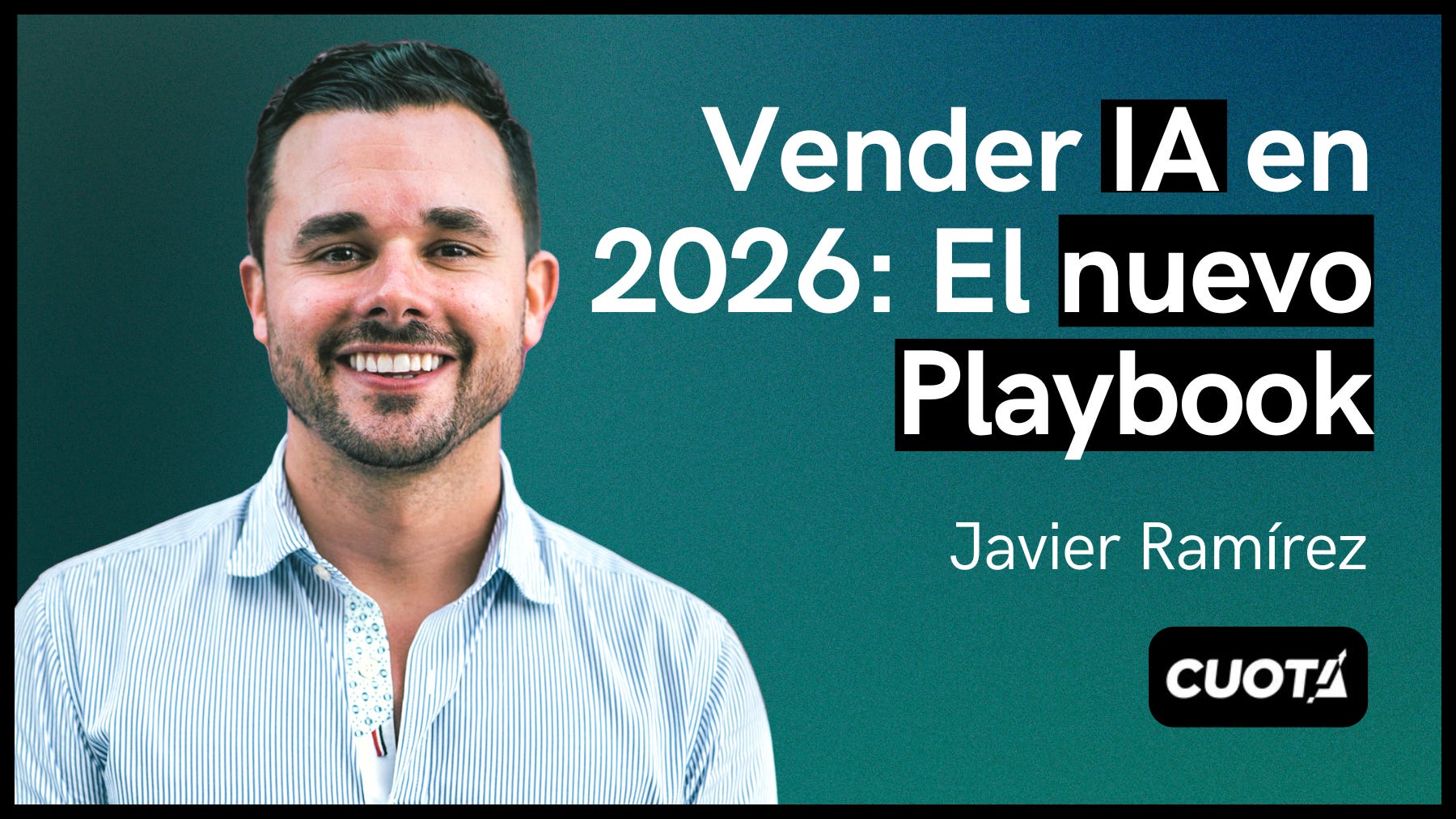
Today I interviewed Javier Ramírez, who led sales at three Silicon Valley unicorns (Zenefits, Rippling, and WeWork) and today advises more than 50 startups as a fractional CRO.
Two years ago most of his clients were selling traditional software: subscriptions, dashboards. Today almost all of them sell something with artificial intelligence at the center, and the demo no longer shows information, it does the work.
That change moved everything else. Who is in the room when the decision is made, how long the cycle lasts, how the contract is structured, what quota you set for a salesperson, and what kind of person you hire for the role.
We talked about the objection nobody tells you out loud, about the framework for deciding what to automate according to the size of the deal, and about why the salesperson is turning into a consultant.
Structure and Key Highlights
What Changed on the Side of the Person Buying
- Before, you showed a dashboard and it looked good. Now you show something that is going to do the work, and that changes who walks into the room
- The CFO comes in to understand the impact on headcount and on margins. Security becomes an active role. The CEO wants to take part because the decision puts them ahead of the change or behind it
- His direct verdict: selling AI is harder than selling SaaS
- The reason is that a lot of people got burned. In 2025 buyers purchased promises that did not work, with a fair amount of vaporware that was a frontend with GPT behind it
- In 2026 the purchase became sophisticated: they have already tried things, they already know what works, and there is a real evaluation process
The Pilot as the Center of the Sale
- The proof of concept now shows up at much smaller amounts. No longer in sales of a million, but in deals of 150,000 dollars or less
- A pilot is not handing over access to the tool and waiting. You have to define success criteria before you start
- The question that organizes the conversation: if we hit that objective in two months, is there any reason they would not buy
- It changes even the contract. Instead of the typical 12 months of SaaS, 12-month contracts appear with an exit clause at month 2 or month 3
- Cycles get longer because there are more participants and more calendars to coordinate. That pushes the quota to stop being monthly and become quarterly
The Objection Nobody Tells You Out Loud
- The visible ones: I already bought something that did not work, and I do not know whether my team is going to adopt it
- The secret one is political. A lot of people fill up with pride at leading a team of 60 or 100 people, and AI promises that they could be 30
- Nobody tells you to your face. What you see is an evaluation process that becomes mysteriously more rigorous
- The concrete case: a deal for a prospecting tool with a European client fell through because on the evaluation committee there was someone from human resources, a role that is not normally present in a commercial purchase, who read it as a risk to the future of the team
- His rule: replacement is never the pitch and never the starting point, because it creates fear. You steer the conversation with questions about how much time the team spends on each task
- The positioning that does work: if I give you back 40% of the time, that team can put it into work of higher quality
“We’ll Build This Ourselves”
- It is much more common in large companies, which have their own engineering team and more technical ego. A small company needs to buy something that solves the problem today
- His favorite counter-question: how much time does your team have available to do vibe coding next quarter, and how much over the long term
- The point is not the initial product but the maintenance, the bugs, and the integrations. That is where people understand that the team should be on the roadmap, not building a new tool
- He is honest about the limit: if your product is a frontend on top of a model, you do not have much of a defense. If it has complex integrations, you do
What Sets an AI-Native Sales Team Apart
- The native team built an internal call-preparation tool, fed with who the buyer is and with the deals they have already won
- That system learns from the recordings and detects patterns. If a salesperson has trouble with the close, you identify it in a 15-minute analysis instead of listening to calls for hours
- The team that is not native has a ChatGPT account, a basic prompt, and uses it day to day. Buying a tool that added AI does not mean your team has AI either
- The underlying mistake: using AI to send 5,000 emails instead of 100. The return does not scale in a straight line
- What does scale is showing up better prepared for the conversation, because that raises conversion over the long term
- The go to market engineering role replaced what used to be revenue operations buying dashboards
Quotas and Expectations
- Carles Reina said on this podcast that at ElevenLabs the quotas were one million dollars per salesperson
- Javier has a client today with quotas of 2 million, 500,000 per quarter
- His own reference point: at Zenefits the quota was 600,000 and it was already considered aggressive a decade ago
- What makes it possible is a higher average contract and putting AI into the top of the funnel, including GEO to increase the flow of leads
- Some companies use product videos to decide which leads to call, so the salesperson comes into the process later
The Framework by Deal Size
- Under 10,000 dollars: the risk is low and few people are involved. Here volume matters more than the touch, and you can automate prospecting and qualification
- Between 10,000 and 100,000: you can automate follow-ups from the meeting notes, connecting Granola with Claude. Objections and negotiation stay human
- Over 100,000: AI works in the background, on the research, the signals, and the business case. The points of contact are human, because no CFO is going to make a decision of that magnitude with a system
- The general logic: the higher the amount goes, the higher the risk goes, and AI moves from the main course to support that speeds things up
His Personal Stack
- He systematized his method in a product he built with Claude Code, trained on his knowledge base and 15 years of experience
- What he encoded is his sales-call framework: introduction, agenda, discovery, pitch, demo, pricing, next steps, and objection handling
- With that he scores calls at scale and identifies patterns. Before, a training would generate excitement for a day and the following week it would fall off. Now he can measure whether the change held
- It surprises him when he walks into a company and the team arrives at a conversation with no preparation beforehand. Today that is the minimum, and you can tell who does it
- Granola transcribes every one of his calls and, connected to Claude, hands patterns back to him. Clay and similar tools, for prospecting lists
- He does not approve what the AI writes as is. It helps him get started, and then he adds his own point of view, because if everyone uses the same tools everyone sounds the same
The CRM and One to One Content
- If he were Salesforce or HubSpot he would be a little afraid. The system of record is going to evolve aggressively
- There are already companies using Gong as a CRM, because the recordings and the information already live there
- Having to go and fill in fields by hand in 2026 strikes him as a product with its days numbered
- On outbound: a well researched email no longer sets you apart, because a thousand companies can send one. What does set you apart is adding a piece of content made for that specific client, such as a video or an animation
- It is content marketing at the level of one. You do not publish it on LinkedIn. It reaches that person
- An important fund in San Francisco told him that in early stage what is working is the founder brand, and there are founders using Claude to put together 30 days of content
What You Should Not Copy in Each Direction
- The most common mistake is copying American benchmarks. The natural sales cycle in Chile or Mexico does not look like the one in Silicon Valley, and that is not new to the AI era
- In Latin America the relationship is still a requirement in order to sell in Mexico City, and there is more evaluation of risk
- The reverse applies as well: in the United States you do not have to invite someone out to eat. You can close a deal of 100,000 or 150,000 over Zoom and email
- And they tell you no faster, which is an advantage. In Latin America people are not very confrontational and they keep saying yes
- His warning: them giving you their WhatsApp does not mean the deal is moving forward
The New Profile of the Salesperson
- The role is getting more sophisticated. In recent interviews he has run into candidates who arrive with a product they built and show it to you
- A demo in a sales interview did not exist before
- The charismatic salesperson who knew the name of the CFO’s daughter got as far as a certain era. Today technical fluency is almost a requirement
- His reading is that the salesperson no longer does consultative selling, they already are a consultant. A friend of his went from consultant at Bain Brazil to a commercial role at Enter called client founder
- The forward deployed engineer is the evolution of the sales engineer: someone who, before the close, builds a specific solution for that client
- Whoever keeps doing the same demo every day, what they historically called a demo monkey, is going to be replaced by a video. The buyer themselves already prefers to be sent the video
Speed of Growth and What Arrives in 2027
- Companies are reaching 10 million in ARR faster than ever, and growing 3x is no longer enough
- He tempers the enthusiasm: there are outliers like Happy Robot, but that is not the norm. There are still companies that have to grind it out doing outbound
- What he expects to arrive in Latin America: autonomous sales agents with no human intervention, for products below 2,000 or 3,000 dollars
- And pricing by outcome instead of per seat. If the outcome equals a person at 30,000, you charge 20,000 for delivering it
- His bet is that it gets adopted first in Brazil and Mexico
Silicon Valley Glossary
| Term | Meaning | Context in the episode |
|---|---|---|
| POC | Proof of concept, a bounded pilot before the purchase | It now shows up in deals of 150,000 dollars or less, not only in enterprise |
| Success criteria | The measurable objectives that define whether the pilot worked | What has to be negotiated before you start, not at the end |
| AI SDR | An agent that does prospecting and writes emails in place of a human | The category with 20 competitors where everyone makes the same pitch |
| Go to market engineering | Building internal tools for the commercial process | The evolution of the revenue operations role |
| GEO | Optimizing so that the models recommend you, the successor to SEO | One of the ways to feed the top of the funnel |
| Forward deployed engineer | An engineer who builds the specific solution for the client before the close | The evolution of the sales engineer in large deals |
| Pricing by outcome | Charging for the result delivered, and not per seat | What he expects to see adopted first in Brazil and Mexico |
| Knowledge base | The body of information you feed a model with | What he encoded with Claude Code from 15 years of work |
| System of record | The system where the company’s operational truth lives | The CRM, which in his view is at risk in the face of the recordings |
| Demo monkey | The salesperson who repeats the same demo every day | The profile he believes a video is going to replace |
People, Companies and References
People Mentioned
- Javier Ramírez: led sales at Zenefits, Rippling, and WeWork, today a fractional CRO and advisor to more than 50 startups
- Carles Reina: from ElevenLabs, a previous guest on the podcast, cited for the quotas of one million dollars
- His friend from Bain Brazil: hired by Enter into a client founder role
- Enzo Cavalie: host of the podcast
Companies and Tools
- Zenefits, Rippling, and WeWork: the three unicorns where he led sales
- Happy Robot: the example of accelerated growth selling AI in logistics
- ElevenLabs: the reference for per-salesperson quotas in the AI era
- Enter: a Brazilian AI startup for the legal area
- Claude Code: what he built his own call-analysis system with
- Granola: call transcription, connected to Claude in order to detect patterns
- Clay: research and prospecting lists
- Gong: call recording, which some companies already use as a CRM
- Salesforce and HubSpot: the incumbents that, in his opinion, should be worried
- Replit: the tool that makes the “we’ll build this ourselves” objection credible
- Supersonic: automated demos, founded by Spaniards