The audio and video are in Spanish. These notes are a translation.
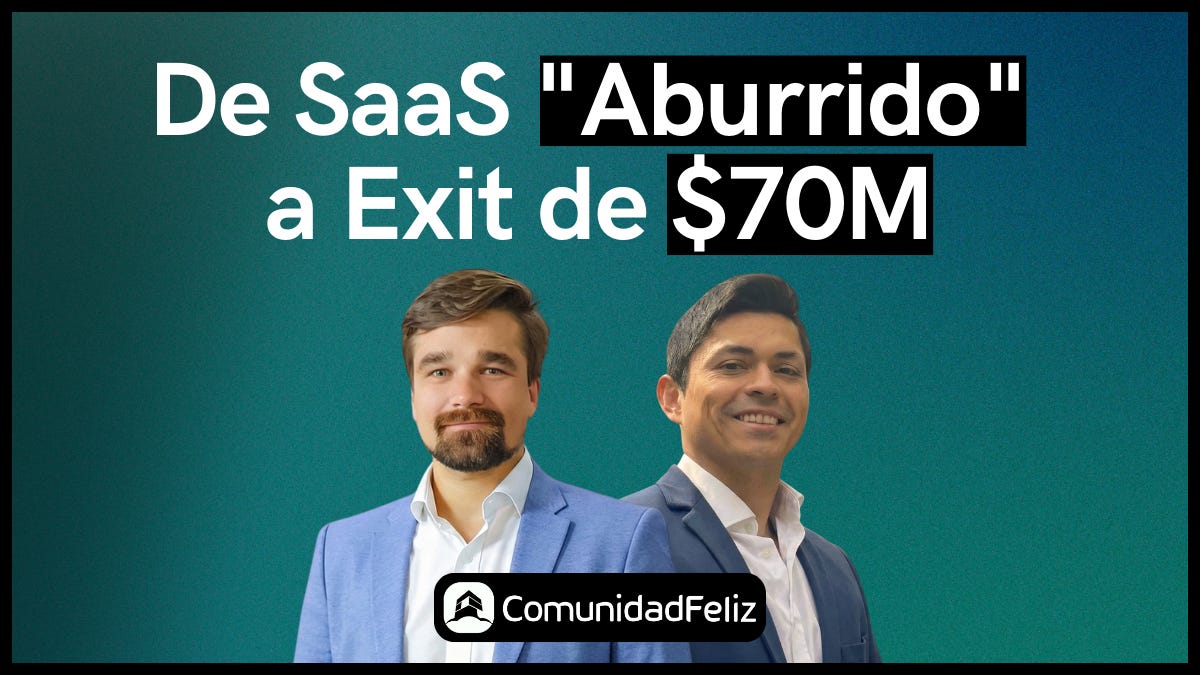
Today I interviewed Antti Kulppi and David Peña, founders of Comunidad Feliz, the leading building-administration software in Latin America, with more than 7,500 condominiums and a million users.
They founded the company in 2015, scaled it until it was billing about 12 million dollars a year, and in 2025 sold it to the Norwegian group Visma for 70 million.
Several investors told them they would not invest because it looked to them like a glorified Excel.
We talked about why it took them five years to reach the first million and only four more to reach ten, why they never promised to be a unicorn, and what they learned selling the company.
Structure and Key Highlights
Where the Hunger Comes from
- David’s father was born in Puerto Saavedra, in the south of Chile, one of the cities destroyed by the 1960 earthquake. He never met his father and his mother died when he was very young
- It got into his head that studying was the way out of poverty. From that town with no paved roads he went to Temuco, then to Antofagasta, and he was one of the first Chileans with a scholarship to study in France
- The image David has burned in: his father walked barefoot on the dirt roads so he would not wear out his nice shoes, and he put them on only when it was something important
- What he told him: you have to achieve more, because you are not starting from there
- Antti comes from the opposite side of the same coin. His father always tried to start companies and it went badly, so he lived, as a family, all the tribulations that implies. Even so the bug was there, and he started his first company at 19
The 60-Second Pitch at the Graduation Ceremony
- Antti already had the prototype and was looking for customers, but he was convinced he needed partners
- At the cocktail of his graduation ceremony he walked through every group giving the elevator pitch they teach in entrepreneurship classes
- He spoke with about 200 people. David was the only one who wrote to him the next day
- David’s reaction: the story makes him feel special and not very special at the same time
- Why he did respond: at university Antti had built an entrepreneurs’ association that brought together tens of thousands of students from all over Chile, and he gave one of the best speeches David had ever heard. He trusted him for anything
- And the problem fit him right away: he came from Osorno and in the apartment his family rented it was never clear what the common expenses were spent on
- The detail Antti added to make sure of commitment: he asked him to pay some money to get in. He wanted to know he was serious
- Before deciding, David had dinner with the CEO of McKinsey. He could stay in strategy consulting or go to a company where they had charged him to get in
Why the Niche Was Not a Problem
- Several investors told them straight: I do not invest because it looks to me like a glorified Excel
- The ones who did understand were the ones who had lived the problem. In Latin America it is more common to own your property, there is more pressure on security, and cities are getting denser
- The insight that set them apart from the rest: building-administration software had existed since the 80s and 90s, but it only talked to the administrator
- They also talked to the residents. If they had only talked to administrators, they would have stayed at the glorified Excel
- The sales argument they discovered: people pay little for a piece of software, but the willingness to pay to make sure the common expenses are done right is something else
- Today in Chile there are about 5.7 million homes and a million use the platform
- The rule an investor gave them and that they adopted: when your niche is small, you have to own the segment, have 50%. There is no smaller option
- And to be the only player you cannot afford to fail. You have to aim to be the standard, not a premium player with 5% of the market
Five Years to the First Million, Four to Ten
- David says he never felt they were going slowly, but that they were learning. They landed the first 100 condominiums in six months
- The insight that changed the curve: they discovered that many administrators did professional work but had no way to prove it
- Residents accuse them of theft or negligence with no proof. With the software the administrator can show invoices, contracts, annexes, overtime, and payment of social-security contributions
- So the administrator became their best salesperson
- What they built from there: a connection to the community’s bank, staff payroll inside the software, access control, facial recognition, vehicle gate opening, digital intercom
- The logic: the customer’s customer is the community, and they want the community to conclude that its administrator is very good thanks to that technology
- Antti adds the emotional part: every year they set goals of 40 or 50% growth and every year it felt impossible
- What kept him calm was retention. They keep more than 99% of customers a year, so it was a matter of time and patience
- The line he took away from a SaaS conference: it is about perseverance
How You Avoid the Slowdown
- Antti’s diagnosis: many startups grow 100%, then 80%, then 60%, and when they notice they are growing 20% nobody wants to invest in them or buy them anymore
- Their answer is constant innovation, with products at different stages of maturity at the same time
- The concrete levers were the payroll module, the residents app, the connection to banks, the connection to the SAT in Mexico, access control, and now attendance control
- Why the residents app mattered so much: if the resident resolves their own questions, the administrator has time to manage more buildings, and if the administrator grows, Comunidad Feliz grows
- The contrast they cite: in Europe or Brazil an administrator handles many more buildings, and in Chile, Mexico, or Colombia they rarely go past 15 or 20, because their time goes to answering residents
How Innovation Holds at 10 Years
- First, a culture of leadership and an excess of information. They make the launches public, and the failures too
- The concrete example: they ran an internal webinar about a rent-payment product they shut down. It was not bad, it processed about 100,000 dollars a month, but other products were growing faster
- They presented the project, the lessons, and where each member of the team went inside the company
- Second, structure. Today they operate as many mini-companies: each business unit has its own sales team, operations team, and development team
- Before, they had the typical pyramid structure, with a CTO and 40 developers reporting to him
- The sales teams start under an experienced sales management, to install processes and CRM discipline, and when they mature they start reporting to the leader of their unit
SaaS Is Not Most of the Revenue
- They always saw that the opportunity was in the network of properties, and that the software was the way in
- They did not know which service was going to work. Nobody comes into Comunidad Feliz to buy something the way they come into Google
- The two that hit were insurance and payments, because both solved a strong pain for their customers
- Insurance is not optional: in most countries buildings are required to have a fire policy, and it is not obvious how much it costs to rebuild a building
- The concept they explain it with is share of wallet. A building handles 20,000 or 30,000 dollars a month in expenses, and although they are not going to sell the trash bags, they can take a growing portion of that spend
- Why the traditional B2B SaaS metaphor does not apply: you cannot sell more seats, because units do not get added to a building
- The discipline they impose on themselves: focus. They have a million potential users and only three or four focuses, because they want to do them well
Why They Never Sold the Unicorn Dream
- It was never in any deck that they were going to bill a billion or be a unicorn in three years
- Their reasoning: mapping the SaaS plus two or three extra services, the number did not get there. It would have taken a bank for condominiums, loans, commerce for the apartments
- Those ideas seemed too far away to sell at that moment. It felt like selling hot air
- What did turn out healthy was being extremely transparent. It narrowed the search, because the funds looking for a thousand times did not fit, but the relationship with the ones who came in was very good
- Their investor director told them he had spent five years on the board and never had to review the contract he signed
- What David would do differently today: with what he now knows he could lay out a bigger dream and be more aggressive, because he would know how to get there
How the Sale Process Starts
- They were looking to raise capital and it did not go well. The market wanted growth and cash burn, and they had a different plan
- They had venture offers, including from a Latin American bank and a Chilean one, with unattractive valuations
- And then a large software company in the United States told them it loved what it saw, especially the assets and the data, but that it did not want to invest, it wanted to acquire them
- Their reading: the market was telling them that maybe it was no longer the moment to raise venture
- Why raising capital would have killed the sale, according to Antti: if you promise an investor five years of execution, and the sale process takes a year and then you commit to staying several more years, you end up committing eight or nine. It does not add up
- They brought in an investment bank so the market would put a price on the company and to align all the shareholders
Expanding Outside Chile
- Mexico came through an investor who was looking for a platform like theirs for his own condominiums, a large real-estate company. He offered them money and 100 condominiums to start with, on the condition that someone move to Mexico
- Antti went with his partner at the time and his dog. For a long time the plan for Mexico was called Antti: he programmed the connection to the SAT, the payment procedures, and the collections engine
- Today Comunidad Feliz has more than 100,000 properties in Mexico
- What David would do differently: send him with a dedicated team and more resources
- The lesson they repeat the most: prepare the person who comes next. They hired someone local who lasted a year and a half and left
- What does work for them: send someone from inside, who knows the values, the products, and who to talk to on each team. It is almost a mini-founder role
- The underlying mistake they made in Mexico: the Chilean pressure to leave the country led them to solve problems with money. They had four or five times more support agents per condominium than in Chile
- How they corrected it: restructure the teams, keep the best people, be clear on the metrics, and stay on top of the customers. After that they had the best results in the history of the company
Selling to Customers Who Are Not Very Digital
- The balance they look for: neither the total personalization of a corporate deal nor the self service of a consumer product
- How they solve it: offer customization that is really configuration of the system, and structured trainings that put many customers on a single call
- The middle point they describe: that the customer feels a personalized treatment and that the numbers work
- What worked to close customers: knocking on a lot of doors, but above all the pedagogical content playbook. Staying current with the laws and the day-to-day problems of a building
- When you have that trust, the sales process almost stops being a sales process
- At the start they sold themselves: I know we are just starting, but these are our credentials and you can call us any day
- The relationship with their first 200 customers was so deep that if the system went down they gave them two days, and they still bring them year-end gifts
- Their favorite signal of a good founder: having their first hundreds of customers on WhatsApp
What Nobody Warned Them About Selling
- What produced the most tension was not them or the buyer, it was everything that happened in the middle
- There are two sides of legal advisors, two of accountants, two of technical people, and each one has its own interests
- Their most uncomfortable observation: there are lawyers who feel pride if they score a goal on the founder, and the person doing due diligence if they find something that lowers the price. That does not always come from the buyer
- David said it in a meeting, holding himself back: they were measuring egos, arguing even about which office to sign in
- What the investment bank gave them: first, agreeing internally. The angels were happy with their multiple and the investors from the last round saw more room for growth
- Second, a competitive process raises the price and shows you what the market thinks
- Third, terms. An investor offered to buy them and let them leave the next day. Depending on the founder’s emotional stage, that can weigh more than the price
- Fourth, an emotional filter. David got anxious and got angry, and the advisors translated that into concrete points of negotiation
- And fifth, they knew the Norwegians at Visma from previous business and went with them to Norway to meet them
- The final contract ran about 100 pages. Their comment: hopefully most of those clauses never get triggered
- The case they cite as a warning is Figma, where the acquisition fell through and one of the clauses talked about a pandemic
Who They Thank
- Antti names one of his angel investors, who was a mentor and always showed him the pros and cons of each position
- David names Antti, who has pushed him since the first day
- And the team. David cried at the 10-year ceremony thanking the people who accepted job offers far below their abilities in exchange for stock options
- His reason: he promised them that someday they were going to be worth something, and keeping that promise is the most gratifying thing
- Also the customers, because if the software failed, they lost their jobs
Silicon Valley Glossary
| Term | Meaning | Context in the episode |
|---|---|---|
| Niche SaaS | Software for a small, specific segment | Their category, and why they had to own half the market |
| Share of wallet | What percentage of the customer’s total spend you capture | Their strategy when you cannot sell more seats |
| Retention | What percentage of customers is still with you after a year | More than 99%, the metric that gave them patience |
| Unit economics | Whether each customer leaves money after costs | What broke for them in Mexico with too much support |
| Adoption curve | Innovators, early majority, late majority | Why you have to launch new products before the current one flattens |
| Due diligence | The thorough review before closing a purchase | Where the advisors look for something that lowers the price |
| Competitive process | Putting several buyers in competition with each other | What the investment bank gave them on price and terms |
| Stock options | Future ownership in the company for employees | What the team accepted in exchange for low salaries, and that the exit made worth something |
| Self service | A product the customer installs and uses on their own | The opposite extreme from the corporate deal, and they looked for their middle point between the two |
People, Companies and References
People Mentioned
- Antti Kulppi: cofounder of Comunidad Feliz, started his first company at 19
- David Peña: cofounder, came from strategy consulting when he decided to join
- David’s father: born in Puerto Saavedra, on a scholarship in France, helped establish television in Chile
- Antti’s father: an entrepreneur for whom it went badly, and from whom he inherited the bug
- Enzo Cavalie: host of the podcast
Companies and References
- Comunidad Feliz: more than 7,500 condominiums, a million users, about 12 million dollars a year
- Visma: the Norwegian software group that acquired them for 70 million
- Tierra y Armonía: the Mexican real-estate company that financed and seeded their entry into Mexico
- HubSpot: the content playbook they say is still king
- Figma: the acquisition that fell through, which they cite as a warning about the clauses in a contract