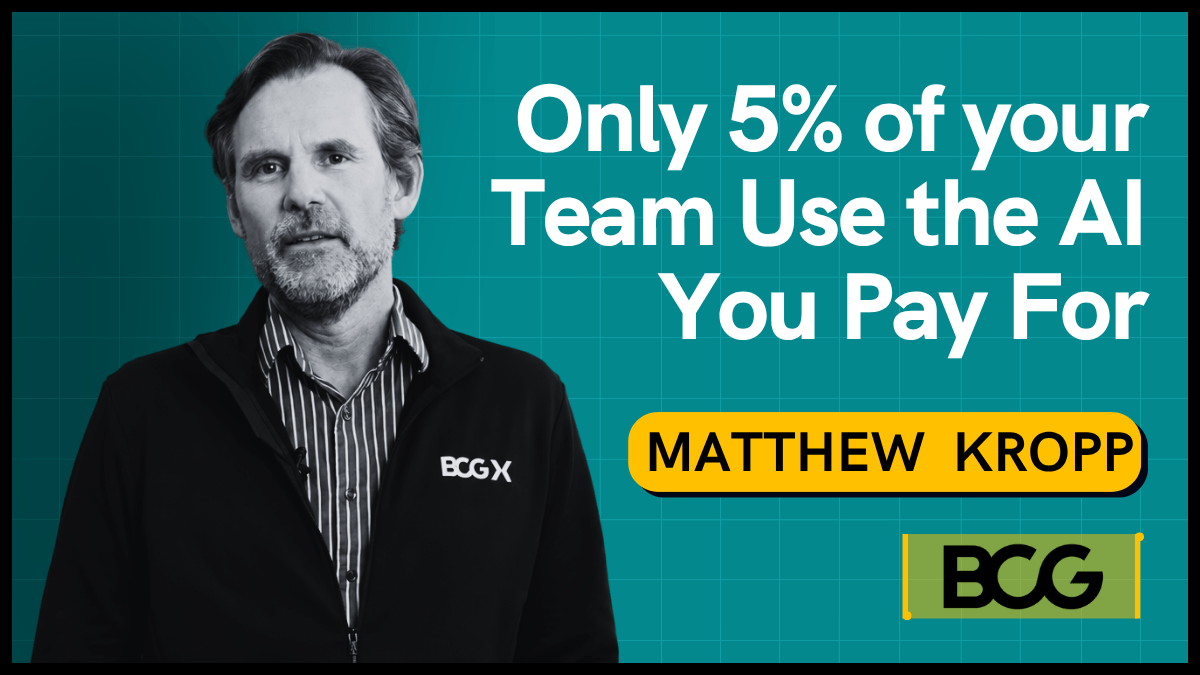
Today I interviewed Matt Kropp, who leads AI at BCG, runs a three thousand engineer team, and has given around four hundred talks to boards and executive teams about what this technology does to their business.
He is also, by his own description, a builder who consults. He started coding at eight on a minicomputer at the hospital where his father worked, quit an aerospace PhD in 1995 because the internet was being invented, and sold his first company into a boom that went from three hundred employees to ten thousand and then to Chapter 7 in about four years.
That combination is what makes his view of the current moment useful. He sits with the CEOs writing the checks and with the labs building the models, and the number he keeps running into is this one: at a big bank with twenty thousand engineers, most of whom have been given a coding tool, fewer than five percent actually write code with it.
Structure and Key Highlights
A Doctor, a Minicomputer and a Book Called Instant Basic
- His father was a doctor who, for no clear reason, was fascinated by computers
- There was a machine at the hospital and he brought his seven or eight year old son in to play with it
- The book that taught him was Instant Basic, read cover to cover, still on his shelf
- Then his father bought a computer for the house, which in the early eighties was not a normal thing to have
Quitting Aerospace in 1995 Because a Roommate Was Charging $8,000 for a Website
- He studied aerospace engineering at UCLA and started a PhD in it, then quit: aerospace was a dying industry and the internet was being born
- The trigger was mundane. A roommate who was a graphic designer showed him a website he was building, and said the client was paying him $8,000
- His reaction was that this is a business, and four of them founded an internet agency with roughly that much capital
- He had turned down an earlier internship that paid nothing and offered a laptop, a connection and a summer to figure out what the internet was. His own comparison: it was the equivalent of an internship at OpenAI in 2015
The Boom He Lived Through, and Why He Says This One Is Different
- They merged with a couple of agencies and sold to US Web in 1997, when US Web was about three hundred people
- By the time he left in 2000 it was ten thousand people. In 2001 it was Chapter 7, completely gone
- He got the timing right on his shares, which he points out most people did not
- The question he now gets in every boardroom is whether we are in a bubble and whether compute is overbuilt
- His answer separates the two. In 2000 the potential was real and the demand was not there, with maybe fifty million internet users against five billion today
- Fortune 500 companies, in his estimate, are two to five percent along in adoption. On compute, his line is that he does not think we have enough
Schlep Blindness, and the Advantage of Not Having Lived Through a Crash
- He keeps going back to Paul Graham’s essay on schlep blindness and recommends it to founders
- The argument: part of what lets young founders start is not knowing how long and painful the work will be
- Someone his age knows, and knowing makes you not want to do it
- So the fact that today’s founders never lived through a boom and bust is, in his read, a benefit rather than a gap
The Avocado Chair, and Why He Opens with a Story Instead of a Number
- The problem he is solving in those rooms is that everyone’s mental model of AI is frozen at whatever they last tried, often ChatGPT six months ago
- He shows the avocado chair images from DALL·E in 2021: lumpy, low resolution, recognizable as both things and good as neither
- Then he shows a video he made with Luma Labs, an architectural digest style documentary about the furniture designer who created the avocado chair, photorealistic, with narration, music and an interview
- There is no designer and no chair. His prompt was one sentence, and an agent produced the rest
- The point is not the video, it is that they feel the slope of five years and see an agent reasoning toward a goal
- He is aware this is unusual. Most of his colleagues open with something utilitarian, and his argument is that you need the emotional hook first or nobody listens to the useful part
- He connects it to Palantir handing new forward deployed engineers a book on improvisation
Why He Can Sell Without Selling
- His advantage in those rooms, he says, is that he is not selling anything immediately
- What he is doing is educating, while representing what the firm can do
- The sale is the natural follow on, because he has spent the hour naming the hard parts and they know who helps with hard parts
- His advice to founders is to engineer the same position: make the audience feel that you understand their problem before you present yours
The Five Percent Problem
- Banks are effectively large software companies, and a big one will have twenty thousand engineers
- Most have handed out coding tools, and many report sixty or seventy percent weekly active users
- Fewer than five percent are actually using the tools to write code
- What he tells engineers on his own team: if you write code by hand, you’re fired. It is not an option
- His estimate for the gap between AI native startups and everyone else to close is three to five years
A Thousand Flowers Blooming, and the Three Things that Actually Matter
- The common failure mode is the hackathon that produces 972 use cases, which is another way of having none
- His instruction to clients is to pick three, fund them, give each one a senior owner who is accountable, and if you are public, promise them to Wall Street
- What those three look like in practice: a call center rebuilt around voice bots, engineers actually adopting, or a marketing organization changing how it works
- The rest of the company is a different problem. In HR or legal there is no single big return, only a lot of small wins
Adoption Is Coaching, Not Training
- The sequence is individual, then team, then process, and skipping to the end does not work
- They run a short training on technique and then attach a coach, deliberately like a personal trainer: the value is not the instruction, it is showing up and holding you accountable over months
- They pair an AI-pilled coach with the skeptics, so someone can show rather than tell
- If only the individual changes, they finish their work in a quarter of the time and go play golf, and the team’s output is unchanged
- Once the team does change, it outruns everyone else and the bottleneck simply moves, usually to product not writing specs fast enough
Where the Roles Are Converging
- The scrum master exists to keep a squad of ten organized. He argues you do not want a squad of ten
- What he calls the power couple is a product manager who deeply understands the customer plus an engineer who understands the architecture
- QA becomes agents: coding agents doing test driven development, then a validation agent running acceptance tests through Playwright
- Product managers should not be writing specs. They should be vibe coding prototypes
The ERP Dilemma, Told Through a Retail CEO
- A friend running a retailer described spending billions on SAP, a system that does not even expose an API, and signing a new implementation close to $10 billion so that it will
- Her problem is that she cannot tell whether any of it will be valuable next year, and she also cannot bet a core system on a startup that may not exist next year
- What he is now hearing from four or five CEOs and CIOs: delay the upgrade and investigate putting an agent layer on top of the old version, reducing the ERP to a database
- On the SaaS apocalypse he pulls it apart. Some products will be subsumed by the model vendors or rebuilt in house because building is cheap now
- What survives: things you do not want to maintain, products with real network effects, and systems of record so core that touching them is pure risk
Token-Based Competition, and the Number Behind It
- His framing is that intelligence and expertise used to be scarce and no longer are. Judgment is what stays scarce
- If everyone has the same intelligence, the companies that win are the ones that maximize productive use of tokens, which is not the same as burning them
- BCG partnered with Cursor to get token consumption data and correlated it with growth for 107 public companies
- Top quintile of token use grew at 15%. Bottom quintile grew at 5%. He is careful to call it correlation, not causation, but the spread is large
- His conclusion for CFOs: if tokens become a sizable share of payroll, that is not a cost problem, it is payroll being amplified
- He blames the timing. AI arrived when companies were focused on cost cutting, and science fiction had already trained everyone to think in terms of replacement
- On layoffs he is blunt: if every company lays off thirty percent of its staff, we have tanked the economy, and framing AI that way is a lack of imagination
- He liked an idea from the founder of OpenRouter: treat an employee as salary plus tokens, a variable line, and make token usage part of the performance review
What Is Missing for Agents to Reach Everyone
- The next wave in the enterprise is giving agents to every knowledge worker, and he does not think any platform is yet up to that
- The existing options split into tools for developers, which leaves out most of the company, and chat interfaces, which are fine for some tasks
- The arithmetic that worries him: BCG has 35,000 employees, ten agents each is 350,000 agents, and nothing today tells you whether they are accurate, running, connected properly or secure
- He also thinks the interface problem is unsolved. A B2B SaaS product was a tailored, high bandwidth interface over a database, and chat is general purpose at maybe a hundredth of the bandwidth
- His own projects put the core logic behind the chat as a plugin, with a secondary web UI that the agent itself can change
Why a Software Company Should Not Become a Services Company
- His answer on services and software collapsing into each other is no, and that going into services is a mistake
- The reason is the old one: you will be valued like a services company, not at a ten or twenty times multiple
- Palantir is a software company that happens to have forward deployed engineers. Software companies have always had a services arm and always kept it under twenty percent of revenue
- The rest is partners and systems integrators, and he expects the same model with AI
- He describes enterprises going to the labs for implementation help and the labs answering that they have no engineers to spare, which is what Deployco is a response to. Making models is a different business
Vesica, the Company with No Humans
- The experiment: a zero human company, agents making every decision, him as governor with veto power but a personal rule to decide nothing
- They named themselves. Apex was CEO, Forge ran engineering, plus marketing and blogging agents
- Day one was the idea, day two formation, by day three a full product spec and a first version. It ran about two months
- They built a genuinely impressive multi-agent platform with telephony, email, voice support and a software factory, and the product they chose was a platform for zero human companies
- What killed it was a lunch. Jim Hornthal ran it through his own business evaluation AI, which came back with ten startups doing the same thing, several funded
- The damning part was not the competition, it was the receipts those competitors published: traffic, signups, and no real businesses being started
- His read on agents: they get you eighty percent of the way, they never subtract, they never finish, and they missed the only question that mattered
- The human part he thinks does not go away is judgment, which he ties to having a body, relationships and something to lose
- His model of the future is Midjourney with a handful of people and a hundred million in revenue. Small teams doing big things, not teams of zero
Who Is Ahead, Who Is Asleep, and What the Valley Is Missing
- The industry that moved first is insurance, which surprises people until you notice an insurer is a pile of documents: policies and claims
- Then banks and software. Manufacturing and industrial goods mostly say this does not apply to them until robots arrive
- His warning is that humanoid robots with reasoning, language and dexterity are closer than they think, and drones changed warfare in a couple of years
- The scenario he describes is not a Silicon Valley attacker but the traditional competitor next door buying a hundred humanoids and running shifts around the clock
- The Valley’s own blind spot, in his view, is willful blindness about how much the models will simply absorb
- He is seeing AI native CEOs say out loud that they do not know if they will be around in a year, because their slice may just become a feature of Claude
- Legal is his example of genuine uncertainty: Harvey and Legora may build a defensible moat, or ChatGPT may become a good enough lawyer that none of it matters
- On data sovereignty he is skeptical that training is the real fear, since enterprise agreements already forbid it. The real fear is being beholden to a monopoly
- Open source, six to nine months behind the frontier, is what caps how much rent the labs can extract
What He Tells His Own Sons
- The younger one is a business student at BU who spent the summer vibe coding for an education nonprofit, which Matt calls the best possible use of that time
- His advice is to start something or join something small in your twenties, when the cost of failure is lowest
- The older one is in medical school and interested in neurology, which he supports: their study on exposure puts physicians among the barely affected
- His closing thanks went to his BCG mentor, Jean-Manuel Izaret, who pulled him into his team early on and is the reason he stayed, and came back
Silicon Valley Glossary
| Term | Meaning | Context in the episode |
|---|---|---|
| Token-based competition | Competing on how productively you use model tokens, not on access to intelligence | His framing for why the top quintile grew three times faster |
| Schlep blindness | Not knowing how long and painful a task will be, which is what lets you start it | Paul Graham’s essay, and why young founders have an edge |
| Vibe coding | Building software by directing a model rather than typing the code | What he tells his engineers to do, and what his son did all summer |
| Forward deployed engineer (FDE) | An engineer who sits with the customer to make the product work in their environment | Palantir’s model, and what enterprises now ask the labs for |
| Harness engineering | Setting up the scaffolding an agent works inside | Part of the short training before the coach arrives |
| Test driven development | Writing the failing test first, then the code that makes it pass | What coding agents do, which is why he thinks QA teams disappear |
| Playwright | A tool that drives a browser automatically | The validation agent that replaces acceptance testing |
| Agent platform | The layer that lets non-developers create and run agents | The gap he says nobody has filled yet |
| Data sovereignty | Keeping control over where your company’s data lives and who trains on it | The stated fear he thinks hides a fear of monopoly |
| SaaS multiple | The valuation premium software gets over services | Why he says a software company should not build a services arm |
| Systems integrator | The partner firm that implements someone else’s software | The arms and legs the labs do not have |
| Physical AI | Robots with reasoning, language and dexterity, not just mechanical automation | The thing manufacturers tell him does not apply to them yet |
People, Companies and References
People Mentioned
- Matt Kropp: leads AI at BCG, runs a three thousand engineer team, roughly four hundred talks to boards
- Paul Graham: the schlep blindness essay he recommends to founders
- Dario Amodei: referenced through the country of geniuses in a data center
- Jim Hornthal: serial entrepreneur whose evaluation AI, Glider, ended the Vesica experiment over lunch
- Jean-Manuel Izaret: his BCG mentor, the reason he stayed and came back
- Enzo Cavalie: podcast host
Companies and Organizations
- BCG: 35,000 employees, and the three thousand engineers he leads
- US Web: bought his agency in 1997 at three hundred people, hit ten thousand by 2000, Chapter 7 in 2001
- Cursor: gave BCG the token consumption data behind the growth study
- Luma Labs: the video model behind the fake avocado chair documentary
- OpenAI, Anthropic: the labs enterprises ask for implementation help, which is not their business
- Palantir: his example of software with FDEs rather than a services company
- Factory: the coding agent company whose customers ask to be taught how it works internally
- Midjourney: his model of the future, a handful of people and a hundred million in revenue
- Harvey, Legora: the legal AI companies whose moat he calls genuinely uncertain
- SAP: the ERP behind the ten billion dollar dilemma a retail CEO described to Enzo
- Vesica: his zero human company experiment, named by its own agents
- OpenRouter: source of the salary plus tokens idea
Numbers Worth Keeping
- Fewer than 5%: engineers at a big bank writing code with AI, against 60 to 70% who log in weekly
- 2 to 5%: how far along he estimates Fortune 500 adoption is
- 15% against 5%: growth for the top and bottom quintiles of token use across 107 public companies
- 972 use cases: the hackathon output he uses as shorthand for having no priorities
- 3 to 5 years: how long he expects the gap between AI native companies and everyone else to take to close
- 80 / 20: agents got Vesica eighty percent of the way, and consulting is twenty percent answer, eighty percent getting people to act