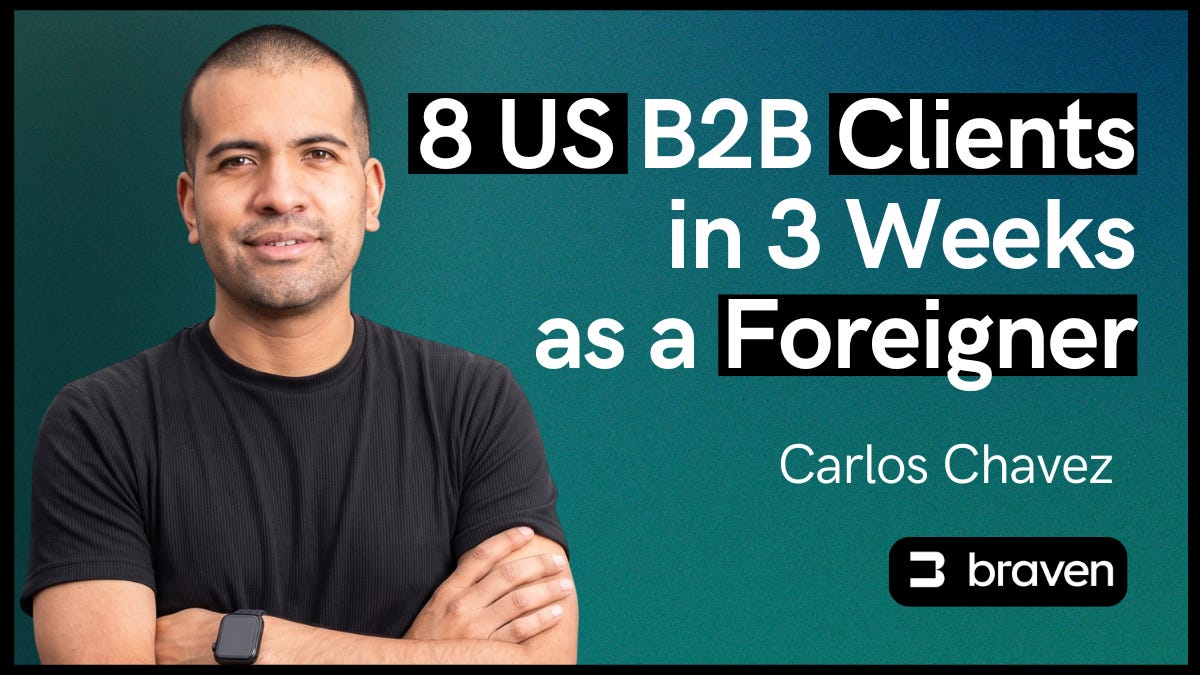
Today I interviewed Carlos Chávez, founder and CEO of Braven, an AI agents platform automating operations for insurance companies in the US.
Carlos built and exited a proptech startup in Colombia and could have built anything from there. He moved instead, with no network, no customers and no reputation, into one of the least fashionable industries for a foreigner to sell into: insurance MGAs and brokers.
Braven now operates across six countries, does seven figures in revenue, and has raised $6 million from US firms including Collide Capital, Fiat Ventures and Bloom Ventures.
The headline is eight clients in three weeks, and his own correction to it is the most useful part of the conversation: it took five or six months of working with a single unpaid design partner while keeping everyone else warm.
Structure and Key Highlights
Why He Left
- The trigger was coming to the US for a program and finding a concentration of very ambitious people
- The decision was instant, and took months to process
- What he was building at the time was a hybrid: a LatAm business with assets in the US
- Having an exit on the table made the decision easier than raising another round
The Gradual Move, and Why He Would Do It Faster
- His first, superficial idea: come for two weeks, meet every VC in Silicon Valley, raise, go back to execute
- Why it proved false: the benefit of the city is not the transactionalism of two weeks of meetings
- What the benefit actually is: proximity to clients and other founders, bouncing ideas, testing live, being in a customer’s office within an hour
- The constraint that made it gradual was money
- Where he stayed for the first long stint: 15 square meters shared with his cofounder for three months, where one had to stand for the other to leave
- They tested Miami, New York and San Francisco, weighing fundraising, commercial connections and whether they could actually be happy there
- Why SF won: density of ambition, and not wanting to look back at 60 having skipped it
Ignoring Two Pieces of Advice
- LatAm investors were the most skeptical that a Latin team could run good commercial processes in the US
- His reaction: do it first, prove it, and then decide if there is still a fit
- The other advice, from VCs and angels: start with a copilot approach for lower adoption friction
- Why they rejected it: with a copilot you depend on usage and are not accountable for the end result
- With end-to-end agentic workflows, either it runs or it does not, and no external factor decides that
What He Found in the Traditional Industry
- The valley narrative he heard: incumbents do not understand tech and will be replaced
- What he actually experienced: sitting down and explaining from first principles why this matters, and finding them prompt to adopt
- He has not met the archetype of the stubborn operator who refuses technology until the day they die
The First Customer
- A US company based in Miami, brought in as a design partner in November 2024
- Unpaid, and worked with exclusively for five or six months to build the product together
- The balance he describes: aggressive in selling their ability to build technology fast, humble in acknowledging the customer owned the insurance knowledge
- In parallel they used family reinsurance connections and angel investors with insurance networks to warm up future customers
- So by launch in April the pipeline was already deep, which is why eight clients in two weeks looked like magic
- What sold the design partner: proximity to the state of the art, being in the same city as OpenAI and Anthropic
- The trait he looks for in an early adopter: someone motivated, who wants to grow and be part of it
- His guiding principle, from Paul Graham: a hundred customers who love you over a thousand who kind of like you
Selling as a Colombian to American Insurance Owners
- The superficial part: insurance is formal, so wear a shirt
- What he refuses to lose: Latin warmth, knowing the name of everyone in his building including security
- The unexpected advantage: nobody calls in the US, they write. He just calls
- Every early customer was closed by going to their office, and every onboarding was done in person
- The flexibility that comes with it: taking a plane to Phoenix, Miami or Ohio, cities you would never relocate to
- The cultural gap he cannot fake: sports, especially college sports. His first basketball game was eight months ago
- His workaround: hire American people for the sales team
Hiring Across Cultures
- If you are building a global company, English has to be the main language
- The honest cost: when five Latin Americans are working together, adding an American feels like a slowdown, because you lose fluency and have to add context
- Why you do it anyway: the sooner you adopt it, the sooner you get the benefit
- The profile that worked for their first US hire: young, a lot of attitude, willing to be part of the transition
- On attracting US talent without a US brand: density of talent is a strategy, and if the best talent is American the answer is obvious
Building Credibility from Zero
- His framing of fundraising: legibility. If you are Bezos or Musk you have enough. If they have never heard of you, you build it from a sum of other things
- What those things are: mutual contacts, warm introductions, traction, product, and being a person with novel ideas
- Their actual strategy: tap into pre-existing networks, including On Deck and their angel investors
- Why it matters: you do not have ten years to build the relationships you would have back home
- The pre-seed lead was a relationship built over more than a year, from the previous company
- The second came from the density of the city: you make friends, and everyone in SF has a VC friend
Where to Actually Meet People
- The options beyond the famous accelerators, whose acceptance rates make them a bad plan A
- Buy a desk in a coworking space full of startups and the networking happens by itself
- Get close to hyper nodes, people who know a lot of people
- The line to walk: distinguishing noise from signal, because being at an event every day is a way to waste a year
- Enzo’s addition: tap into the first and second generation diaspora from your own country, which lives in WhatsApp and Facebook groups
What US Investors Pushed Back on that LatAm Investors Did Not
- Market size: almost everyone in LatAm assumes anything in the US is big enough, and US investors have larger return expectations
- His warning: do the exercise, do not assume the US market is big by default
- The higher bar: defensibility, moats and vision, because they have seen it many times
- On technical depth: VCs here are often in the same hackathons you are, so a demo is not enough
- The structural difference: they have been close to acquisitions and IPOs, while the LatAm market is still young enough that return hypotheses remain unproven
The Personal Side
- His counterintuitive answer: he decided from the start that it was going to be fun
- What is genuinely hard: being far from family, missing his mother and sister
- What he insists on: fundraising is not fun and the stress ramps up, so if you do not enjoy the ride, choose an easier line of business
- The logistics nobody mentions: furniture, finding an apartment in the SF market, winning one fight a day
- His view of the city being boring as a superpower: here, working is the fun thing
- What he still recommends: three hours away is a natural paradise, with Big Sur and the most beautiful highway in the country
- And the correlation he names: friends and happiness. If you find a crew, you are in a good position
Who He Thanks
- His cofounder JP, who he calls the most ambitious person he knows, and with whom he has philosophy and philanthropy conversations
- Jeff from Bloom Ventures, who challenges assumptions exactly when you get comfortable
Silicon Valley Glossary
| Term | Meaning | Context in the episode |
|---|---|---|
| Design partner | An early customer who co-builds the product with you | Five or six months with a single one before launching |
| Copilot vs agent | Assisting a human versus running the workflow end to end | The advice he rejected, because copilots leave you unaccountable for outcomes |
| Agentic workflow | A process an agent executes from start to finish | What Braven sells into insurance operations |
| MGA | Managing general agent, an underwriting intermediary in insurance | Part of the customer base he sells into |
| Legibility | How readable and referenceable you are to an investor | His framing of what fundraising actually requires |
| Warm introduction | Being introduced by someone both parties trust | The mechanism for building legibility from zero |
| Hyper node | A person connected to an unusual number of people | His shortcut for hacking into the network |
| Forward deployed engineer | Engineer embedded with the customer | How they ran onboardings in person |
| Density of talent | Concentrating strong people as a deliberate strategy | Why hiring American talent was never a mental barrier |
| Defensibility | Why a competitor cannot replicate you | The bar US investors set higher than LatAm ones |
People, Companies and References
People Mentioned
- Carlos Chávez: founder and CEO of Braven
- JP: his cofounder at the previous company, who he calls the most ambitious person he knows
- Jeff: of Bloom Ventures, who challenges him when he gets comfortable
- His wife: who moved with him and who he describes as a team
- Paul Graham: for the hundred customers who love you principle
- Enzo Cavalie: podcast host
Companies and Organizations
- Braven: AI agents for insurance operations, six countries, seven figures in revenue
- Macondo: his previous proptech company in Colombia, which he exited
- Collide Capital, Fiat Ventures, Bloom Ventures: the investors in his $6M
- On Deck: the program that first brought him into the ecosystem
- OpenAI and Anthropic: the proximity argument he used to sell his first design partner